Friday, 9 November 2012

News briefs - Australia, Florida, Indiana, Ireland, New Zealand, Philippines, South Africa, Virginia

Australia - Sydney to pursue three new toll funded highways

The Australian Daily Telegraph (via the Herald Sun) reports that the New South Wales State Government’s 20 year infrastructure strategy includes three new major highways in Sydney which are proposed to be funded through tolls, including reforms of existing tolls toward distance based pricing.  Let’s be clear this does not mean a change in technology or full network based charging, but by setting the tolls on toll roads at rates to reflect the distance between tolled points on the network.  The price is estimated to be A$10 billion, although it is thought the price could be lowered by private sector innovation and cut and cover construction techniques. 

The New South Wales Government has been studying options for reforming tolls in the Sydney metropolitan area, to normalise what vehicles pay across the tolled network to reflect distance.  The logic seems simple, but the difficulties are around addressing the costs of different concessionaires, as the motorways that have been built had different construction costs (e.g. tunnels are far more expensive than more rural highways).

Florida - Customers paying in high denomination banknotes can be detained at booth

According to the Newspaper.com, in the case of Chandler vs. Florida Department of Transportation, the US Court of Appeals has found that "Motorists can be held indefinitely at toll booths if they pay with large denomination bills".

The report says: "Under FDOT policies in place at the time, motorists who paid with $50 bills, and occasionally even $5 bills, were not given permission to proceed until the toll collector filled out a "Bill Detection Report" with data about the motorist's vehicle and details from his driver's license".

The court decision, responding to a claim that it was a constitutional violation to stop the vehicle from proceeding is as follows:

"In Florida, a person's right and liberty to use a highway is not absolute; it may be regulated in the public interest through reasonable and reasonably executed regulations."

The judges found it was reasonable for Fanueil to set regulations for use of the road -- including the types of acceptable payment. The court decided that drivers implicitly agreed to those conditions by choosing to use the toll road.

Florida - State Road 408 collects 43% of all toll revenue of the Orlando Orange County Expressway Authority.

The Orlando Sentinel reports that the 22 mile long SR408 toll road generated $108 million in 2011, or 41% of the Orlando Orange County Expressway Authority's total revenue.  It carried over 126 million toll transactions in that year and its revenue effectively cross subsidises the rest of the Expressway Authority's network.

Indiana - toll road privatisation touted as success

According to the Newark Advocate, Michael Cline, Indiana Department of Transportation commissioner, has been touting the successes of the privatisation of the Indiana toll road.

He said that the lease paid off old debt and provided "millions" of dollars to counties the road passes through to complete major projects including the extension of Interstate 69 from Evansville to Bloomington and Indianapolis and the reconstruction of U.S. 24 between Fort Wayne and Toledo "dubbed the highway of death for its high number of fatal crashes".

He claimed it "made sense for Ohio to study a similar plan for its section of the toll road".

The report said:  

The Ohio Department of Transportation is conducting a $3.4 million study with Texas-based KPMG Corporate Finance LLC to examine the ways to maximize the financial benefit of the toll road for the state. Jerry Wray, ODOT director, said the study will be completed by mid-November and he hopes to have a recommendation to the state legislature by Jan. 1.

During Cline’s presentation, he tried to eliminate some myths about the Indiana Toll Road lease, including that toll rates have doubled since 2006. Although the cost to drive the entire stretch across Indiana has risen from $4.65 in 2006 to $9.40 this year for drivers paying cash, tolls have remained frozen for drivers using electronic toll pass technology. Those rates can’t increase until 2016.

Tolls for many Ohio drivers have risen at higher than the cost of inflation during the past two decades. The turnpike operates entirely on its own revenue. It had $11 million in profits last year, and turnpike officials previously stated that more can be found through savings.

It is helpful to have this sort of information, because it is easy for privatisation advocates and opponents to both use slogans and cliches to justify their positions.  The best thing for Ohio will be to weigh up the evidence of what went right and wrong in Indiana, but it seems like a balanced approach has been taken that suits the needs of that state.

Ireland - Sacyr looking to offload debt ridden toll roads

The Independent (Ireland) reports that Spanish owned toll road concessionaire Sacyr is looking to sell its toll road concessions in Ireland.  Infrastructure fund Globalvia is said to be interested in these assets.  The concessions in Ireland are:
- N6 (56km motorway/dual carriageway between Galway and Ballinasloe, with a 7km connection to the Loughrea bypass);
- M50 Dublin (operation and maintenance contract for the 41km of Dublin's part-ring motorway);

New Zealand - unprofitable toll road gets revenue boost but still not enough

According to the Bay of Plenty Times, the Route K toll road has seen a 37% increase in revenues following a 50% increase in the toll for cars.  However, it still remains insufficient to cover the interest costs on the debt of the local authority financed road.

Philippines - Two new toll roads to be pursued in 2013 and Metro Pacific to expand Northern Luzon Expressway


The CALAX project, which will connect the Manila-Cavite Expressway (CAVITEx) and South Luzon Expressway (SLEx), will be among the two projects under the Public Private Partnership (PPP) scheme the Department of Public Works and Highways (DPWH) will pursue in 2013. The PPP section is the 36.01 km length of the expressway from Kawit, Cavite to Sta. Rosa, Laguna. The ODA section is the remaining 11.01 km part of the road from Sta. Rosa, Laguna to SLEx at Mamplasan Exit in Laguna.

"The private proponent shall be responsible for the financing, designing and constructing of the PPP section, and the subsequent operations and maintenance (O&M) of the entire CALAX," the PPP Center explained.

The project is estimated to cost US$1.01 billion.

Meanwhile, Rappler also reports that Metro Pacific Investments Corp  is allocating P2.5 billion (US$61 million) in 2013 to expand and repave parts of the Northern Luzon Expressway.  This includes a P1.6 billion-worth (US$39 million) toll road that will link NLEx Cloverleaf and McArthur Highway near the Valenzuela City Hall with a 2.1-kilometer, 4-lane highway. Depending on how fast the government is in securing right-of-way, construction for Segment 9 will likely start by November or December and will be completed in 2013

South Africa - Gauteng e-tolling allowed, Moody's approves

According to Business Day Live (South Africa), the decision by the Constitutional Court of South Africa to allow the implementation of electronic free flow tolling as part of the Gauteng Freeway Improvement Project, will make a substantial difference to SANRAL's financial position.  Tolling on the project was due to be implemented in April 2012, but was stopped due to a court injunction.  The tolling has been opposed in South Africa on various grounds, but which largely appear to be about the injustice seen in tolling existing as well as new roads, because the existing roads have been upgraded, and because of fears of corruption in the contracts with the foreign suppliers of equipment and tolling services (which have not been substantiated).  The delay has cost SANRAL US$309 million since April.

The report outlines how taxpayers have been providing bridging finance to SANRAL to cover the gap:


Government responded by providing the roads agency with R5.8bn in funds to compensate for the lack of e-toll revenue and to defray operating costs, including debt service payments on the GFIP debt, a large proportion of which government guarantees.

Moody’s said the GFIP was mainly responsible for the rapid surge in Sanral’s debt, which rose to R37.5bn or five times its 2012 annual revenue as of August this year, from R6.2bn in March 2007.

Moody’s downgraded Sanral’s rating to Baa2 from Baa1 in May due to negative pressure on the roads agency’s liquidity.

The rating agency noted that at the end of June, Sanral’s cash reserves and government’s funds totalling R7.1bn were sufficient to cover operating expenditures and short-term obligations, including debt service, over the next 16 months.

Moneyweb reports further on SANRAL's financial position.


Virginia - I-95 HOT lane contract criticised, but doesn't tell the full story and I-495 express lanes about to open

The Newspaper has published an article critical of the PPP contract between the State of Virginia and TransUrban for the I-95 HOT lane project.

The reasons it cites are:

- It is a 73 year contract offering revenue to the concessionaire with no new lanes being added; 

- Casual carpooling will be dissuaded, as all carpoolers (only HOV 3 – meaning at least three people must be in the vehicle to be eligible) must use an EZ Pass tag to “declare” their presence. Those without will be fined; 

- If more than 35% of lane users are HOV (i.e. not paying tolls), the state must pay for each additional HOV vehicle an equivalent to 70% of the tolls that would have applied The state must pay an amount equal to 70% of the toll that would apply TransUrban if more than 35% of lane users are HOV (i.e. not toll paying); 

- If the State wants additional lanes, it must first negotiate an addition with Transurban. If it decides not to adopt an approach including Transurban, it must compensate the firm. The same applies to additional capacity on specific parallel routes. 

- Two-thirds of the project's financing is backed by taxpayers. Virginia is providing US$71 million in grants and US$242 million in revenue bonds. US$300 million comes from the Federal Government with a TIFIA loan.

Certainly it appears like Transurban has a good deal, although it doesn't look that good if traffic levels are flat, and there is a low volume of users with less than 35% of road users being HOV not toll payers.  That's the risk Transurban carries.  If car pooling takes off (which the article suggests is less likely because of the inconvenience of getting an EZ Pass tag), then it will be positive for the state (and users of the existing lanes), and will be because Transurban has encouraged it.   However, it is also understandable that Transurban gets first right of refusal to build new capacity, and that if taxpayers pay for new capacity elsewhere, Transurban gets compensated.  Such is the environment of privately owned lanes vs. government owned lanes. 

Furthermore, the article is plain wrong in asserting no new lanes are being provided.  In fact there will be some new lanes, and some extensions to existing lanes.  The press release announcing Transurban has won the extension specified these, and after all, it does not cost $940 million to do a HOV-HOT lane conversion.  There is a lot of new construction to make these lanes a more complete corridor congestion bypass system.   If you were paying for such improvements, you wouldn't want the state to be suddenly paying for parallel ones to enable motorists to bypass your improvements (and the tolls you need to recoup the costs).

Meanwhile, WAMU reports that the I-495 express lanes are due to open on November 17th.  The report says:


The two new lanes in each direction spanning 14 miles between the Springfield interchange and the Dulles Toll Road will be E-ZPass only.

Everybody needs an E-ZPass to use the express lanes. Carpools need the E-ZFlex for the toll-free trip. So far the Virginia Department of Transportation says signups for E-Z Pass are going well in the local area.

Stewart Schwartz, the executive director of the Coalition for Smarter Growth, criticises the project claiming that it will result in induced demand, filling up the space from vehicles shifting to the express lanes.  This has long been a criticism of any projects involving building new highway capacity, but in an environment where traffic growth has stabilised and there may be a long term trend of flat traffic, does this hypothesis still apply?  If so, does it matter if the new capacity is being charged to ensure it remains efficiently used?

Thursday, 8 November 2012

Delhi-Gurgaon Expressway woes

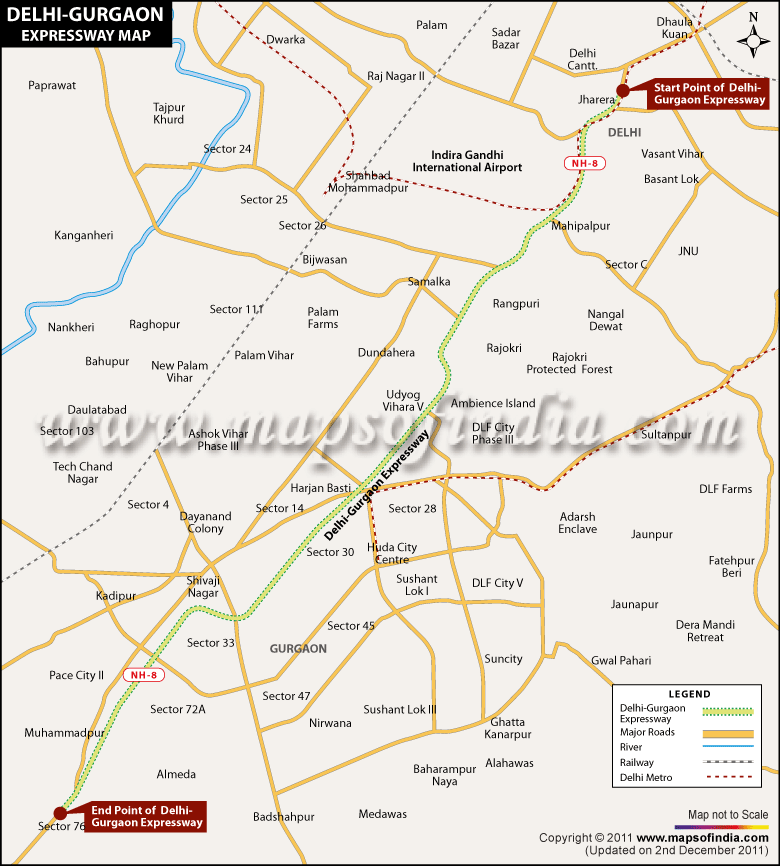
I've written before about the Delhi-Gurgaon expressway, which has one major problem - its toll plaza is chronically congested.

The reasons for this are clear.  The plaza is too small, throughput is inefficient and there is insufficient use of modern tolling technology.  So how is it going to be fixed?  Well the government thought it could be solved by going to court, so operator DS Construction was facing a court case brought by the National Highway Authority of India.  An out of court settlement sees the operator return about US$70 million to five public sector banks that provided loans for the road.  

DS Construction has since been asked by the Punjab-Haryana High Court to prepare a report on how to improve traffic flow according to Hindu Business.

Ideas include the following:
- Waiving the US$29 fee for tag users, and cutting the monthly account charge by a third;
- Adding four reversible lanes at the congested toll plaza;
- Introducing toll collectors walking with hand held devices along queues to accelerate payment;
- Penalising non-tag users who enter tag lanes.

The Hindu Business Line says that an out of court settlement has been reached about the road.   Charges for prepaid users are to be cut by a third, which will encourage a shift from cash to account payment.  Smart cards will also be available for faster payment in cash lanes.

Meanwhile, Rohit Baluja,  President, Institute of Road Traffic Education in an article in the Times of India claims the problem is because of a lack of indigenous Indian traffic engineering capability  There has been a total lack in the application of traffic engineering. Most developed countries have traffic engineering centres in cities as well as for the highways. But India hardly has any functional or scientifically operated traffic engineering centres, as most of such services are outsourced to consultants.

Of course this isn't a clear explanation, what is more important is being able to procure concessionaires and specify service standards that require them to get consultants to deliver outcomes that are sought.  

He is right in saying that technology and engineering could help solve the issues on the expressway, but  this is a governance matter.  He is also right that traffic management needs to be integrated and development of new highways must also be reflected in works on the roads that they connect with.

India's rapid growth in traffic will mean both the new tolled routes and the routes they bypass will need to be upgraded, which means having an approach to highway funding and governance that radically changes the relationship between government, concessionaires and road users.  There is a path forward, it is not ad hoc changes to meet individual cases, but a strategic approach to the long term maintenance, construction and operation of national strategic highways.

Meanwhile, The Times of India has published a rather odd review of electronic tolling technologies that briefly considers Singapore, Dubai, France and Toronto.  It is largely correct as far as it goes, but it should have considered technologies rather than locations.  For example, there are a wide range of electronically operated barrier systems, fully free flow DSRC based electronic systems (with variations between passive and battery powered systems), automatic number plate recognition based systems and (completely ignored in this case) GNSS based tolling.   What will happen in the future is likely to see vehicles equipped with communications and vehicle ID technology at source, and for smartphones and vehicles to be connected to better enable automated options for toll collection.

Wednesday, 7 November 2012

Debate continues in Australia about congestion pricing

Road pricing has shot up the agenda in Australian politics, with two politicians recently expressing opposing views on the issue.

The ABC reports that Independent Federal MP Rob Oakeshott has come out in favour of congestion pricing, saying that it is politically unpopular and "Both sides know that this is something that at some point has to happen”. He opposes increasing taxes on fuel and vehicle ownership, saying these unfairly impose costs on country motorists and truck operators to pay for new transport investment in cities.

By contrast, Liberal Party Federal MP Scott Ryan is opposed (The Liberal Party is in Opposition at present). In the Australian Financial Review he writes a contorted argument that pricing in an artificially constrained market isn’t reasonable. In short, he says while the market arguments about congestion pricing sound good, they don’t add up when the state decides on road and public transport systems, and the state benefits from the revenue. He says unless alternatives can be developed to respond to the price, then it is not a real market. Indeed, he goes so far as to question whether government should ever assess the “value of time” for road users, by determining if the value for those willing to pay is higher than those unwilling (even though it is, by definition). He says it ends up being a tax increase or state imposed rationing system.

I accept Oakeshott’s view that congestion pricing is inevitable to manage congestion in Australian cities, and that general motoring taxes across the board create significant distortions by raising prices for all, not just those benefiting from any new capital investment. However, Ryan’s view simply neglects the fundamental point that not charging road users directly results in demand exceeding supply in a way that he would consider unacceptable in most other sectors of the economy. He wouldn’t tolerate waiting to put a phone call through at peak times, or awaiting a ration of electricity at peak times, so why tolerate it for roads? His key points have validity, in that it is important to decide who sets the charges, on what basis and what the money is used for. I wonder if he’d share the same view if other motoring taxes were reduced in parallel, such as fuel tax.

Still it is good for there to be debate, and positive for one MP at least to be honest about the issue. However, there is still a long way to go before the debate becomes a matter of how, rather than if. 

Tuesday, 6 November 2012

Debate continues in Vancouver about road pricing

I wrote a few weeks ago about how Vancouver is now having an active debate about the future role of tolling and road pricing in raising revenue and managing traffic in the city.  Unlike some other cities, where discussions appears to involve a large vocal and dismissive opposition to any form of tolls, it appears the debate here is more measured.  Those raising concerns are doing so whilst making some useful points, around equity and what money should be spent on.

Most recently , Frank Bucholtz editor of the Langley Times but writing for Peace Arch News says that
Surrey Mayor Dianne Watts advocates a distance based charge. Apparently, she anticipates that such a system would allow for a reduction in gas taxes, and if drivers see that those who drive the most actually pay the most, many of then will likely support such a system. 

This is the key point.  Talking openly about reducing other taxes changes the terms of the debate, which all too often will face opposition for simply charging more.  Bucholtz also notes proposals for distance based charging in Washington State (USA), which could provide a model on the doorstep of British Columbia.  Key to his article is noting that whilst many know of the London congestion charge, it is very important for the public and officials to be aware of many other options.

In the Vancouver Sun, Gordon Price, director of the City Program at Simon Fraser University, argues for a more comprehensive road pricing strategy than tolling the bridges (the obvious easy option). He says the reasons are: 

- The need for revenue to maintain the transport network the city needs. 

- Tolling bridges alone is inequitable. 

He advocates that Vancouver should look at the pilot trial to distance based charging being considered in Oregon. He says it allows charging by place, time and distance, although that misconstrues what is happening there – as it is just about a distance based tax for electric, hybrid and plug-in hybrid vehicles to supplement the fuel tax. However, in the context of Vancouver, having distance based charging would and should allow for differentiation by route and time of day.  This is exactly what is being considered in Singapore at present, and I have long held the view that this is the path towards the least distorting, and most economically efficient form of pricing.   Charging individual routes or cordons alone are very much second best options for many cities.

The big question is how to get to that point, as I believe it will need to involve a pilot, and incentivising people from paying fuel tax to paying by distance.  

Meanwhile, Vancouver does need to think about how it spends any money collected.  A letter to the editor of Tri-city News suggests that road pricing is about propping up the subsidised SkyTrain.  This suggests how important it is for those advocating road pricing to get support for what they are going to spend the revenue on.  It is, after all, the inevitable and inescapable question that gets asked of those advocating road pricing.

Calgary considers road pricing or a fuel tax rise

The Calgary Sun reports that the City of Calgary is having to consider how it bridges a funding shortfall due to declining real revenues from provincial government.  The options being floated include either raising fuel taxes or what it describes as "tolling", which apparently is more a case of more widespread road pricing.

Mac Logan, the city’s general manager of Transportation says there is a C$200 million (US$200.6 million) shortfall between 2013 and 2022.

The report continues to say that Logan would prefer an increase in the federal fuel tax, which is C$0.10/l.  Alberta also has a C$0.09/l provincial fuel tax.  However, there is a concern that such an increase would not see Calgary getting the revenue it seeks.  Tolling becomes more attractive, although he makes it clear this is not about funding discreet highway projects, but about raising revenue for the entire transportation budget.

What that implies is everything from congestion charging to a full network pricing initiative.

The newspaper report includes the predictable kneejerk reactions from politicians:

- Alderman Shane Keating said "A toll road system would be impractical for Calgary’s roadways — there’s just not enough room for such a system and the tolling booths could be easily circumvented her" and "All in all, toll systems are very inefficient in design".  What's a bet he thinks of manual toll booths as being tolling, and he thinks of tolling being individual points rather than a distance based charging system?

- Alderman Ray Jones said "people could simply drive through other neighbourhoods to get around it". Again, an area charge, zonal charge or distance based charge would avoid all of this.

It would be good for Calgary to at least explore options, and consider that the long term sustainability of fuel tax is questionable given vehicle efficiency and alternative fuels.  However, I'd suggest that if this is about revenue, the solution needs to be at the provincial level.  If Calgary wants to manage congestion, it could certainly consider options that deliver such benefits and generate revenue.

Conclusion

To determine the right solution, the problem needs to be well defined.  In short, Calgary should present, in a transparent way, exactly what will happen if it has a growing funding gap.  It needs to consider options for greater efficiencies, fare increases for public transport, fuel tax increases, parking and road pricing alternatives.  Then it can start to see how to match revenues to more efficient pricing overall.  Considering a source of revenue independent from its impact on behaviour and the distributive impact of that source of revenue is not likely to provide the best solution.

Friday, 2 November 2012

Transport for London proposes tolling existing tunnel to pay for new one

East of the city of London there is a distinct dearth of road crossings of the Thames, which shows in the severe congestion experienced on them all.  Between Tower Bridge and the North Sea, there are only three road crossings.  The Rotherhithe Tunnel is a 104 year old route only suitable for light vehicles.  At the other end is the Dartford Crossing, which has tolls and is soon to have that toll system converted to electronic free flow technology to reduce the bottleneck at this spot.  Options to expand capacity at the Dartford Crossing are currently being investigated, but closer to London it is a matter for the Mayor of London and Transport for London.  The previous Mayor, Ken Livingstone advocated a now defunct bridge called the Thames Gateway Bridge, which would have been tolled.  This was stopped by the current Mayor Boris Johnson, who is now pursuing an alternative option - called the Silvertown Tunnel.

Transport for London has released its latest round of consultation on new east London river crossings this week, and has now included more details on the preferred options.  I'll largely ignore the proposal for a new vehicular ferry service, as it is laughably absurd to think that with the chronic demand for cross-river road capacity between Tower Bridge and the Thames Estuary that a small vehicle ferry could ever deliver more than a minor increase in capacity.

The more seriously useful proposal is called the Silvertown Tunnel, which is proposed to be built as a toll road, providing a new local link across the river.  

Location of proposed Silvertown local toll tunnel under the Thames
This would be intended to take more local traffic flows from the Blackwall Tunnel, relieving congestion in those tunnels and improving connectivity.  The tolls would help pay for the tunnel, but also enable congestion to be managed at peak times.

However, a more controversial part to the proposal is to toll the nearby pair of tunnels known as the Blackwall Tunnel (singular – though there are two two-lane one way tunnels) on the grounds that:

if the Silvertown Tunnel is built and subject to tolling, the Blackwall Tunnel would also need to be tolled – otherwise there would be serious delays at the Blackwall Tunnel as so much traffic would wish to use it

This curious statement appears to claim that the Blackwall Tunnel will be subject to delays in the future, if a new crossing with tolls is built.  Yet, whilst there is a point to be made about having a tolled crossing near an untolled one (as it means demand for the new crossing is suppressed whilst the untolled option remains), this statement is nonsense as it stands.

The Blackwall Tunnel today is heavily used and frequently severely congested.  This situation is likely to continue.  A new tolled Silvertown Tunnel would provide an alternative for some trips using the Blackwall Tunnel, so will help relieve congestion.  However, usage of it will be less than it would be if the Blackwall Tunnel was not tolled, as some motorists will pay to use the new tunnel only at times when the Blackwall Tunnel is congested.

Yet congestion at the Blackwall Tunnel will not get worse if the Silvertown Tunnel is built and tolled on its own.  Why would it?  This argument simply wont wash.

There are three reasons to toll the Blackwall Tunnel at the same time as the Silvertown Tunnel:

1.  Those who use the Blackwall Tunnel benefit from the shift of some traffic to the Silvertown Tunnel, so should contribute towards the capital costs of the new parallel route.  Otherwise, they will gain the benefit of the tunnel without directly paying for it.
2.   Tolling the Silvertown Tunnel alone will not raise sufficient revenue to pay for it if the Blackwall Tunnel is not tolled.
3.   The regular congestion in the Blackwall Tunnel suggests that pricing could moderate demand and reduce congestion, as well as helping finance new capacity.

However, TfL is strangely not arguing that it is unfair to relieve the Blackwall Tunnel with a new tunnel, but only make those using the new tunnel pay for it.  That's unfortunate.

Tolling the Blackwall Tunnel will be opposed because little is being offered in return

Tolling the Blackwall Tunnel will inevitably be opposed by many, largely because the standard of service offered by this link is not good enough to justify it.  Six lanes of highway traffic to the north and south squeeze in and out of the four lanes of tunnel capacity, with the northbound tunnel having restrictions on vehicle size and speed (it was designed for horse drawn traffic having opened in 1897).  The northern end of the tunnels has traffic signals on what is one of London's few (partial) major orbital arterial highways.

The likelihood is that opposition to tolling the Blackwall Tunnel will be significant, because nobody will believe anything will get better, and because so many believe they pay enough now through fuel tax.  Yet TfL could package this more cleverly and it could be linked to the government’s desire to get more private investment in roads.

Private sector option with tolls could transform this corridor

It could offer to lease (or sell) the Blackwall Tunnels to the private sector allowing the new owner to introduce tolls on a new Silvertown Tunnel and the Blackwall Tunnels on conditions that the concessionaire built the new tunnel, and (if it were an outright sale or a lease of 50 years or more) build a third Blackwall Tunnel to replace the Victorian era northbound tunnel.  TfL believes building the third tunnel is high risk, expensive and difficult, so let the private sector decide how and when this can be delivered within a specific envelope.  The owners or lessees could manage, maintain and improve the major approach roads (the A102 through to the A2 in the south, and the A102 including the A12 through to the A406).  In short, the entire East Cross Route, Blackwall Tunnel, and the southern approaches, with the Silvertown Tunnel, could be owned and operated by a private concessionaire for 50-100 years (or for good if one wanted to be very brave).  The image below depicts the two Blackwall Tunnels in red and green, the East Cross Route and Blackwall Tunnel approach roads in blue, and the proposed Silvertown Tunnel in yellow. 


Blackwall Tunnels, proposed Silvertown Tunnel and approach roads

This is likely to be controversial, as it will mean tolls on the tunnels (it could even allow for tolls on the approach roads, but the new owners would need to meet minimum standards for maintenance and route availability.  If there are fears about excessive tolls (which environmentalists should not oppose), then there could be an initial range of tariffs set in advance, indexed to inflation, with a 100% surcharge permissible for times of heavy congestion. 

All of that ought to please those seeking to manage traffic demand, but the catch would be that tolls couldn't be introduced until the Silvertown Tunnel is built. I'd suggest a timeframe for a 3rd Blackwall Tunnel  (the existing Victorian era northbound one could be relegated to a local link or one way bus tunnel) of say fifteen years after the Silvertown one.  Doing that would enable this corridor to be sustainably and professionally managed, keep the roads maintained, manage demand to capacity.  Beyond that, there would also be the expectation that pricing would manage congestion, so that any new owner would be required to ensure free flow conditions are maintained in the absence of any incidents.

In other words, let this be a showpiece example of how the private sector and tolling might own, operate, improve a piece of strategic arterial highway in London.  This would go further than the management and construction concessions for the M25 and M40, but rather involves new owners having a customer relationship with the users of the facility.

Blackwall and Silvertown Tunnels with East Cross Route in greater London

Yes, there will be opposition from Friends of the Earth and the Green Party, all of whom think road capacity should be frozen permanently, but are suspicious of using pricing to manage demand if it is also used to fund improved highway capacity.  Yet, they ought to reconsider.  A private Blackwall Tunnel, even with new capacity, would be priced, so congestion should be avoided, reducing emissions.  Public transport would be more attractive compared to the priced corridor.  In other words, there are environmental benefits in having a major piece of highway infrastructure priced to ensure traffic flows freely through it, and to not divert taxpayer funds to expand it.   On top of that, if this would demonstrate the value of tolling as a way of managing corridors in London, it may set a precedent for the long term management of highway capacity in the city in a way that the congestion charge could not.

The congestion charge, after all, has worked in central London, but having been tried in west London, is simply not capable, in its current form, of being readily expanded in a way that is acceptable to the public.  Further road pricing in London should be about giving something back to those paying.  Allowing a new Thames Crossing and the existing Blackwall Tunnels to be tolled, both to recover infrastructure costs of new capacity and to manage demand, would show that selective enhancements to the highway network can be sustainably funded and managed, but also that a more commercially oriented approach is capable of delivering a better highway experience for all users.

Thursday, 1 November 2012

Radical privatisation of UK highways proposed by thinktank

Could the UK's entire road network be privately owned and operated?

This is what has been proposed by the Institute of Economic Affairs (IEA) in a report authored by Dr Oliver Knipping, president of the Institute for Free Enterprise (a German free-market think tank) and Dr Richard Wellings, deputy editorial director at the IEA and director of the IEA’s transport unit.

It is a radical vision of a UK road system owned and operated by private entities ranging from larger companies that may own sets of highways and regional networks, to smaller rural or urban co-operatives, all offering different pricing approaches ranging from distance to single point tolling, to access passes, to free routes (paid for by property owners).  A very decentralised network, which bears little resemblance to the current central and local government controlled system, and is even more dynamic than the energy and telecommunications utility sectors that it is often (negatively) compared with.

The full report is available here.  It is well worth a read, not only for those interested in UK transport policy, but those interested in highways reform worldwide.  Why?  Because it sweeps away many of the assumptions made about the status quo seen in almost every country, and taps a handful of examples of private sector participation in the roads sector that are useful.

It goes far far beyond public-private partnerships as well.  Unfortunately its release on Sunday was more than overshadowed by the rather pointless over-reporting of an alleged proposal to have a two-tier vehicle excise duty/vignette system for the UK, which seemed to have little real substance.


Why privatise?

The case is for private ownership of the UK road network.  Knipping and Wellings make a compelling case that the status quo is sub-optimal, given that congestion costs £20 billion per annum and the network as it stands costs 2,000 deaths and 25,000 serious injuries a year.   They also argue that £9.5 billion worth of spending on roads is poorly allocated because it reflects political rather than user preferences.  Certainly, it seems odd that new capital projects can proceed when increasing proportions of the network are poorly maintained and shabby (with signage, lining and road surfaces visibly neglected).

They argue these outcomes arise from the inherent incentives around the current governance of the highways system, and believe that commercial and market oriented incentives would produce superior results. one issue cited is that UK transport policy being strongly biased towards expenditure on public transport rather than roads, as is reflected in the deferral of road projects with higher benefit/cost ratio appraisals than approved public transport projects.  Furthermore, local authorities have poor incentives to improve network maintenance, in part because they do not benefit from revenue raised from road use (although they do from parking) and the planning system has largely hindered development of the highway network, because it magnifies the views of opponents, compared to those who benefit from the positive externalities of highways.

Certainly the process of getting highways built in the UK is glacial, and due to enormous amounts of consultation and the need for hypersensitivity about environmental and social impacts.  Knipping and Wellings believe that private companies needing to respect private property rights as the first principle, would be better placed to compensate landowners and take into account community views being driven by the profit motive, rather than to fit criteria determined by government.

The report notes historic underinvestment in new capital in the roads sector, but highlights the Humber Bridge as an example of poor investment - it being a toll bridge that has had part of its debt written off because the benefits in promoting growth did not eventuate.

What about road pricing?

On the topic of this blog, road pricing, the key point the authors make is that whilst widespread road pricing would be beneficial, this "would not in itself solve the fundamental problems associated with government ownership of roads" because the two key benefits (better use of existing capacity and better direction of future investment decisions) are undermined by pricing being set by politically determined rather than market oriented criteria.

The authors don't proscribe a road pricing approach per se, but see it as being up to the privatised road owners.  They say that no single pricing mechanism would exist under a privatised road structure, it could be highly diverse and dynamic, and should be.  The full range of options could exist, from time/distance/place based charging, to tolling with manual toll booths on quieter rural routes, to access passes (like vignettes) for networks.  In all cases, it would be about comparing revenues, to yield, to asset management and the transaction costs of different charging options.  

The authors claims prices would be market set, with the key being competition from alternatives.  The obvious alternatives of mode and not travelling are part of this, but also what matters is how privatisation is implemented to encourage competition between roads.

How could privatisation promote competition and so pressure on road prices?

The authors propose that:

"a denationalisation of the road industry should aim initially at creating smaller-sized lots of road networks than  privatising the state monopoly in a single chunk, which would create a dominant position in the road market. Smaller sizes – whether area-based or route-based – would facilitate consolidation or deconsolidation moves in the road industry and shape something like an efficient market structure, save for the unavoidable inefficiencies and distortions that had been created by previous state monopoly."

In other words, the Highways Agency might be broken up into multiple regional or route based entities, and perhaps local authority networks could stand alone on their own right, or be broken up as well.  Whatever would happen ends up being dynamic, and would see a progressive transformation (probably some consolidation for economies of scale, subject to competition regulation concerns) to see a range of road companies emerging.  

The big question is how competitive they may be.  Area based road owners would be less likely to offer choices for specific routes (and of course for local trips, such choices may be unlikely to exist), whereas corridor based ones could do.  However, at present there is no competition, and the government levies 6p per mile on the average car doing an average trip, through fuel tax.  

For local roads, models are suggested such as the Swedish Road Association model which effectively creates co-operatives for rural roads, to property owners operating in their own co-operatives for urban local roads.  In addition, in many cases there are rights of way that exist over roads, based on historic property development and ownership.  Such rights of access are assumed to remain, but road owners that wanted to override them could do so with the consent of the rights' owners, who may be presumed to want compensation for the loss of the rights.


What about externalities?

A key point is that better pricing resulting from market related decisions should see lower congestion and consequential emissions, but beyond that private owners would have to negotiate with property owners and communities regarding any new construction, and would be well incentivised to manage negative externalities.   They also respond that there are positive externalities to the presence of roads that are often ignored, such as the network effects of a road providing universal access.  Fundamentally, it is thought that a property rights approach combined with more efficient pricing could result in better overall results for the environment, even though road owners will want to incentivise the greatest efficient use of their networks.

How would road taxes be reformed?

The authors have a radical proposal.  Once all roads are privatised, they would empower the new owners to price road users as they saw fit, but abolish Vehicle Excise Duty (the tax on ownership) and cut Fuel Excise Duty by three-quarters from 59p/l to 15p/l.  The new owners would be paying for the roads from road user charges, so government spending on roads would cease.  However, this cut in motoring taxes would reduce revenue by far more than what is spent on roads.  The rest would be made up by the predicted windfall of £150 billion from selling the network, which could be used to cut public debt (and resulting interest) or simply to offset the loss of revenue until the economic benefits of better pricing and a more dynamic highways sector flowed into the wider economy.  It is clear that this proposal implies government spending restraint more widely.  One of the longer term effects is seen to be that subsidies for rail can be phased out, primarily because if roads are priced efficiently, the case for subsidising rail is difficult to sustain on pure economic efficiency grounds.

Conclusion

This is a radical set of proposals to shift the UK highway sector into the private sector, well beyond the commonly referred to "public-private partnerships" and beyond what the Government has proposed (which appears to be encouraging more private participation, not abandoning public provision).

The most interesting and useful dimensions to the report are the economics, and considering that to release the full potential of road pricing, it needs to be dynamic and to be supplying market signals not only to users, but to providers of roads.  The report also intelligently responds to many of the concerns raised by those who would instinctively oppose privatising roads.  I find it refreshing, and a very helpful contribution to the debate, although perhaps what was needed a little more of was the right transition path to take to generate some of the benefits and build confidence in a private model.   The other issue is that there is discussion of options for privatisation that effectively mean granting ownership to new user or property ownership co-operatives, which of course would not generate any money for the state or local authorities.  It is highly unlikely politicians will swallow an end to so much revenue so quickly unless they could sell the roads.   In the current climate, it is also highly unlikely that sufficient investors would be found to buy the whole network.

Yet, the potential is there for the Highways Agency's network, which could be privatised, but would need to be accompanied by a cut in some motoring taxation (e.g. cutting Vehicle Excise Duty to an administrative fee, or reducing fuel excise across the board) to enable the new owners to toll with less public opposition.   

For those interested in road pricing, it does help to change the terms of the debate.  For over a decade, transport economists and public officials have been trying to convince the public, the media and politicians of the merits of introducing road pricing in the UK.  Perhaps the key is to remove such decisions from political/bureaucratic structures and shift them to the private sector.  Then the debate will be only slightly less about what people pay, but will also be a little more about what they get for their money.

Footnote

The Institute of Economic Affairs (IEA) describes itself as:

the UK's original free-market think-tank, founded in 1955. Our mission is to improve understanding of the fundamental institutions of a free society by analysing and expounding the role of markets in solving economic and social problems.

Tuesday, 30 October 2012

Higher road tax for UK motorways?

Some UK newspapers have a history of vocal opposition to any suggestion of road pricing, so what appears to have happened in the last 24 hours needs some explanation.

The report comes from a senior Treasury official apparently saying that one of the options considered for reforming vehicle excise duty (VED - an annual vehicle licencing fee commonly but misleadingly called "road tax" as none of the money collected is hypothecated for roads) would be to charge motorists much less in VED, but charge a higher rate for permission to access the motorways and other major trunk roads.

In short, it would replicate the vignette system which applies in eight countries in Europe and is soon to be introduced in Belgium.  Those systems mean that motorists who wish to use the motorways/major highways need to buy a vignette for access to those roads, but those who choose not to, can use the rest of the network for no more.   Most countries with such systems offer options to buy 1 year, 1 month or 1 week for those who may not regularly use the network.

The reason for it is primarily to allow for foreigners to pay a share of the costs of using those network, a relatively minor issue for the UK, which has less than 2% of traffic carried by foreign vehicles.

The Daily Mail produced the headline claiming that there would be a "two-tier" road system with the rich paying to use motorways, and the poor left to using other roads.   It claimed "spy cameras" would catch those who don't pay, which is just going to be ANPR cameras, such as those used to enforce the London congestion charge, speed cameras and service station fraud.  

The AA rightfully said it would encourage diversion onto non-arterial routes, and that would be correct.   It makes little sense to charge the motorways and trunk roads more, largely because the marginal infrastructure costs of using these is lower than using local roads, and the environmental and congestion impacts lower as well (as it does not expose pedestrians or residential buildings to as much pollution).

Another option cited in the article would be a one-off tax on new vehicles, which would be worse as this would simply delay new vehicle purchases, meaning the vehicle fleet would get older over time.  This would mean more fuel consumption, more pollution and less safe vehicles than would otherwise be the case.


Oddly, the Daily Mail also reports that the one option that would make a positive difference, has been excluded:


A proposal to link the amount motorists pay in road tax to how far they drive on motorways, or their use at peak times, has been ruled out.


The RAC Foundation published an interesting report by Brian Wadsworth of the "Roads Ahead Group" proposing such reform.   He suggested that once people pay VED, they could earn discount points if they opt into a system that means if they do not drive at peak times on certain congested roads, they earn a credit towards their VED.  It means at one extreme, the rural driver who never goes on congested city or arterial roads would earn a substantial discount on the following year's VED, whilst at the other end, the driver who frequently drives at the peaks on busy roads, loses all discount points and that is that.  That driver just pays VED - as now.   The system would require technology on board vehicles to measure time or distance spent in peak zones to calculate the discount, which wouldn't be dissimilar to road pricing.

Of course, this doesn't fix the long run revenue issue, which for VED is the fact it is an ownership tax that is based on CO2 emissions.  Revenue from such a tax is unlikely to grow as people get ever more efficient vehicles.

What it does do, is create a new level of trust with motorists that government measures regarding tax are not always punitive, and helps to derisk the future introduction of road pricing to replace existing taxes, although I remain unconvinced that this is the right way to do it.  It is fuel tax that is the real issue for long run revenues.

Yet the reports in the Daily Mail and Daily Telegraph do not enlighten.   What they do display is the ease by which motorists can be angered and upset by ill thought out ideas, because there is no trust in how governments set, collect and spend taxes that are levied directly or indirectly on vehicle ownership and use.  Until that is addressed, any reforms will be a political liability and unlikely to be implemented.

Conclusion

I doubt the UK government will introduce a vignette system for UK trunk roads, as there is little discernible benefit in doing so, and plenty of negative impacts from the idea.   Too many would divert from motorways and trunk roads to local roads, creating congestion and additional pollution, and it would not adderss the fundamental revenue issues.

Given the unwillingness to directly charge for road use on existing roads, it is fair to say that the most useful thing that may come under this government is some sort of hypothecation of existing motoring taxes and reform of the highways sector to allow for private ownership and commercial operation of the highways networks.

A few have been publishing interesting ideas about how to do this, including myself.  I will write about these shortly, but the key point is that until the way roads are governed and managed, the way spending on roads is determined and allocated and the incentives on road providers are radically altered, there is no way that tinkering with the existing second-best pricing tools will make a meaningful difference to the experience of road users.

Monday, 22 October 2012

Copenhagen congestion charging looking less likely

Last year, the government in Denmark changed, with the election of a leftwing coalition which included in its coalition agreement a commitment to introducing congestion pricing in Copenhagen.   I wrote optimistically at that point, as it appeared that the real debate was not about "if" it should be introduced, but "how".

Original cordon concept for Copenhagen congestion charging
Yet no one should underestimate the politics around congestion charging.  The real push for charging in Denmark has been from the Socialist People's Party (a green/socialist party) which had it as a core part of its platform to reduce traffic and emissions in Copenhagen, and to boost walking, cycling and public transport as an alternative.  The party leader pushed in the elections that he would slash public transport fares with the revenues from the charge, which gained support among non-motorists in Copenhagen.   However, the SPP has only 16 out of the 179 seats in the Danish Parliament, compared to the senior partner, the Social Democrats (a centre-left party) which has 44 seats, and is significantly more sensitive to public opinion.

The core problem is that the modelling of future revenues proved disappointing.  According to the Copenhagen Post, the revenues were estimated to be less than half of the DKr.2 billion (US$352 million) originally forecast, dashing hopes that congestion charging could fund a major cut in fares and major capital works on the scale envisaged.  

Opposition to the concept was strong among business leaders, and the opposition Venstre party (free market liberals - which is ironic given the attribution by some that congestion pricing is a market oriented approach), but it was the opposition from local leftwing politicians, aligned to the two main parties in government, that made it increasingly embarrassing for the central government.

So the result is that congestion charging has been shelved, for now.  The government announced it is spending DKr 1 billion (US$176 million) on improving public transport and reducing fares in February 2012, and created a Congestion Commission to look at long term solutions to addressing congestion and air pollution in the city.

Yet that Commission is having problems of its own.  It cannot get agreement among its 24 members about potential solutions.  It is meant to report on recommendations by 1 January 2012, but the Commission is deeply divided between business representatives (opposing charging) and environmentalists (supporting it).

A Copenhagen Post article claims the government is optimistic an outcome will be reached, but the Venstre Party believes it is too divided.

I previously wrote about how I thought Copenhagen should go about it, describing the main proposal for a cordon around central Copenhagen. For it should not simply consider the single cordon, it should not just consider a cordon ala London, but consider how similar type systems exist in Italy and Singapore.  

The key is really to not be wedded to a single concept, to consider experiences elsewhere and to develop options that not only mean pricing is more discreetly targeted at congestion, but that the net revenues are used for some combination of new capital investment in the transport network of the charged zone and/or tax relief for businesses in the zone.

It is notable already that there is support by some other political parties for congestion pricing in Copenhagen, but not the cordon solution previously described.  The Radical Left party (Radikale Venstre - socially liberal centrist party) is also part of the coalition, with 17 seats.  It is glad the concept has been scrapped, but it support GPS based distance based road pricing.   The party's transport spokesman, Andreas Steenberg, claims the opposition Venstre and Conservative People's Parties share that view.

Bearing in mind that Denmark is also pursuing GPS based road pricing for heavy vehicles (more on that soon), this is consistent with such an approach.

Conclusion

It appears unlikely that Copenhagen will get congestion charging in the near future, partly because only one of parties in government is still pushing it, but also because the concept being supported is insufficiently flexible or targeted enough to avoid criticism from businesses that the impact will be blunt.

My guess is that the Congestion Commission will agree that pricing could reduce congestion and emissions, but disagree about how it should be implemented and what it should look like.   I suspect the cordon option, unless radically altered, will be gone, but that talk of GPS based pricing will remain.   If so, whilst GPS based distance charging in an urban environment would have many advantages, one of them is not cost and another is not rapid deployment.

It can be sure that if there is a lot of support in Denmark for the broad idea of charging to manage traffic demand, then the GPS option will remain for some time.   The political advantage of that is that it can always be said to be too risky to do at present, but that offers little for relieving traffic congestion in Copenhagen.

Friday, 19 October 2012

Vancouver Mayors hear views on road pricing

According to the Vancouver Sun, pricing existing roads in Vancouver has moved up the agenda a little, as a panel of experts (including well known figures such as Ed Regan and Jack Opiola) was invited to talk to Metro Vancouver mayors about options for road pricing.

Previously I have written:

- The C.D Howe Institute proposed converting HOV lanes in the city to HOT lanes which would raise C$81 million per annum, and offer a new congestion bypassing option on certain routes;
- Vancouver City Council is seeking more powers to raise revenue including options to toll existing bridges and roads;
- New Port Mann Bridge to introduce free flow electronic tolls and provokes talk of more road pricing.

Now it seems the mayors of the local authorities are open minded about how to move forward.  The article says that a number of points were made:

- Large scale options include zonal fees or distance based charging;

- All road pricing options mean a shift from general taxpayers to users (notable given the Mayors are to consider shortly whether to increase a long standing property tax to fund some transport projects);

- Jack Opiola suggested Vancouver had similarities to Stockholm, but might choose to introduce a system similar to Siena in Italy, which has multiple zones.  He also said that people perceive driving should be free regardless of the cost to maintain the infrastructure and that the city needs to define the costs it wants to recover to help the public understand;

- Ed Regan suggested that whatever is done needs to generate value for those paying elsewhere, such as reducing fuel tax given that fuel tax revenues are declining due to vehicle efficiency.  He also suggested that the broader the charge, the fairer it will seem to be.

Mayors seem open to looking at options. Radio station CKNW reports that Langley city mayor Peter Fassbender said that
"...... we're not just tolling bridges, we're looking at pricing throughout the region. User pay."

Meanwhile,  "BC Chamber of Commerce President John Winter says they and the Vancouver Board of Trade want mayors to approve the temporary property tax increase" although they admit it is a stopgap approach to funding transport.

Of course the real tradeoff is that to get the most revenue and greatest equity, you need the longest time and cost to implement the most radical option (time, distance, location based charging), in the meantime options such as charging only bridges, are feasible, but create distortions.

Vancouver has a reputation among public transport enthusiasts for being a city that has adopted sustainable solutions for urban mobility.  Whether or not that is true, the introduction of road pricing could have a profound effect not just on traffic, but on urban transport more generally and the urban form of the city.

I can only hope that Vancouver continues to get expert advice and has a sober look at options, and does so with an open mind to not just transplant what has been done elsewhere.