Thursday, 7 April 2016

Slovenia to have network heavy vehicle toll in 2017

ITS International has reported that Norwegian toll provider Q-Free in consortium with Telekom Slovenia. Q Free confirms in its own press release as well.  The contract is for US$111 million (€99.99 million), which is for system delivery, including back office, "toll tags", service, maintenance, communications and systems integration.  There will be a 10 year service and maintenance element, with a three year possible extension.  The DARS (Slovenian Motorway Company) motorway and expressway network is 610km long.  
Slovenia's vignette charged road network


Slovenia's current heavy vehicle toll road network
Slovenia's road user charging policy is a curious combination of manual tolls for heavy vehicles only (trucks and buses) on main highways and a vignette (time based charge) for light vehicles.  The heavy vehicle toll rates are based on distance.  Note the heavy vehicle toll includes buses and coaches, not just trucks.  Slovenia is, of course, a major transit point between Italy/Austria and Croatia, Hungary, with transit freight (and passenger) traffic growing now Croatia is an EU Member State.

Ptolemus reports that there were three failed bidders (Kapsch, Autostrade and Skytoll), but most interestingly,  it is a conventional DSRC tolling system that is being implemented, not a GNSS based system - essentially updating the manual toll system in place for heavy vehicles to be more akin to the systems in Austria, Czech Republic and Poland.   The new system will expand to apply to all motorways and expressways in Slovenia, not just those currently subject to the toll. One report estimated an increase in expected revenues of €13m per annum due in part to the expansion of the tolled network and the improvement in traffic conditions.

It probably makes financial sense to simply convert manual tolls to electronic free flow on this relatively small network, as it updates what DARS already has.  There are long term operational cost benefits, and reductions in delays for heavy vehicles.  However, the decision to reject GNSS technology for now means it could not be extended beyond much of the motorway/expressway network economically, and the chance to build an ITS application sector on top of it (like Hungary has done).  As DARS is a commercial highway company its decision may be assumed to make commercial sense.  

I don't have further details as of yet, but it appears that the system has been procured in the conventional manner, not a PPP, so that DARS  will continue to own and operate the toll system.  However, the procurement of this system has been problematic over some years, with the initial call for interest in August 2011, but then suspended in March 2012, restarted in February 2013 and stopped again, with the current tender having been launched in July 2015.

The choice of a DSRC approach reflects it being the lowest cost tender.  Newspaper Večer has reported (Slovenian) that, saying that the other tenders were priced at €110.11m (Skytoll and Iskratel), €114.6m (Autostrada, Cetis and Engineering Informatics) and €114.96m (Kapsch).   Kapsch has a minority shareholding in Q-Free as well.  DARS says the Q-Free consortium had the highest scoring, and those who object may appeal.

There has been a request from Kapsch to audit the procurement according to Delo (Slovenian). Claims include that the tender documentation changed and that the specifications gave the winning bidder an advantage.  Concerns over the transparency around procurement of systems in other countries are known in the industry, so there is understandably sensitivity by both DARS and bidders.  It would be a shame if there were substance to allegations and concerns to delay the project further.   One concern is that because Q-Free bought Slovenian Company Traffic Design in 2014, that this gave it an advantage.  One report claims (Slovenia) that much of Traffic Design's business was obtained without competitive tenders, but representatives of the company and DARS strongly deny there were any irregularities.

Curiously,  DARS published a press release (Slovenian) on 30 March (after the announcement of the winning bid)  responding to allegations of irregularities in the procurement of the toll system.   It would appear it is not the end of this issue.

I have used Google Translate to extract the DARS press release in response to allegations, so apologies for the fractured English:

In connection with the reporting of some media that the implementation of the procurement procedure "Establishment and operation of multitrack electronic toll system in free-flow traffic on motorways and expressways" occurred organizing tenders and irregularities DARS d.d. denies such biased statements and strongly rejects any complaints about any organizing and editing your bids so by DARS d.d. as a third party. DARS d.d. All offers submitted by tenderers in any procurement procedure, led by DARS d.d., therefore, be kept in a specially protected room at the headquarters of Dunajska 7, Ljubljana, in the same way DARS d.d. also keeps the tenders received during the procedure.

The process is carried out in accordance with the provisions of the Public Procurement Act and the Act on the legal protection in public procurement procedures, so DARS d.d. during the course of the procedure will not land on the media influences and pressures. Also due care providers DARS d.d. He will not comment on the process, which is still in progress, regardless of the pressures of some of the media. Following this process, the public will be duly informed.

We emphasize that, in accordance with the provisions of the Public Procurement Act public opening of the bids in the presence of the media, suppliers and all stakeholders. Following the decision the client has all the bidders, at their request, granted access to both the tenderers who have submitted offers as well as documentation of the client. Among the insights all providers in accordance with the provisions of the Public Procurement Act and the Companies Act, protect their interests and on the basis of a decision on the protection of business secrets is a subscriber data offers all the providers that have been marked as business secret deals adequately protect (blanketed with several layers of paper). Consequently, the bid documents of all bidders correspondingly increased.

Once again firmly and strongly reject all allegations of irregularities opening and management process.

Wednesday, 6 April 2016

Toll major crossings in Vancouver to reduce congestion- says professor


He supports the idea of Delta Municipal Council Mayor, Lois Jackson, for a C$1  (US$0.77) toll on all major crossings in greater Vancouver as a starting point, but advocates going further.   

He says congested crossings should have higher tolls and these should be time differentiated, effectively targeting congestion where and when it is most severe, and conversely having much lower tolls at off peak times or times when there are no tolls.  He also implies that 22 pinch points on the network (which goes beyond crossings) should be charged, with perhaps similar charges on each for equity and public acceptability reasons.

He wisely opposed a downtown cordon/area charge scheme akin to London or Stockholm, because of the absence of congestion at those times.  

Evidence of impacts of peak toll charges is mixed.  In Sydney, a peak charge was introduced for the harbour crossings (A$4 in peaks, A$3 inter peak and A$2.50 off peak), but that had only a 0.19% impact on peak volumes.  Not enough to relieve congestion.  In San Francisco, a peak charge on the Bay Bridge did have an impact  (PDF), with a 4% reduction in vehicle traffic in the morning peak, but that paralleled introducing a charge for HOVs, which previously travelled free.  Demand elasticities at peak times may be quite low, requiring quite high charges to make a large difference. 

However, both such cases involved vehicles that already were paying tolls.  Introducing tolls where previously there were none should have a more significant demand response.

Meanwhile, check out this rather good video from Canada's Ecofiscal Commission, called Stuck in Traffic with an Economist in Vancouver. It isn't a bad summary of the core urban congestion/road pricing issues:


Tuesday, 5 April 2016

Jakarta's congestion pricing programme is further delayed: HOV rule to be temporarily suspended

The Jakarta Globe reports that ERP (Electronic Road Pricing) for the city remains a "pipe dream" even though only a couple of months ago it appeared the city was ready to procure a congestion pricing system that would pioneer the policy for Indonesia.  I've written extensively about it here.

The report says:

Jakarta Governor Basuki Tjahaja Purnama said the regulations and payment procedures for ERP, where cars pay to pass certain streets using an onboard unit, were still not ready, though the technology and infrastructure are available.


However, it would appear it isn't just regulations and payment procedures (which should not be difficult):

"It's okay to suspend the three-in-one system, as long as a replacement is ready," the Jakarta Police's traffic unit head Adj. Sr. Comr. Budiyanto said. "But the problem is, there are still so many things to prepare for the [implementation of] ERP, including human resources, infrastructure, the legal aspects and databases related to it."


In other words, without either the Automatic Number Plate Recognition (ANPR) systems to reliably identify Indonesia's less than easy to read number plates, nor a database with sufficient accuracy to identify the names and addresses of vehicle owners (and to update this when ownership changes),  it is difficult to implement electronic road pricing.   This sample number plate from Wikimedia has various dimensions that reduce the reliability of ANPR technology, which should achieve accuracy levels of between 83% and 98% in the latest implementations of such systems.  The small numbers at the bottom of the plate are likely to prove difficult to read, and with a light on dark plate, with characters close to the rim increase the scope for inaccuracy compared with this UK sample plate.  

I wrote about this several times before, and it astonishes me that Jakarta hasn't focused on addressing this issue and the number plate database issue.

Meanwhile, the Jakarta Post reports that the city appears about to abandon its "3-in-1" rule temporarily, which essentially make two major roads in central Jakarta all high occupancy vehicle (HOV) routes (that's the whole road, not just a lane).   It applies from 0700-1000 and 1630-1900 weekdays.
Jakarta 3 in 1 network highlighted

The purpose of the rule is to reduce congestion, by requiring cars to carry three people, but it has spawned an informal industry of people who queue up near the boundaries to be paid to fill cars.   The proposed ERP congestion pricing system is meant to replace the rule, but "3 in 1" is accused of spawning child exploitation, as "joki" (jockeys - people who hire themselves as passengers) are blamed for running child begging, street performance and rental rackets.  

It is to be suspended for a week for city officials to assess the impacts, both on child exploitation and traffic.  The Jakarta Globe says the problem is that a few jokis are drugging their young children whilst undertaking their trade, and carry them to increase the chance of being picked up by drivers (drugging the children means they are not a nuisance).  They get US$1.50 per trip, which in Indonesia is more than the average hourly income.  Australia's ABC has more on this. However, the Police oppose the trial because of the impact on traffic congestion, although it will enforce bus lanes to ensure they continue to operate relatively freely.

UPDATE: Antara reports that the 3 in 1 policy is being replaced by enforcement of the odd-even number plate policy (which rewards those with two cars), but also claims that the Governor now wants ERP implemented.

It describes implemention of ERP geographically as follows:

According to the plan, the ERP implementation area will be divided into three sections. Area I will cover the Blok M-Kota Station, Jalan Gatot Subroto (Kuningan-Senayan), Jalan Rasuna Said-Tendean Tendean-Blok M, and Jalan Asia Afrika-Pejompongan.

Area II will comprise Dukuh Atas-Matraman-Manggarai-Jatinegara-Gunung Sahari and Kampung Melayu-Casablanca-Jalan Prof. Dr.Satrio-Tanah Abang.

Meanwhile, Area III will include Grogol-Roxi-Harmony, Tomang-Harmoni-Pasar Baru, Cempaka Putih-Senen-Gambir, Cawang -Pluit -Tanjung Priok, Cawang-Tanjung Priok, and Sunter-Kemayoran.

Tempo reports that the ERP rates "will" start at  30,000 Rp (US$2.28) raising to 50,000 (US$3.80) if congestion remains, although it could be free if traffic is temporarily diverted into ERP charged areas.  A 200,000Rp (US$15.21) deposit for the vehicle OBU will be required.

Of course, the problem of enforcement remains, the question of what happens when someone doesn't have an ERP OBU has to be addressed.

Monday, 4 April 2016

Belgium's Viapass truck toll is in operation, but problems persist

Belgium has the world's newest national distance based road user charging system, but as I posted on Thursday, it hasn't been without teething problems which are not yet behind it.  Flanders News reported on a "chaotic start".

I summarised the scheme in February, which charges main highways and parallel roads in Flanders and Wallonia, and all roads in Brussels as seen in the maps (with charge rates in Euro) below.
Belgium's charged RUC Network

The problems last week appeared to be a mix of a small number of dysfunctional OBUs, delays in delivering OBUs to users and delays in responding to queries by phone or online.   Viapass claims 135,000 users have been successfully registered and are paying the toll, but the contract with Satellic was to get 700,000 trucks signed up.  Long queues emerged on Friday as foreign trucks, especially from the Netherlands queued up at service centres to obtain OBUs, with much congestion.  OBUs were meant to be available from automatic  dispensing machines, which were quickly exhausted and not resupplied. Another report on Saturday indicated some technical problems with the system.

Metro Belgium reports (Flemish) that the Walloon transport Minister demanded an urgent meeting of the Viapass board. The report notes Viapass saying it did warn not to wait until the last day to get OBUs and that it had embarked on a major campaign of publicity months ago, including writing to 60,000 operators.    Le Soir reports (French) that the Viapass board had the urgent meeting, but said the system had worked well, except for queues at borders and said that Satellic needed to improve performance to meet its contractual obligations.   Some reports indicate that one problem was the efforts by the TLN to get the introduction of the system delayed may have encouraged Dutch operators to not get accounts and OBUs in time.

HLN (Flemish) reports that Viapass (the company set  up jointly by the Flemish, Walloon and Brussels governments to manage the RUC scheme) has told Satellic to improve its performance.  Two roads were blocked in Wallonia out of protest, with particular problems at border crossings with the Netherlands (which are typically free flow since border control was removed many years ago).   Via pass called for quicker response time, for OBU dispensing machines to be constantly replenished and for a maximum two days waiting time for faulty OBU's to be replaced by post, or immediately at service centres.

Meanwhile, Metro Belgium reports that the Flemish Transport Minister does not understand the delay, given there have been "months" for truck operators to get ready, and notes the German system had problems when it started (although I would have thought after 10 years some lessons would have been learned)!

Requests to delay introduction of the system were refused by Flemish and Walloon transport Ministers, but RTL reported (French) on Saturday planned protests against the charge.

I suspect things will settle down in the coming days, as OBUs get delivered and delays ease at service centres, meanwhile it will be interesting to see if stories of what may be seen as "unfair" enforcement emerge.   What the Belgian experience shows is that you may not be able to do too much publicity in advance of such a change, and that the way the publicity is undertaken may need to be improved elsewhere.  Although availability of accounts and OBUs stretches back into late last year, the urgency has not been clear to many operators, particularly foreign ones.  Perhaps financial incentives for early take-up could have been made available (e.g. a discount for a month or two, or credits to accounts based on the deposit).  However, most important is to provide the capacity to cope with last minute rushes at service centres and call centres.   I'm a little surprised at the problems, given how many other systems have been launched, with some of the same issues emerging years ago.  As the next country likely to deploy distance based truck road user charging looks likely to be Slovenia, I hope it can learn from the Belgian experience.

Meanwhile, Satellic has a strong incentive to get things right this week, it is getting paid enough to do so in any case.

Interesting, on Friday Viapass announced that Axxès, a French toll service provider, has been certified as the first new service provider for the system, competing with Satellic.   Viapass has said it passed the certification tests for accuracy and communications. Axxès operates in France, Spain and Portugal, so this is its first venture into deployment of GNSS based distance charging.   Does this mean some of the dissatisfied future users may choose Axxès over Satellic?

Friday, 1 April 2016

Belgium's heavy vehicle road user charge starts tomorrow but...

As previously reported on this blog, Belgium is set to be the tenth country in Europe to implement distance based truck tolls (and the fifth to use a GNSS based measuring technologies) tomorrow (1 April), but it already appears some teething problems are emerging.    The system is expected to raise €750 million per annum, but issues appearing include delays in delivering OBUs to operators that have pre-ordered them,  claims that some are unreliable and long delays in call centre or email responses from Satellic. 

Notwithstanding attempts from the Dutch  (TLN) and Flemish (TLV) Associations for Transport and Logistics to legally challenge the charge, it looks like it will be operational tomorrow.   TTM reports (Dutch) that it is "chaos" and that TLN claims that call centre delays are around half an hour or more and that emails are not being responded to, and that operators are still waiting on OBUs paid for and ordered "weeks" ago.  The response from Satellic is that operators that haven't received them need to go to service points at the Belgian border, which is likely to cause chaos.  TTM  says that the border points on Wednesday were without sufficient OBUs, although Satellic claims to guarantee everyone who ordered an OBU in advance will have one in time for tomorrow.  TLV claims that Satellic isn't ready and wants leniency in enforcement and TLN pledges to support anyone with a legal challenge for enforcement, if they have taken all reasonable steps to comply. 

Viapass claims that 350,000 users will be registered by 1 April, but claims that 800,000 OBUs are available now.   In parallel to the launch of the system, Belgium will withdraw from the Eurovignette (which charges truck over 12 tonnes GVW) and has cut annual registration fees for trucks down to 3.5 tonnes GVW).  It has put out a press release in advance of the system launch where it points out that there are 128 automatic dispensers of OBUs.  

HLN.BE reports (Flemish only) that a survey from transport organisation Febetra (the Belgian freight and logistics industry association) indicates 60% of truck operators reported problems with either unreliable OBUs or difficulty accessing Satellic's (the concessionaire operating the system) call centre. It is concerned that operators with OBUs that have failed cannot get them replaced by tomorrow. Yet Flanders Today has reported that Satellic says the defective OBUs only need a software update which is automatic (presumably via mobile data) and there is no need to replace the OBU.  Apparently of the 2000 OBUs reported defective (out of 350,000) 90% have been fixed.

I suspect that enforcement over the next month will be sufficiently nuanced to not fine those who appear to have made best efforts to comply.  There are ways of designing enforcement procedures for introduction that do not undermine compliance in the medium term, but also give users a fair chance to become compliant. The fine is €1000 which must be paid within 3 hours otherwise a further €1000 must be paid.   However, enforcement is done by different entities in each of the three regions that the charge is collected.  It is a tax in Flanders and Brussels, but a fee in Wallonia (because its roads are managed by a private concessionaire).  So there is a chance that enforcement responses to early issues may vary.  The deposit for an OBU is €135.  

Gazet Van Antwerpen is reporting (Flemish only) that some critics claim the system will charge for use of parallel roads, to which the CEO of the managing company Viapass says that customers can check this on their invoices and it will be corrected if true.   One operator said it will increase the costs of freight transport in Belgium without any countervailing reduction in congestion, although it is not intended to manage congestion.

The problem of not enough OBUs having been installed before introduction is not new.  This happened in Slovakia as well, and the issue comes to whether it is a problem of the lack of supply of OBUs or the truck owners/operators simply waiting until the last week or so to get their vehicles equipped.  Having incentives for early installation would have helped that, a simple discount for the first month or so for those who are early installers would cost revenue, but would also spread out the logistical nightmare of last minute account set up.  Similarly, call centre problems are entirely predictable.  When London introduced its congestion charge, it provided vastly larger capacity for its call centre just to ensure that when the charge started, nobody could accuse Transport for London of not being able to "get through".  Indeed, a parallel call centre was established in case the main one failed.  Of course all this is expensive, but to get through the pain of introduction, it pays off in terms of acceptability.  

It's far too early to tell whether this is just a matter of far too many operators responding in the last week, or any mistakes on behalf of Satellic or Viapass, but hopefully nobody will be unfairly penalised for doing their best to comply.   Of course if Satellic is seen as giving poor service, it will be a strong incentive for the new competing service providers to offer better service.

Meanwhile, Satellic has produced this advice from its website, reproduced from its front page below to cover what appear to be all eventualities, except perhaps getting to a service point and there being insufficient OBUs or insufficient parking space for those queuing to get one:
You have an OBU
Couple your OBU to a vehicle in the Road User Portal. Install the OBU in your vehicle, switch it on and keep it on whilst driving in Belgium and abroad. If the OBU turns green you are ready to go! If the OBU shows a red light please check our Q&A section.

You don’t have an account - you don’t have an OBU
Go to a Service Point as soon as possible, create a fast-track account and get your OBU. Be sure to bring all the necessary vehicle papers.

You have an account - you have not registered a vehicle - you don’t have an OBU yet
Go to a Service Point as soon as possible to get an OBU. Bring the login and password for your account on the Road User Portal and all necessary vehicle papers. Log in to your existing account, complete your vehicle registration and get your OBU.

You have an account – you registered a vehicle – you don’t have an OBU yet
Go to a Service Point as soon as possible to get an OBU. Bring the login and password for your account on the Road User Portal. Login to your existing account and get an OBU.

You have an account – you registered a vehicle – you ordered an OBU but did not yet receive it
Go to a Service Point as soon as possible to get another OBU. Bring the login and password for your account on the Road User Portal and the necessary vehicle papers. Login to your existing account on the Road User Portal and re-register your vehicle. As a license plate number can only be registered once in one account, you need to register your license plate number in a different manner. For example: if you registered 1ABC123 you can re-register as follows 1-ABC-123 or 1.ABC.123 or 1 ABC 123.


Wednesday, 30 March 2016

Next London Mayor will have to increase congestion charge says Boris Johnson

It's been reported in the Evening Standard that current (and outgoing) London Mayor Boris Johnson has said that the congestion charge has to be increased or reformed into "smart charging" if his successor is to manage congestion and implement policies to pedestrianise some streets.  The most popular post on this blog is my one on ten years of the London congestion charge, and since I live in London and use public transport and drive, I have a personal interest in what happens.

Boris Johnson was elected in 2008 and has served two terms, he won a constituency at the 2015 General Election in west London and is rumoured to be interested in succeeding David Cameron as Conservative Party leader (Cameron has said he does not wish to be Prime Minister beyond the next General Election in 2020).  So he is saying this without much political baggage, except, of course, he shrank the area of the congestion charge in his first term, by removing the Western extension that included Kensington and Chelsea (which was an electoral pledge of his in the 2008 election).   That makes his latest statement seem contradictory, but there was a case that the Western extension was poorly conceived and was largely a political stunt by his predecessor, Ken Livingstone, to hit the wealthiest part of London with a congestion charge (even though it perversely gave all of its residents a 90% discount to drive into central London).   With only a 3% reduction in traffic speeds in the zone of the Western extension after it was scrapped, it indicates that it was a blunt instrument that was poorly targeted.

The reason Johnson is advocating an increase or reform is simple.  The congestion reduction benefits of the congestion charge have been exhausted, because a significant proportion of road space in central London has been reallocated from general traffic to bus/taxi lanes, cycle lanes and wider footpaths.  With ongoing population growth (10,000 a month across Greater London), growth in delivery traffic because of internet retail, growth in minicab/Uber traffic and ongoing economic growth, the gains from the charge have completely been eroded.  Indeed, the volumes of cars entering central London has dropped by 30% since 2000.  If there were no private cars in central London during the day there would still be severe congestion.  A quick look at traffic data for one street in central London (Charing Cross Road near Trafalgar Square) shows a total average daily traffic count of 9674 vehicles in 2014, of which only 5791 vehicles were cars, minicabs or taxis.  As the RAC Foundation head of external affairs, Pete Williams suggests, it indicates that the volume of traffic isn't the issue (as car traffic is in decline), rather roadworks and the reallocation of road space have meant that remaining traffic delays have got worse.

London central congestion charge zone and the defunct western extension
The report indicates that delays have increased by 13% in the past two years with average speeds down to 7.4mph, with average speeds across Greater London down to 16.5mph, which is a new low. Around 66,000 vehicles pay the charge each day and gross revenues are around £257 million a year, with operating and capital costs of £84.9 million a year, resulting in net revenues of around £173 million (source: 2015 annual report)   That suggests the congestion charge remains expensive to operate compared to other charging systems internationally (the Stockholm congestion tax costs US$26 million a year in operating costs).  It is worth noting that 108,000 vehicles a day drive in the congestion charge zone and pay nothing, primarily taxis and buses.  There has been talk of extending the congestion charge to some taxis, although the impact of this on congestion would be negligible.  A charge of £11.50 per day could easily be spread across multiple trips for any cab, although it would certainly mean some marginal trips may be shifted onto other modes, this is unlikely to make a noticeable difference.  One other underlying concern is that bus patronage has been dropping after years of increases, with one reason apparently being congestion making bus travel too slow and unreliable.  As much of the road network has no scope for bus lanes, addressing congestion is also about improving the reliability of public transport that isn't on rails.

Little political interest in serious change

The Mayoral election is on the 5th of May this year.  However, neither major candidate (Sadiq Khan for Labour and Zac Goldsmith for the Conservatives) have shown much interest in transport policies that have anything meaningful to say about roads.  Khan's transport policy focuses on a freeze in public transport fares, but also says he wont increase the congestion charge.  Goldsmith focuses on public transport too, although also says he wont increase the congestion charge and wants to 'crack down' on pollution from trucks.  Clearly, neither candidate thinks there are votes to be won from advocating reforms to the congestion charge, regardless of their merit.  By contrast, Liberal Democrat candidate Caroline Pidgeon advocates increasing the congestion charge, with higher peak charges, although she's wrong if she thinks the peaks are 0700-0930 and 1600-1800, as traffic levels are lower at 0700 than they are during the middle of the day.   The Greens have previously advocated London wide distance, time, location based road user charging to penalise car traffic and raise money for public transport and cycling infrastructure.

What could be done?

Tuesday, 22 March 2016

Vancouver toll reform needs fundamental rethink

Vancouver has been talking about roadpricing in one form or another for over five years now.  It has been driven by revenue, as ambitions to upgrade and expand public transport aren't able to be met by revenue from users nor existing sources of taxes.  However, behind it is also the interest in using tolls or urban road pricing options to achieve behaviour change.   Both can be achieved simultaneously, but the fundamental problem is public acceptability.  Nowhere in the world have motorists warmly supported paying more to use roads to pay for expansion of public transport.  Stockholm's congestion tax gained support because it literally demonstrably reduced congestion.  Manchester held a referendum on implementing a congestion charge sold primarily on raising revenue to pay for improved public transport, and lost 3 to 1.  

July 2015 a plebiscite was held on establishing a sales tax to pay for improved public transport in greater Vancouver, but nearly 62% of the 52% who voted in the plebiscite.  It seems less likely that motorists will support them paying for other people to get improved public transport, but that doesn't mean that road pricing in Vancouver is fruitless.  Instead, a more complete strategy needs to be developed.

Vancitybuzz reports that the Surrey Board of Trade supports "regional road pricing" with 60% of surveyed respondents agreeing with tolls being introduced on existing roads to support new infrastructure construction.  The issue in Vancouver arises from there being tolls on two bridges on the Fraser River, but not others raising the issue of equity among road users who pay directly to use some crossings but not others.  The report notes that not only are revenues on the (tolled) Port Mann and Golden Ears bridges well below forecasts, but that the untolled crossings are facing higher levels of traffic as motorists avoid the tolls.  One bridge (Pattullo Bridge) needs replacing and the plan is for the replacement to be tolled and the George Massey Tunnel is in a similar position.   The case for a comprehensive strategy to toll all crossings to pay for all crossing improvements and maintenance is not unreasonable, but it will create a de-facto cordon charge towards the south of Vancouver.

In the map below, the black dots are the Port Mann and Golden Ears bridges (from left to right), the red dots are the George Massey Tunnel and Pattullo Bridge (left to right), with a question mark over the Alex Fraser bridge (the only untolled crossing west of the Golden Ears bridges that doesn't need replacement).

Vancouver Fraser River tolled and untolled crossings

However, The Now newspaper online reports that British Columbia Minister of Transportation thinks a solution to the "toll problem" could be years away because it only matters if a decision is made to replace the Pattullo and Massey crossings with tolled crossings.   Whereas Premier Christy Clark when asked about "mobility pricing" (one of the many terms for charging existing roads) she said it was "controversial" and she isn't in a position to take sides (which I think is code for thinking it is a good idea, but not being sure how to support it and not lose too many votes).  

It seems obvious that focusing on toll reform at these crossings is a positive step, as long as it is focused on recovering the capital and maintenance costs of all of the crossings, with tolls that are higher at peak times to reflect demand (and conversely lower off peak).   Raising revenue for wider plans, especially those not involving roads is going to be more controversial (this CBC report indicates two-thirds oppose any increases in taxes or charges to pay for public transport)  but raising revenue for the crossings, including their maintenance will reduce pressure on public finances more generally.  

A long term strategy

Tolls exist on two crossings now over the Fraser River.  Two further crossings need replacement, so the case for tolling them should be able to be made, which raises the question of two other crossings that do not need replacement for now, but will face unacceptable levels of congestion if left untolled.  The case for tolling those crossings needs to be made based on the users of those crossings benefiting from the tolled ones - because of the transfer of demand (and congestion), and for those crossings to be better maintained as a result.  The tolls should be used not just to pay for crossings, but their approach roads and other routes directly related to using the crossings.  

If successful, the obvious next step is to think about the Vancouver Harbour crossings, but also to more clearly investigate more strategic reforms into how roads and public transport are funded for the Vancouver metropolitan area.   That means looking at existing taxes (on vehicle registration and fuel) and whether these need reform or replacement with more usage based charges such as are being piloted in Oregon and soon California (although fuel tax in Vancouver is much higher than in Washington State).   However, it should also do a proper study into the merits of urban road pricing for the city, whether it be looking at cordon charging, area charging or distance charging.  

Yet it also reminds me of how Australia is treating heavy vehicle road reform, (summarised here PDF) which is to reform how roads are funded and managed before introducing direct road user charges.  Going back to first principles may help increase efficiencies and make transparent why and how public funding of land transport infrastructure (and public transport services) is justified.  Having a funding and governance framework that is more widely accepted will make it easier to justify new or higher charges and proposals on spending.

Without this, Vancouver and BC will remain stuck between ambitions for spending that neither users nor taxpayers are willing to pay for, and infrastructure problems of both congestion and aging capital that need addressing.  Can the local authorities and province go to first principles and develop a long term strategy that can get wider support?

UPDATEToronto Metro reports that Vancouver is likely to get capital funding from the Federal Government for at least some of its public transport initiatives, but still faces problems finding the funds to support operating subsidies, with road pricing still on the agenda.  Whereas the Toronto Star editorial from Sunday supports the use of tolls being introduced on two major highways in the Toronto area to fund repairs and upgrades of them, not only because those who pay will benefit from the improvements but because tolling can help reduce congestion (implying the use of peak time tolls to manage demand).  Although a separate type of project, this editorial from one of the largest newspapers in Toronto is a positive sign (although the editorial notes the political reticence over tolling).

Monday, 21 March 2016

Jakarta congestion pricing facing problems by charging only main roads

The Jakarta Post reports that the city's planned Electronic Road Pricing (ERP) congestion charging system has been delayed, for governance reasons.  It had previously wanted to introduce the proposal by the end of 2015, which seemed ridiculously ambitious. 

The "ERP management unit" (with the acronym BLUD) has to be set up first, which of course makes perfect sense, and it apparently will be established in July.  Following that establishment, tenders for the design, installation and operation of the congestion pricing scheme will be let.

However, I'd urge some caution.  It would make sense for the ERP management unit to be bedded down and establish its objectives and procurement strategy before jumping into procurement.

As part of that the report notes

Korlantas chief Insp. Gen. Condro Kirono said police were gathering vehicle data for the ERP electronic registration and identification (ERI).

“We have held workshops with police offices and have supervised their digital data collection,” he said. 

A key element of any congestion charge will be reliable identification of number plates and associating plates to owners who can be billed/fined as appropriate. This is already proving to be a problem

The proposed congestion pricing scheme fits into the vision of Jakarta as a "Smart City" although that "Asia One" article weirdly thinks that 4,800 CCTV cameras will help this, when it really has little to do with it (except perhaps a related function of monitoring traffic volumes)

A substantial public marketing campaign is proposed to be launched in September/October, but it does have some major problems as Asia One news reports (includes TV report in English):

One of the challenges facing the implementation of ERP concerns motorists using small shortcut roads. Jakarta has a complicated network of roads which includes small shortcut roads.

The provincial government is well aware that motorists may try to bypass the ERP by using shortcut roads. But while taking such a route may save some money, it may not save time because during peak hours shortcut roads are even more congested.

This of course, is the key problem with proposals to charge only main roads.  There effectively needs to be a cordon put in, or parallel charges introduced for alternative routes.

In addition to pricing, it is useful to take some of the advice from Widya Anggraini, a Jakarta-based urban planner, in this article by City Metric, particularly addressing sexual harassment on public transport and ensuring pedestrian and bicycle access is improved.  This is clearly an important mode now and Jakarta should avoid the mistakes of some other developing country cities in letting these modes be neglected, which of course helps to encourage car use.  Walking and cycling for short trips is an obvious answer both in encouraging efficient use of road space, but also reducing pollution and improving the liveability of the city.  Development does not mean abandoning active modes.


Friday, 18 March 2016

Singapore will have world's first GNSS urban congestion pricing scheme by 2020

The world's most sophisticated urban road pricing system is going to become even more sophisticated as Singapore looks like being the first city to ever implement a full distance, time, location and vehicle type based road pricing scheme, using GNSS technologies. 

Singapore's Land Transport Authority announced the winning bid for its procurement of a GNSS based electronic road pricing (ERP) system on 25 February - a consortium of NCS and Mitsubishi Heavy Industries Engine System Asia. NCS holds the contract for maintaining the ERP system and Mitsubishi was responsible for developing the original ERP system.   NCS is a subsidiary of Singtel, Singapore's major telecommunications carrier, itself owned by Temasek,  the Singaporean Government investment company that invests in firms such as Singapore Airlines.

The cost is S$556m (US$407m) and implementation is expected in 2020, with development starting around April.  According to Channel News Asia, the existing ERP system will operate in parallel for an 18 month transition period.  Two other participating suppliers were ST Electronics, which bid the project for S$1.26b, and the consortium of Watchdata Technologies and Beijing Watchdata System which did not reach the bidding phase.  This enormous difference in bidding price must have been influential, as well as NCS/Mitsubishi's long standing experience and understanding of the current ERP system.

The winning consortium will build and maintain the next generation GNSS urban road pricing system.   Although it will primarily use GNSS systems to detect and measure distance, it is also reported that beacons may be used to supplement GNSS signals in some locations.  It is using 4G systems for communication, but according to Business Times intends to still be compatible with stored value cards - a first for GNSS charging systems (as no OBUs in use anywhere currently take payment cards).

Channel News Asia published this image depicting some value added services that the new system will bring, including real-time traffic and parking information, and payment systems for parking.  The OBU is intended to be "open to new applications" to enable the ERP system to be a telematics platform.  One feature will be warning in advance of a charged road, so that a road user can choose to divert elsewhere.

Singapore congestion charging based on GPS

Context

Since September 1998, Singapore has had the world's most sophisticated urban congestion charging scheme, which has directly targeted only segments of roads that are heavily congested and applies prices to those segments of road based on achieving a minimum "level of service" (operating speed).  Its prices vary by time of day and direction of travel, apply to virtually all vehicles (including motorcycles and buses) and are reviewed regularly to ensure they are appropriate - that means the prices rise if speeds drop below a set threshold, or are reduced if they go above another threshold.  The intention being to optimise the use of the network.

It goes back to the Area Licensing Scheme in 1975, which essentially introduced a pass based system of congestion charging for access into central Singapore, and the subsequent introduction of controls on the numbers of vehicles allowed to be licensed in the country (a policy that is more plausible in a city-state than in a larger country, let alone the individual liberties concerns in many countries).

Singapore has curbed car ownership by limiting the number of cars in the country, but it has not stopped the country building adequate road capacity.  12% of the land area is taken up by roads, although again, in a city-state it is hardly surprising, built up areas need access which means they need roads, and there is little room for farms or forests which can cover vast areas with little road access.

Transport Minister Khaw Boon Wan has a target of 75% of trips made by public transport by 2030 and 85% by 2050.  It is doing this by increasing the bus fleet by 35%, doubling the rail network, expanding cycling paths and quadrupling covered walkway distance (essential during Singapore's tropical downpours).  However, I wonder how much difference vehicle automation might make, as Singapore would appear to be well positioned to pilot incentivising automated vehicles to get better use out of the road network.

ERP today

An interactive map of all charging points which you can click to get the prices of reach vehicle class per time of day is here.  Most gantries operate at peak times only, but some charge during interpeak periods and some on Saturdays (e.g. Orchard Road in downtown Singapore).

Singapore ERP gantry points
Prices for cars at set times at one Singapore ERP charging point
Prices range considerably, with prices set to reflect vehicle type according to metrics of road space occupancy based on PCU (passenger car unit equivalent) Cars, vans and taxis are 1 unit, motorcycles are half, heavy goods vehicles and minibuses are 1.5 and the largest trucks and full sized buses are 2.  This is a measure of congestion impact and nothing else.

Rates are reviewed quarterly to ensure charges maintain average speeds of 20-30kph on main roads and 45-65kph on expressways.  If speeds drop below that at specific times passing by a gantry on a regular basis, prices for that direction of travel at that location are increased (to reduce congestion).  If they go above that, prices are reduced (as it is assumed prices are too high and are suppressing efficient demand).  This excellent article (PDF) published five years after ERP was introduced discusses Singapore's experience with the system and the results.  Violation rates are less than 0.5% of trips.

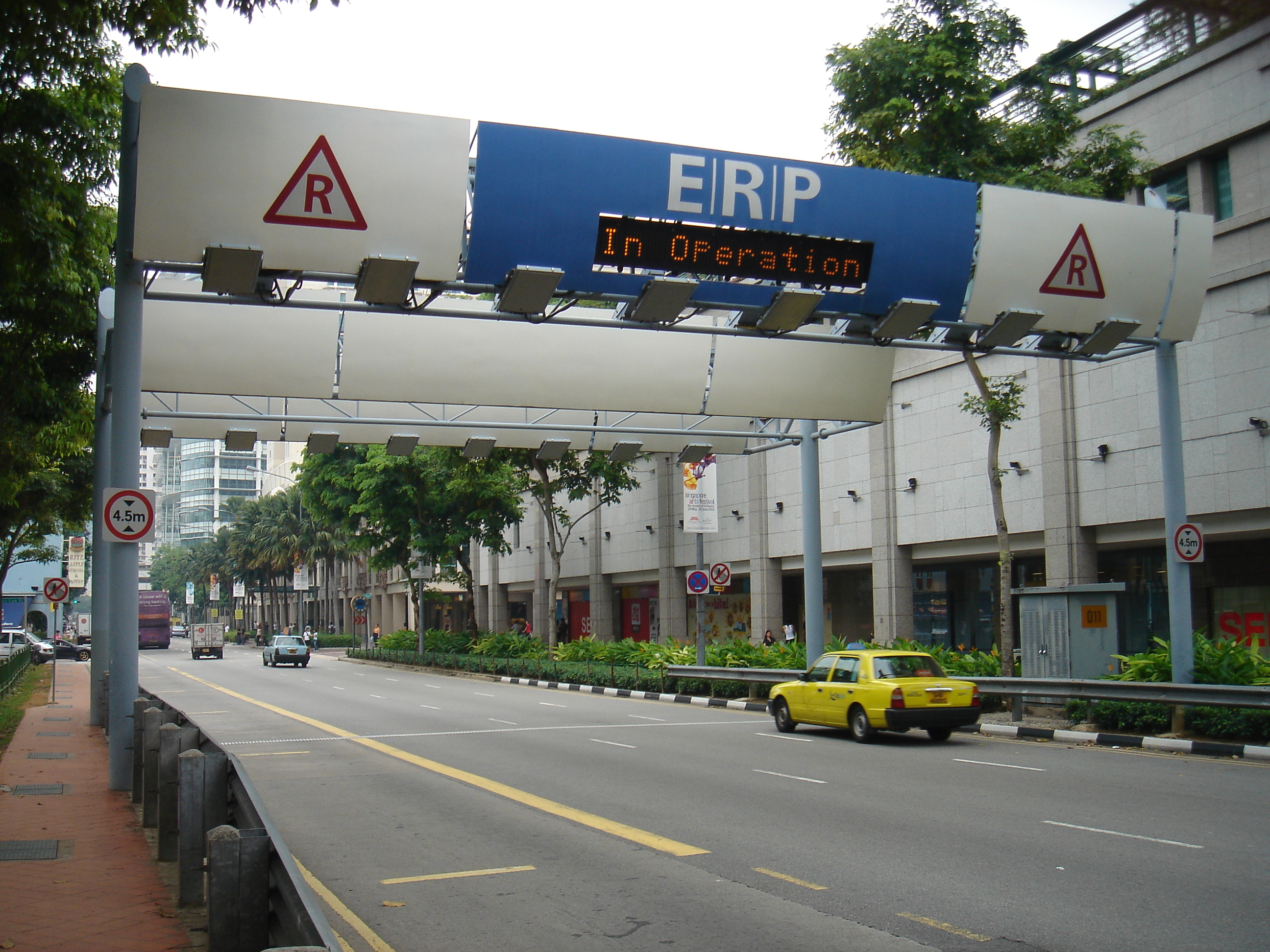
Singapore has long used what is now a rather dated tag and beacon system (DSRC) that is non-standard, and involves a two-way communication with vehicle on-board units (OBUs) by deducting prepaid credit from smart cards inserted into the OBUs.  To achieve the detection, the communication from the unit and back to the smart card (and provide back-up ANPR cameras for enforcement) has resulted in Singapore having very large elaborate gantries that many cities would see as unsightly (and which are increasingly controversial in Singapore itself).


Singapore ERP gantry

Thursday, 17 March 2016

UK does not increase fuel tax for sixth year in a row

With the release of today's UK Budget, the rumoured increase in fuel duty did not occur, making it the sixth year in a row that the Government has decided it is inappropriate to increase a tax that has ever decreasing yields due to inflation and the increased efficiency of the vehicle fleet.

It is rumoured that any increase would have been opposed by backbencher Conservative MPs.  For although the price of fuel is now the lowest it has been in many years, it is clear that fuel duty (and VAT on fuel duty) comprises the majority of the price of petrol and diesel (at £0.6954/l), with retail prices usually between £0.999 and £1.10/l depending on location.   Given no UK fuel duty is hypothecated and it has no relationship at all with spending on roads, it has usually been seen as an "easy" tax to raise, but it is clearly unpopular with grassroots Conservative MPs and supporters.   As the Conservative Party has a small majority in the House of Commons, and Chancellor of the Exchequer George Osborne is expected to be seeking to succeed David Cameron as Conservative leader when he stands down before the next election, it is not surprising that he has taken a political decision that raising fuel duty is not wise.

The net impact is a loss of revenue of between £435m and £450m (XLS) per annum each year (the previous assumption being a CPI based increase).  Also notable is that Vehicle Excise Duty and the HGV Levy (vignette) are not being inflation adjusted, costing around £5m per annum in lost revenue. Curiously, Treasury's assumption about the impact of price reductions on fuel consumption is as follows (PDF - pg 53):

For a 1% reduction in pump prices, the model assumes a short-term 0.07% increase in the quantity of fuel consumed which increases to 0.13 as consumers react to the price change.

However, there is no indication that revenues have increased due to lower prices.
Road spending programme

Curiously though, and apparently unrelated, the Budget announced a long term funding approach for the English Strategic Road Network after 2020 (PDF) (Strategic Road Network means the central Government owned motorways and major highways in England only -  Scotland, Wales and Northern Ireland get bulk funded as part of devolution and manage their own transport spending, although not taxation of vehicles and fuel). £15 billion has already been committed through to 2020, that is assured and forms a programme of maintenance and capital spending that is agreed.   The document above is all about consulting about long term priorities, and should be welcomed as developing a closer link between what users want and what money is spent on those roads.  Having long term guaranteed funding streams enables maintenance costs to be optimised across the life cycle of the network and to help depoliticise funding decisions, instead of subjecting the network to annual budgetary whims of increases and decreases in funding.

This notes that from 2020/21, Vehicle Excise Duty in England (effectively the annual registration fee) is to be hypothecated entirely into spending for that network into a new National Roads Fund ( a term I last heard in New Zealand in 2001).   That's worth exploring more.

Tax on ownership?

From a economic pricing point of view I've alway thought that a little odd.  Vehicle excise duty is a tax on owning a vehicle, but it bears no relationship whatsoever to usage of any part of that network.  For example, in London there is very little such network as there are only three motorways that enter metropolitan London, and in each case only reach around halfway from the M25 orbital motorway into central London.  Many thousands of London motorists may never use the Strategic Road Network, so why should their taxes on ownership be used to pay for it?  It would make much more sense for the National Roads Fund to be supporting investment in all local roads, which all vehicle owners use, and treat it as an access charge to recover the fixed costs of the network.

I presume that Vehicle Excise Duty includes the Heavy Goods Vehicle levy which comprises much of the cost of VED for UK registered HGVs and is imposed on foreign ones too.  The link between revenue from the HGV Levy and the Strategic Road Network is 

There could, of course, be a cunning plan behind this, which could allow for a transition from VED to tolls or some other form of road user charging to be introduced on the Strategic Road Network.  A political deal whereby you can choose to not pay VED and instead pay by weight and distance could benefit millions of car owners who rarely use the motorways, and no doubt would reap in much more revenue in the longer term.  However, it will raise the issue of fuel tax, which Treasury resists in seeing as a tax on road use, even though it is - in effect - primarily generated from that activity.

Future for fuel tax?

For now, the UK Government wont entertain road user charging to replace any existing motoring taxes, although it ought to look at the deadweight costs of these existing taxes and watch what is going on in the USA as Oregon and shortly California pilot replacing fuel taxes with distance based charging.  However, to do this well it will need to build up political capital to convince people that any such move is about raising money for roads and about replacing existing taxes.   Given local elections in May, a referendum on EU membership in June and a forthcoming Conservative Party leadership contest, it would appear the interest in taking what would be seen as "brave" steps towards reforming how people pay for the roads is nil.

Meanwhile, given it has been over 20 years since the Federal fuel tax was last increased in the USA (and the state tax in California), is six years of no increases meaning the UK is hitting the same political obstacles the US has already hit with fuel tax?

Will the car oriented motorists of California be phasing out fuel tax whilst UK politicians wring their hands about increasing a tax that it has encouraged motorists to not pay at all?