Monday, 24 October 2011

News Briefs - Israel, South Africa, Tajikistan, Sri Lanka, Indonesia, New Zealand, Texas

Israel

Sale of stake in Cross Israel Highway:  The Cross Israel Highway (Route 6) is Israel's great north-south highway corridor extending from the outskirts of Haifa, to be nestled between Tel Aviv and Jerusalem, towards Beersheva.  The road is owned by concessionaire Derech Eretz Highways Ltd.  Globes reports that Shikun u'Binui Holdings has sold 24.6% of Derech Eretz to private equity company Israel Infrastructure Fund for NIS773 million (US$212 million). The sale reduces Shikun u'Binui's shareholding in the company to 25.5%, and the company reports a return on the sale of 8%.

Globes says:

Shikun u'Binui did not sell its 24.5% stake in Derech Eretz Highways Management Ltd., which operates the Road 6 toll road, and is waiting for permission to increase its stake to 35%. The deal reflects a company value of NIS 3 billion  (US$824 million) for Derech Eretz. The sale is part of IIF's effort to block rival Noy Infrastructures and Energy Fund's acquisition of 49% of the government's rights in Derech Eretz for NIS 1.39 billion (US$382 million). Shikun u'Binui said that the price tag was based on Derech Eretz's value in the Noy Fund deal. 

Price schedule is here in Hebrew

South Africa

Toll road success:  For all of the controversy over the Gauteng tolling project, it is clear that toll roads have already proven profitable for private investors in South Africa. The Financial Mail reports on the success of the N3 PPP between Heidelburg and Cedara (the complete N3 connects Johannesburg and Durban). N3 Toll Concession (Pty) Ltd won the concession in 1999 for a 30 year period, so is nearly halfway through the concession to design, construct, finance, operate and maintain the highway.   The concession has quite diverse ownership.   The article contains comments from Old Mutual Life Assurance Company Infrastructure, Development and Environmental Assets Ideas Fund manager Jurie Swart, who says 25% of the fund is invested in toll roads (other roads include the N4 between Pretoria and the Mozambique border, and the N1/N4 toll road).

Swart claims there are benefits beyond simply financing and building the road:"Each road has a pavement management system that has to conform to national road specifications. It has a dedicated engineering team, and a maintenance programme that must be audited independently. Toll toads like the N3 to Durban are also involved in local tourism efforts. " Certainly there is transparency about the contracts, and they do appear to help ensure a high standard of service.

Investors are keen to follow this with the controversial N1-N2 Winelands toll road. 

For all of the controversy over tolling in South Africa, it has worked to develop a lot of new highways, and most of all the PPPs have delivered world class standards of service.

Prices for the N3 toll road, per toll plaza, are here.

Tajikistan

A report from Trend notes that one of Tajikistan's major highways (M34) is a 354-kilometre toll road from Dushanbe to Chinaz. It is state owned, financed through a $280 million loan from China, which the Tajik government is repaying through the toll which started on 1 April 2010.

It wasn't easy to find much information about this road, but it is encouraging that tolling has penetrated central Asia, and I can only hope Tajikistan is making sure it optimises its revenue from tolls.

Sri Lanka

Toll road opening delayed:  Sri Lanka's first toll road opening has been delayed till December 2011 according to Lanka Business.   I reported the details about the road in July, when it was about to open.  Tolls were already controversial then for risking essentially fraud, and creating potential bottlenecks.  Well the Sri Lanka Road Development Authority has created more controversy with the delay, which is due to failure to complete toll booths and fuel stations on the road.   A fibre optic network is to connect toll booths, and the expressway curiously will have its own fire brigade and police patrols to optimise response to incidents.  Tolls are meant to be collected manually with a closed system involving a ticket issued on entry, and used on exit to determine the price.   Yes, you read correctly, and this is in 2011.

Indonesia

Astratel expands toll road portfolio:  The Jakarta Globe reports that Astratel Nusantara, the highway construction unit of Astra International, has bought 95% of the 40.5-km toll-road linking Kertosono and Mojokerto, in East Java (outside Surabaya) for Rp750 billion ($88 million). 

Astratel also owns:
- 79.3% of PT Marga Mandalasakti which owns the 72.5-km toll road linking Merak (Banten province) and Serpong (outer Jakarta); and
- 40% of PT Marga Trans Nusantara, part of a joint venture building the 12.5-kilometer Jakarta Outer Ring Road II project which will link Serpong and Kunciran in Jakarta.

The total value of its toll road assets will be Rp3.4 trillion(US$384 million).

New Zealand

Hapless toll road debt grows: I've written before about the financial disaster that is the Route K toll road in Tauranga.  The bad story continues.  The Bay of Plenty Times reports that debt from the road is now NZ$60 million (US$48 million) on a road that cost NZ$45 million, and daily traffic count is 5,000.  Revenue needs to double for the road to be viable, and at present trucks form 13% of users, but 38% of revenue.  Annual losses just go on debt.  How long can this continue?

Texas, USA

Indra wins contract: 4 Traders reports that Spanish company Indra has won a €10.6 million (US$14.7 million) contract with TexToll services in Texas (itself a subsidiary of Cintra, the subsidiary of Spanish infrastructure investor firm Ferrovial).  The contract is to implement electronic toll collection back office services on the SH-130 toll road near Austin, the LBJ Express project and the North Tarrant Express Highway project.  It reportedly makes a big impact on the firm's presence in the USA.

Spam

I moderate comments for one reason - spam.  If you attempt to post spam you will be blocked, and you will fail.  I have so far allowed one comment with a spam link, and it wont happen again.  This blog does not exist to promote your business.  It exists to publish articles I find of interest that I hope others find of interest as well.  Spam at best wastes time and is a nuisance, at worst it can spread malware.

News Briefs - UK

More toll roads?

According to Public Finance, the Confederation of British Industry (CBI) has called for the government to develop major new roads with tolls, rather than the conventional PFI (Public Finance Initiative) approach used in the past.  PFI means PPP, but in the UK most PPP road projects do not involve tolls, but rather shadow toll or service availability payments.   A position I can understand, although of course they are hardly mutually exclusive.  I presume there is effort undertaken by the Highways Agency to identify toll"able" projects, as there should be by local authorities.   I'm in favour of there being some recognition that when vehicles use roads they pay fuel tax and that part of that revenue should be recognised as a positive contribution to the viability of the road (and to be fair the UK transport appraisal framework - WebTag - does count impacts of fuel consumption and fuel tax revenue, although not in that way).

Truckers want toll road fees cut

The Birmingham Mail reports that the Road Haulage Association has said that "the Government has to step in to find a way of making use of this important piece of infrastructure. We are not critical of toll road operator Midland Expressway, but it can’t be right for the country to have that infrastructure resource and not use it.”  Now the RHA has not said quite what the government should do, but it has three options.  Regulate it (which would hardly encourage private investor participation in infrastructure investment), subsidise it (which using fuel tax collected from the use of the road would not strictly be a subsidy), or buy it (and Midland Expressway is uninterested in selling).  I have previously written that I think the M6 toll is a success because the facility is there, well maintained, is reducing congestion, and its private owner is quite happy to retain it operating at a loss.   To get change, the RHA may have to convince Midland Expressway that the suppressed demand from the high tolls more than would make up for any reduced toll.

Detection based accounts popular for London congestion charge

MayorWatch reports that 150,000 "auto-pay" accounts have been created since they were launched in January 2011.  "Auto pay" accounts mean that motorists do not need to declare their intention to enter the London congestion charge area in advance of their trip, but can drive and have the amount of the charge automatically deducted from their account.   A £10 (US$15.95) registration fee per vehicle is required, and access to a credit/debit card or bank account direct debit, and in return there is a £1 (US$1.60) discount off of the £10 daily charge.  A benefit to users is no need to remember to declare, making it easier to be compliant.  However, a key part of the success has been the new generation of ANPR cameras increasing the reliability of detecting vehicles.  After all, declaration only payments meant people would pay to drive into the charging area whether or not they actually did so.  Detection based accounts mean that sometimes vehicles wont be picked up by the cameras, although given I was once told the average vehicle is seen by three sets of cameras on a trip within the zone, the proportion of vehicles not picked up by cameras is likely to be less than 5%.

Friday, 21 October 2011

Australian news: Calls for new tolls in Sydney and truck tolls nationwide

Calls to reintroduce toll on Sydney motorway to reduce congestion

The St George & Sutherland Shire Leader reports that the Australian Productivity Commission’s draft report on the regulation of Australian airports has criticised access to Sydney airport by land. It has proposed reintroducing tolls on the M5 East motorway (which were withdrawn in 1997), to manage congestion, delay the need for new road capacity and incentivise changes in modes and travel times.

It is broadly supportive of reducing congestion more widely in Sydney using targeted tolling and says:

"Tolls would increase incentives for drivers to change modes of travel and, in the long run, may affect work and residential locational choices in a way that lessens congestion in the tolled areas."

That would be logical, but politically highly contentious. The simple question motorists would ask is "what happens to the money"?  It is right to improve pricing on a congestion road, but one of the biggest issues for any introduction of tolls on an untolled road is that point.  Of course, meanwhile the government is paying the private concessionaire that owns the road an estimated A$13 million (US$13.2 million) this year in compensation because of the volume of traffic using the road, which effectively substitutes for the toll revenue that used to be collected - an election bribe at the time that must be some nuisance to the current government.

Council of Australian Governments supports weight/distance charges for trucks

The Council of Australian Governments (COAG) has been embarking on a study on road reform for Australia in recent years that is now culminating in final proposals. COAG represents the states and local government. Its preliminary findings reject fuel taxation as a sustainable option.

According to Fully Loaded:  Unlike a monitoring system using GPS, the CRRP says fuel charging will not provide information on road use and where funds should be directed.

It says monitoring the actual distance of a truck rather than using fuel as a proxy will provide direct information on vehicle road use, which in turn can be used for infrastructure planning and investment.

Furthermore, the CRRP adds that monitoring a truck’s distance will provide a direct signal to operators about the cost of using a road.

“In short, measuring actual distance more directly resembles a user charge as compared to paying via fuel costs and so is more likely to provide an effective and transparent signal about road use costs. It is more akin to a service charge used to price other utilities,” it says in its findings.

The COAG road reform plan has a dedicated website where you can read its discussion papers. It serves as a counter to the Australian Trucking Association (ATA) which vehemently opposes any form of distance based charging.

Thursday, 20 October 2011

SANDAG debates how to pay for the South Bay Expressway

I've written before about the bankruptcy and "nationalisation" of the South Bay Expressway near San Diego California. Why does San Diego want to buy a bankrupt toll road? and San Diego Association of Governments (SANDAG) deciding to buy the toll road.

Sign on San Diego reports on SANDAG attempts to figure out how it is going to pay for it:

It cost $847.3 million to build with a combination of private bank and federal Department of Transportation loans. On emerging from bankruptcy, the South Bay Expressway was valued at $309 million although outside parties have placed the figure as high as $896 million.

So SANDAG has decided it should pay $247 million in cash, with loan payments paid to the federal Department of Transportation of $92.6 million from toll revenue, while retaining a small lien for the banks and federal DOT of $4.5 million.

The options to raise the cash include:
- A toll revenue bond (effectively what a private buyer might have done);
- A loan from TransNet, which manages the 0.5c sale tax dedicated for transport projects (I'll let you guess why people buying food or books should pay for a road);
- Using other sources of public funding.

Despite the need to find the money, Mayor Cheryl Cox of Chula Vista says it is good value being at a "60% discount". Property developers and residents of South Bay have high expectations, hoping for growth if tolls get cut in half. In other words, they are hoping that San Diego taxpayers subsidise the new asset.

If successful, then SANDAG can lower the tolls, but still make enough money to pay for the purchase and pay to keep the road maintained.  The expectation being that it will relieve the parallel congested Interstate Route 5.   The difference between public and private ownership will be the difference between maximising usage of the road and maximising revenue from it, or rather whether it can generate a financial surplus or need an effective subsidy.

A new toll road for Britain? UPDATED

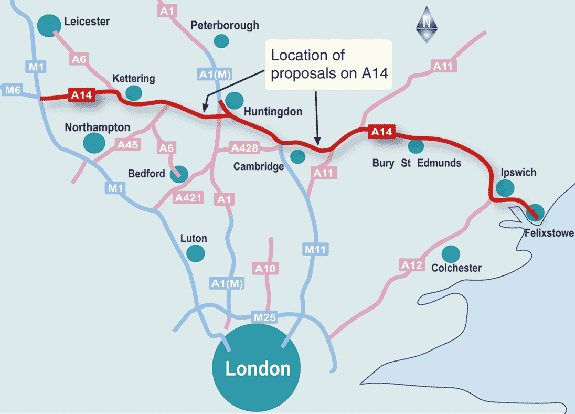
One of the largest new road project proposals in the UK is a £1billion proposal to upgrade the A14 highway.  The project has the following components:
  • A new dual carriageway to the south of Huntingdon between Ellington and Fen Drayton with three lanes in each direction (except between Ellington and the A1, where only two lanes would be needed);
  • Widening of the existing A14 to at least three lanes in each direction between Fen Drayton and Fen Ditton;
  • Local access roads alongside the widened A14 to separate local and strategic traffic;
  • Major interchanges with the A1 at Brampton, the existing A14 at Fen Drayton and the M11/A428 at Girton.
The importance of the A14 may not be obvious, but it is essentially the key link between the busy port of Felixstowe (and the nearby port of Harwich) and the West Midlands, including Britain's second (equal) largest metropolis - Birmingham.  The West Midlands is the location of a lot of logistics, warehousing and distribution points for England, so this route is busy with a lot of trucks.

Public funding for the proposal was suspended by the British government in October 2010 because of pressures on the UK’s budget deficit that saw almost all areas of public spending subject to review in order to cut spending.  The project is currently suspended.
Where Britain's next toll road might be - A14 in the East Midlands

As a result, the then Transport Secretary Philip Hammond has been considering transferring the entire highway (127 miles) from Felixstowe to Leicestershire to private ownership according to the East Anglian Daily Times. The intention being that the upgrade work could be undertaken, but with toll funding.  A final report to government on alternatives to 100% public funding is expected in June 2012.

However, the idea has not been embraced by many local residents, nor by local politicians even though they are from the ruling Conservative Party.  Local MP Dr Therese Coffey (Conservative) has expressed concern, whilst another local MP, Daniel Poulter (Conservative), is concerned about people avoiding the toll using roads through towns, increasing congestion.

It is understandable, given that tolling would almost certainly have to include the existing road, and so would have to be priced to avoid such diversion. Given the dearth of major highway toll roads in the UK, the likelihood is that more motorists would avoid the toll than would be economically rational, as the perception of the cost of paying a toll when one is not used to it, is likely to be higher compared to a situation where tolls are common.   The only other toll roads in the UK are crossings, except for the M6 toll (which bypasses a section of untolled motorway that is periodically congested).   I suspect modelling of demand for the A14 upgrade as a tolled route will be sensitive to the maximum amount of revenue possible vs. the costs of diversion.

Certainly full points for the British government for being innovative, but given the UK has some of the highest fuel taxes in Europe (with the equivalent of less than 20% of that revenue spent on roads), it will be unsurprising if tolling an existing road in itself is unpopular.

UPDATE: More details released on the preferred concept for tolling the A14

Monday, 17 October 2011

Copenhagen congestion charge looks likely with change in government

In August 2011 I wrote on how the debate on congestion pricing in Copenhagen has largely evolved from "whether" to do it, to "how" to do it.   The recent change of government in Denmark from a centre-right to a centre-left coalition means that it looks like the debate has moved further in that direction, which looks like the one reflected by Lord Mayor of Copenhagen Frank Jensen, and Mayor of Rødovre Erik Nielsen.  The new government supports introducing a congestion charge, but the Mayor says the exact location and price of the charge is still up for debate.

According to the Copenhagen Post they just want to debate the how, not the whether:

we are thoroughly convinced that far more people will benefit from the congestion charge through a reduction in the amount of time they spend on the road and in terms of a cleaner environment. Major investments in infrastructure and public transport will alleviate some of these inconveniences, but it is paramount that we discuss where exactly the borders of the congestion charge zone should be drawn in order for it to have the greatest possible impact and fewest possible inconveniences for people living in the region. A congestion charge is a way of financing major improvements in our transport infrastructure. By improving public transport and lowering ticket prices, we hope that many commuters will transfer from privately owned vehicles to public transportation so that the Copenhagen air will be cleaner and the city will be more accessible for everyone

So there is a strong belief that the charge will be transformational for Copenhagen, which may well be true. It is not a timid vision

The Copenhagen Post reports some details about what a charge would look like:

by 2012 toll facilities would be set up at the city’s northern edge, along Ring Road 2, and through inner Amager to the south. Fees to enter or leave the zone would vary depending on the time of day, but according to the proposal rush hour fees would be 25 kroner (US$4.66). The yearly cost to a commuter crossing the toll ring daily during the rush hour would amount to 11,100 kroner (US$2,069).

Concept for Copenhagen congestion charge
The map on the right is a depiction of what the cordon would look like and is what Tetraplan consultants modelled for the charge.


A study by Tetraplan consultants shows that a congestion charge can reduce road traffic by 23 %, air pollution by 5 to 10 % and CO2 emissions by 10 to 15 %.

The Social Liberal Party argued that there should be national road pricing by distance using GPS.  The Copenhagen Post also quotes an expert who also is not keen on the cordon:

Harry Lahrmann, a traffic researcher with Aalborg University, also argued that road pricing is a more effective solution and that the congestion charge would create more traffic from motorists taking detours.

“Experience from England and Sweden suggests that while traffic within the zone decreases, it increases outside it,” Lahrmann said. “Motorists will still be queuing on the Køge Bay Motorway if a congestion charge is introduced. Road pricing using GPS is the only real solution.”

However, with the change in government it appears that there is a far greater chance of this solution being implemented.  This is despite criticism from motorists' lobbying group FDM, which argues that car drivers in Denmark are already heavily taxed (with 25% VAT on the purchase price and a 105% purchase tax on vehicles up to a price of around US$14,000 (180% on every DKK above that)).  The Danish Chamber of Commerce claims that the charge would damage trade and business in Copenhagen.

Criticism is lining up according to the Copenhagen Post, as one survey indicates only a third support the idea.  The Danish Construction Association claims it wont be financially viable until 2025.  The Copenhagen Post reported that traffic and pollution expert KĂĄre Press-Kristensen from the Ecological Council, told Politiken newspaper that the zone would have a negligible impact on fine particles air pollution, which can cause respiratory illnesses...If the goal of the congestion zone is to reduce pollution, then I’d have to say that as it stands it won’t have much effect. I would anticipate that pollution will drop by between seven and ten percent, with a five percent margin of error".  One reason being that Copenhagen already has good air quality.

The Copenhagen Post itself thinks the better option is national road pricing saying wisely:

a more equitable way to accomplish the same goals would be a national road pricing system that charges drivers based on where, when and how many kilometres they drove, rather than on whether they crossed an arbitrary line.

Another benefit road pricing has over a congestion charge is that it could replace the current tax and registration system, which punishes car ownership, not car use, and makes it cheaper to buy new, fuel-efficient cars. Due to the high purchase price of new cars, Denmark currently has the oldest average age of cars on the road of any country in Europe. Moreover, its “weight charge” puts relatively heavier, but more efficient, hybrid cars well out of the price range of the average family.


The Copenhagen Post is right, but road pricing should not exclude congestion pricing as well.  It's solution that distance charging should be done by odometer is mistaken, because that is fraught with enormous potential with fraud (New Zealand's experience with light vehicle road user charging, which I am familiar with, shows the risks of that approach).   However, is it not refreshing that a major newspaper is arguing about how to introduce road pricing, rather than simply opposing it?
  
What intrigues me is the statement that the charge will in part be used to subsidise lower public transport fares.

Two billion kroner (US$373 million) total is expected to generated from tolls, however, and this money would be put towards reducing the price of public transport by 40 percent, resulting in an average savings of 5,192 kroner (US$968) a year.

The advocates of congestion charging in Copenhagen are hoping for a major mode shift, and given they are advocating reducing public transport fares, this is likely to happen. Yet this doesn’t appear to be economically rational.

The fundamental reason why urban public transport demands subsidies is because much of the capacity is needed only for peak trips largely in one direction. During interpeak periods, between half and three-quarters of public transport network capacity sits idle. The subsidies effectively meet this, and the economic justification is because, in the absent of efficient road pricing, car commuting is underpriced at peak times. Once peak time car commuting is efficiently priced, it will in itself encourage more trips to go by public transport, but there is then a case for increasing fares so that those users now pay the full costs of their trips.

In short, setting aside social policy reasons for public transport subsidies, the economic efficiency argument for urban public transport subsidies is eroded when you have congestion charging because you no longer need to price public transport cheaper than car traffic through subsidies. The congestion charge should price road traffic at a rate to ensure the network operates efficiently.

Beyond the economics, I believe the Copenhagen Post is right in pointing out that communication to the public is critical.  Motorists need to get something in return, which means that at least some of the revenue should go to improving roads, or in reducing some motoring taxes (in particular, Denmark's punitive tax on new cars must have a negative impact on those wishing to buy new more fuel efficient cars).  I have watched how failed communications strategies and overall strategies brought down plans for congestion pricing in Edinburgh and Manchester.  Copenhagen needs to learn the unpublished lessons learnt from those disasters.

Some of them are:

-  Get your concept well designed, ensure it does reduce net congestion, that it targets congestion well and does not have too many exemptions;
- Decide what you will do with the net revenue, and make sure motorists get some of it back in some way;
-  Take charge of the communications strategy and make sure you spend good money on leading the clear simple messages of the proposal and you can answer all of the critics;
-  Spend good time talking to business and road user groups, make sure they understand what your objectives are and why you are choosing the option you have selected;
-   Don't get blinded by technology, be clever with vendors.

I hope Copenhagen can find a solution that meets its needs, but I would urge it to avoid using charge revenue to cut public transport fares, or to ignore giving motorists anything at all.   I have sympathy for the view that perhaps a distance based approach could create less distortions, but there is no reason why a small area charge can't deliver some benefits for the city.  However, the solution should not be dictated by what economic modellers can model, traffic engineers can imagine or what looks elegant on a map - it should be determined by whether it can deliver net benefits to the city.

I suspect the next four years for road pricing in Denmark will be interesting indeed.  For not only does the new government want to introduce congestion pricing in Copenhagen, but it wants to introduce road pricing for trucks across the country.  More on that later.

Selection of articles on toll road privatisation, all in opposition!

Several articles that have drawn my attention:

Minnesota law review gets political on privatisation

According to the Newspaper
, the Minnesota Law Review published a critique by Julie A. Roin that argued such deals have more in common with the medieval practice of tax farming than true privatization.

She apparently cites the case of leasing Chicago's parking meters as somehow being enough evidence for the conclusion: Roin wrote. "The upfront payments received by jurisdictions entering into privatization agreements... are, at best, the present value of what would have been future tax (fee) revenue. Rather than true privatization transactions, it is more accurate to describe these deals as loans repayable out of future governmental revenues."

This isn't law, it isn't even sound economics, it is politics. Selling or leasing an asset is just that - a trade of value for value. She advocates new laws to control the prices paid, but quite why there should be laws to govern government decisions on asset sales or purchases is unclear.

Roin suggested better legislation would protect future taxpayers by forcing any such deals to escrow funds equal to the amount of taxes or fees that would have been generated by the leased asset. These funds would be released year-by-year so that the present generation would not be borrowing from a future generation. Roin argued that without some limitation, such deals would grow more intrusive.

However, would she argue that taxpayers be protected by requiring politicians to spend their money in ways that would always generate greater value than if taxpayers had the money themselves?  Would she argue a similar test for when governments buy assets?  Would she argue that governments borrowing always identify how they will generate net revenue to repay debt?  No.  Perhaps she should stick to law, and not politically motivated attempts at regulating economic policy of governments?

Ohio Turnpike privatisation

Debate on the proposed leasing out of the Ohio Turnpike is heating up.

Marilou Johanek in the Toledo Blade claims that a private owner might "mean cutting corners on maintenance to save money, or raising tolls to pad company profits? What safeguards would guarantee protection of the public against unscrupulous vendors?".  What happens now with road maintenance?  Don't untolled roads in many places face this?  The safeguard on tolls is to restrict increases to inflation, and for people to consider diverting to other routes.   Yes there should be debate on ensuring maintenance standards can be reached, and tolls not increased beyond certain limits.

Various State Representatives from the Democrat Party, according to the Toledo Blade, claim that "the long-term lease would amount to selling off a public asset paid for over decades by taxpayers, and could lead to a loss of turnpike-related jobs and an increase in toll fees."  Well yes it would be a sale, but it would amount to avoiding debt that taxpayers would have to pay too.  The loss of jobs may occur if it is not efficiently run, but that does not mean it shouldn't happen.   Should taxpayers run a toll road as an employment programme? 

Ohio Democratic Congressman Tim Ryan said, according to WKSU, "The road probably won’t get taken care of,"..."And I feel like that’s really a tax on business, as we’re trying to develop and make Ohio competitive. If you say, ‘Hey, if you’re using the turnpike, at the end of the day, you’re going to be paying double the tolls.’ That’s really an anti-business move quite frankly".   He is uninterested in evidence of privately owned toll roads elsewhere which are well maintained.  Double the tolls would be a concern, but what evidence is there that this will happen?

Thursday, 13 October 2011

Peak free - or the opposite of congestion charging #2 - Spitsvrij

Last week I wrote about Spitscoren, the trial in the Netherlands that pays motorist to not drive on a highway at peak times.  Effectively a congestion charge in reverse. The key foundation of the project, (which is an integration of telecommunications, tolling related technologies, e-commerce/payment systems and customer management) is to pay selected motorists for not driving in the peak, and the provision of tailored information to motorists through smartphones. An application on the phone gives trip alternative options, there is a service to facilitate carpooling and teleworking is facilitated through  a free flexible remote office that can be used by anyone on the scheme.

Recently launched is a second similar project, called Spitsvrij (Dutch only website). The project lasts till the end of December 2012.  It is in the Utrecht region of the Netherlands, bounded by the A1, A27 and A28.  The intention is to sign up 5,000 motorists (2,000 through their employers) to participate.   This time, network usage is to be monitored by On Board Units (OBUs) on vehicles backed up by Automatic Number Plate Recognition (ANPR).
Spitsvrij area of operation

This time motorists get credit at the start of the month that may range between €30-€120 (US$41.50-US$165.47), which has money deducted from it depending on driving behaviour during that month.  Each trip at peak times in the region may cost between €1.50-€3 (around US$2-$4) off the credit.  The incentive is obvious.  The less you drive the more you keep.   Again the alternatives are to not take a trip, drive off peak, use public transport, motorcycles, cycling or walk or carpool (with someone without the unit).   A maximum of €100 can be available at the end of the month for the participant to use.

In additional to supplying the on board unit and e-commerce systems, the Spitsvrij project offers a smartphone travel app (but unlike Spitscoren no actual phone) with a carpooling database (to facilitate people carsharing) and customised alternative travel options.  The project also offers teleconferencing workshops and teleworking kits to support employers that participate, with a loyalty programme for such employers.   The intention is that it be a long term solution to managing congestion within the area, with a major emphasis on supplying intelligent and personalised travel information (including options and traffic conditions) to users through a website, smartphone app and the installed OBU in the car.  Meanwhile, participants (who like the Spitscoren programme are invited on the basis of being identified as regular motorists at peak times) keep track of their credits and are incentivised to not drive.   The minimum usage required to be able to participate is to have been a continuous user of the roads in the area at least 25 times during peak times over a 5 week period.  If a motorist qualifies he or she may join.

It is led by the Province of Utrecht and the Ministry of Infrastructure and the Environment.

BNV Mobility formed and leads the operations, development and implementation of this project together with Goudappel Coffeng and Technolution.

Apparently at least 50 employers are now participating, encouraging their own employees to join (and the employers get a financial benefit, although how much that is, is not yet clear).

The peak times are 06:30-09:30 and 15:30-18:30.  A trip of up to 5km can be undertaken without risking a loss of credit, to enable trips to be taken for school runs or to drive to park and ride facilities.

Installation of the GPS based OBU is done professionally and takes one hour.  A key part of the system is that it only measures distance travelled within the "credit area" concerned and during peak times.  It does not operate outside those times and when it detects departure from the "credit area".

An important dimension for the Netherlands is that privacy is secured, with no details onsold, and no records kept beyond what is necessary to credit for lack of use.  In essence, if you have it installed and never drive during the peaks, it wont ever notify the system.

The project was officially launched on 7 October by the State Secretary for Transport, Melanie Schultz van Haegen.
  
Again, another fascinating project that is the opposite of congestion charging.  This time it isn't just one road, but a whole area that is subject to the system.  The other interesting variation is the use of an OBU using GPS to measure and identify when participants drive in the zone, and for how long to determine the extent to which they keep or lose credits.

It is far too early to say what the results are, but if this is as promising as the Spitscoren project, it would appear to provide an excellent example of an alternative approach for cities or regions seeking to manage congestion, in a way that is far more politically palatable than introducing congestion pricing.

Tuesday, 11 October 2011

LA follows San Francisco with variable parking pricing trial

I reported in July about San Francisco’s innovative intelligent parking trial called SF Park. It means that kerbside parking in a part of downtown San Francisco is now subject to a form of dynamic pricing whereby the prices are set to ensure that parking is always available on every block. As a result, prices at times of highest demand are set higher than at other times. Prices are not truly dynamic, but are varied monthly.

Los Angeles is about to trial the very same in downtown LA according to the LA Times and Streetsblog (which both have useful articles about the concept). It is to be called ExpressPark. 

The website says:

A 4.5-square-mile area in Downtown will support ExpressPark™, a one-year pilot program that will infuse technology and demand-based pricing into an innovative parking management strategy. Created with $15 million in grants from the U.S. Department of Transportation and $3.5 million in City funds, the project will test ways technology can help the City realize its goals to increase the availability of limited parking spaces, reduce traffic congestion and air pollution, and encourage use of alternative modes of transportation. ExpressPark™, one component of the Los Angeles Congestion Reduction Demonstration, is set to operate beginning Spring 2012.

The LA Times says it “will use not only new meters but also a network of wireless pavement sensors to keep track of parked vehicles in real time. The sensors will help transportation officials determine which meters are in use and which have expired. Eventually, roadside signs will guide motorists to empty spaces in municipal parking garages and lots.

In other words, when parking demand increases, meter rates increase; when demand drops, rates drop.” …"What we're striving for is pricing such that 85% of meters are occupied and 15% are open," said Peer Ghent, senior management analyst with the meter operations division of the city's Department of Transportation, or LADOT.

Good stuff, it combines maximising availability of parking for businesses located in the city and for those seeking a park, while reducing congestion because it eliminates those circulating for long periods looking for parks, as well as deterring those driving at times of peak demand. 

Area of LA parking pricing trial
5,500 on street metered spaces and 7,500 unmetered public spaces in off-street city owned parks are included in the trial. 

The LA Times continues:

Meter rates downtown now range from $1 to $4 an hour. Under the ExpressPark pilot, the prices would be adjusted, probably once a month, but would rise or fall no more than 50% at a time, officials say. Bruce Gillman, an LADOT spokesman, said the city took in $33 million from parking meters in the most recent fiscal year. What effect ExpressPark will have is unknown because revenue will rise in some areas and shrink in others.

The new pay stations and meters popping up throughout the city are harder to thwart. Even if the coin slot is clogged, motorists have the option of paying by credit card. It will no longer do to place a plastic bag over a broken meter and pray.


Some of his points include:
- If ExpressPark is eventually extended to other parts of the city,I think many meter rates will go down. Two years ago the city doubled meter rates everywhere, and I’ve since seen entire blocks where there isn’t a single car parked at a meter. The prices should come down on these blocks. In other words, the city applying a purely administrative approach to setting prices has proven ineffective, this approach should be optimal for utilisation, and potentially revenue.

- Pasadena returns all of its meter revenue to pay for added public services in the metered neighborhoods, and Old Pasadena is a good example of the benefits. Old Pasadena was until the 1980s a commercial skid row and now it is one of the most popular shopping destinations in Southern California. Parking meter revenue helps to explain that success. The meters, which were installed in Old Pasadena in 1993, bring in $1 million a year to spend on in added public services in just that little shopping district. The meter money paid to replace all the sidewalks, streetlights, street trees, and street furniture. It paid to clean up the alleys and put electric wires underground. The meter money also pays to pressure wash the sidewalks twice a month and to provide added police services. If LA adopted Pasadena’s parking meter policy, all of our business districts would be much more prosperous. Residents of LA would not have to go to Pasadena or Santa Monica or Culver City to walk around in clean and safe environments.

Basically hypothecated parking revenue being recirculated into improving the entire road corridor environment for all users.  It can fix road surfaces, lines, signs, traffic signals, lighting, street furniture and facilities for pedestrians.  It is crucial in my view that if parking pricing is to be adopted, that those paying and those living and working in the zone should see direct benefits from the revenue raised.

- San Francisco started its program, called SFpark, this year and last month it made the first price adjustments based on occupancy rates. Prices stayed just the same for 37 percent of the meters, increased for 32 percent, and decreased for 31 percent.  Which simply indicates how difficult it is to predict demand accurately!

- The main problem we already have in L.A. is the widespread abuse of handicapped placards. A disabled placard in California is like a “free parking” pass for the entire state. One of our students just finished his Masters thesis on placard abuse in downtown. He surveyed one block on Flower Street where there are 14 metered parking spaces. Most of the spaces were filled most of the time with cars that had disabled placards. For five hours of the day, all fourteen spaces were occupied by cars with disabled placards. A problem not unknown elsewhere. In the UK it is the "blue badge" problem. Finding a solution to the holes in disabled parking schemes needs to be a parking policy priority.

- Shoud concludes "The poorest people can’t afford cars, and they won’t pay anything for Express Park. Their lives will improve because the city will have more money to pay for public services and the bus system will run better. The buses that they ride in won’t be mired in traffic caused by cars cruising for parking."

Quite.  It will be interesting to see if both San Francisco and LA encourage other cities to be cleverer about parking pricing and technology.  In the absence of congestion pricing (and indeed even with it), it provides a fascinating solution to the problem of optimising parking use, and reducing vehicle circulation by those seeking parking spaces.  The next step forward is surely pricing that is dynamic by the hour, not the month, with mobile phone applications that enable prices to be instantly available, or even for spaces to be booked?

Seattle's SR 520 floating bridge to have congestion pricing tolls

In December 2011, the existing "Governor Albert D. Rosellini Bridge—Evergreen Point", in Seattle, will have tolls reinstated. The original bridge was built in 1963, with the toll removed in 1979. It is the longest floating bridge in the world being over 2.2km long and it reaching the end of its useful life. It closes in high winds and is at risk of collapse in an earthquake. It currently carries around 115,000 vehicles a day.   Vehicles using the current bridge will be untolled until the new bridge opens (and tolls will be instituted on that bridge).

Seattle's floating bridge (blue) connects the city with Redmond
A new bridge is to be built with six lanes, two of which are for bus rapid transit and HOVs, maintaining the general traffic capacity of the current bridge. It is currently a major bottleneck and curiously features peak travel in the direction AWAY from Seattle during each peak, because it is the best route to Redmond - the home of Microsoft.  It will cost $4.65 billion.

Tolling is intended to be fully electronic free flow using the DSRC system branded "Good to Go" by the Washington State DOT (using the long standing 915MHz technology).  

Vehicles without a "Good to Go" tag will be expected to pay within 72 hours, or receive a bill through their address identified through automatic number plate recognition.   Customers have a choice between having the prepaid tag, registering as a number plate customer, or simply waiting to get a bill in the mail (the latter costs an additional $1.50 per trip).  Outlets for "Good to Go" include online (a tag is sent in the post), retail outlets and customer service centres.  All options, except setting up an account at a customer service centre (where cash is allowed) require credit or debit cards, or bank account details.  Accounts must be opened with a prepaid balance of $30 with top ups required when balances drop below $8.

However, there has been some trouble with the installation of the toll system on the existing bridge.  The Seattle Times reports that Texas based Electronic Transaction Consultants have faced some difficulties, having promoted early sign ups to "Good to Go" earlier this year, but being then it "ran into problems, both with sluggish customer service and with the technical challenges of counting tolled trips and merging those into a new statewide toll-accounting system". It has had $2 million deducted from its contract worth $23 million for the delays.   The company claims it is unusually complicated because it is integrating with "Good to Go" which is run by the state for two other toll facilities.

Besides the point of tolling an existing old bridge to pay for a new one, what else is interesting is that the tolls wont be a standard flat rate.   The rates will vary as follows (for cars with tag accounts):

 WEEKDAYS
midnight-5am                   Free
5am-6am                           $1.60
6am-7am                           $2.80
7am-9am                           $3.50
9am-10am                         $2.80
10am-2pm                         $2.25
2pm-3pm                           $2.80
3pm-6pm                           $3.50
6pm-7pm                           $2.80
7pm-9pm                           $2.25
9pm-11pm                         $1.60
11pm-midnight                  Free

WEEKENDS

midnight-5am                     Free
5am-8am                             $1.10
8am-11am                           $1.65
11am-6pm                           $2.20
6pm-9pm                             $1.65
9pm-11pm                           $1.10
11pm-midnight                    Free

As you can see, it shows some interesting demand patterns.  I wonder if motorists will understand that degree of complexity at first, but the pricing itself is quite elegant.  Timed to manage any bunching of demand either side of the peaks and during the day.  Weekends are more interesting, with the higher rate matching steady day time demand. 

What this means, of course, is that Seattle is getting congestion charging, albeit on the tolls on this one crossing.  It looks sophisticated from an economic point of view, and the bus rapid transit system will offer an alternative for some.   I will look forward to see how the tolling affects congestion on the existing bridge as a prelude to what may happen when the new one is built.