Showing posts with label Cambridge. Show all posts

Monday, 11 September 2023

Cambridge cancels congestion charging and it isn't a surprise

I wrote in March 2023 about Cambridge's ambitious proposal for what it was calling a "Sustainable Travel Zone", but which was actually a congestion charge, and how it was not going well.

Well the BBC has reported that it has been cancelled, less than two weeks after revised plans were suggested that ought to have been the original plans in the first place.

I criticised the original proposal because its scale and scope were too ambitious, and because it offered little for those who would pay, as it was primarily designed as a revenue raising scheme, which had its scope defined by the amount of money local politicians wanted to raise to uplift the quality of its bus service.  £50 million was to be spent enhancing services.

As a revenue raising scheme that was also described as being intended to "reduce traffic" it is hardly surprising that those who faced paying didn't see what they would benefit from, especially as few could envisage how the proposed improvements to bus services were "better" than their own cars, and there was next to no effort made to sell the proposal on the basis that it might improve travel times for those who still drive.

From that objective came a scheme design that was blunt and ill-focused.  Why?

  1. It was designed as an area charge, like central London's congestion charge, so there could only be a single charge per day regardless of how much driving was undertaken.  Those who undertook a single trip would pay the same as those driving commercially throughout the day.  
  2. The area charge encompassed ALL of Cambridge. It effectively made the entire city into a congestion charge zone, regardless of how busy any streets were at any time, it priced the city for access, so those who drove towards the central city (who likely had other transport options for their trip) paid the same as those crossing from one side to the other (which would typically involve a less direct public transport trip).
  3. The charge would apply all day, from 0700-1900.  So there was no effort to focus on peak charging at all, or focus on congestion.  Although it would initially only apply in the AM peak in 2025 to commercial vehicles it would expand to all day operation from 2027 for all vehicles that would not be exempt.
  4. HGVs would pay exponentially more than cars, at £50 per day (perhaps £25 if zero emission) compared to £5 for cars.  It's unclear how Cambridge expected to function effectively by treating HGVs as if they take up 10x the road space of cars (and have no modal substitute) when they actually take up 2.5-3x the road space of cars.
There was a proposal for a low-income discount for some drivers, along with exemptions for those attending medical appointments and a range of other categories. However, much of this did not seem to help much with the public perception.

The public response to the proposals was highly negative, with protests, a petition and debates, plus the local election in 2023 seeing the Conservatives (who oppose the proposal, as it has been advanced by the Labour led Council) win a seat on the Council.

I suggested the proposal be scaled down, to peak only charges (with a half-price shoulder period), cordons rather than area charges (and two cordons, one around the city centre and one around the city edge) and a lower multiplier for heavy vehicles.  

Revised plans

At least one of those ideas was taken on board, with plans announced in August 2023 for peak-only charges (0700-1000, 1500-1800) and 50 "free days" for residents to be able to drive without charges, every year. A 50% discount would also apply to locally owned businesses using HGVs and vans, and a 50% discount for people on low incomes.

The revenue to be collected would only be £26 million per annum, but would be enough to implement significant bus improvements. Perhaps had the scheme been scoped like that from the first place, it might have had a chance of being implemented. 

However, it has since been abandoned altogether, not least because the Liberal Democrats have withdrawn support. The Liberal Democrats govern the neighbouring South Cambridgeshire District Council (which surrounds the city of Cambridge) and lead the Cambridgeshire County Council. As the proposed congestion charge has to be agreed by the Greater Cambridge Partnership Assembly (which includes representatives from multiple local authorities), it would be difficult to see it proceed without their united support.  The Liberal Democrats asked for a "pause" to investigate other sources of funding to upgrade the bus system. 

It appears this reflects increased national antagonism at measures which appear designed to penalise driving, and concern about the political fallout of supporting such measures at this time.

 Collapse and what now?

The final collapse of the concept came when the Labour group on Cambridge City Council withdrew support, out of concern for impacts on low income families. This is clearly not assuaged by the proposed 50% discount for low income households or the proposed 50 "free" trips permitted per annum for residents. What this all appears to be is a political reaction to a response to proposals that did not convince the public.

The Councils all still wish to upgrade bus services, and are not opposed to the fundamental objectives, but it is not clear how they proceed, short of recasting the whole scheme to include something  for those who drive.

I'm not surprised it has all faltered, in part because notwithstanding much of the public's stated interest in addressing environmental issues including climate change, there is much less enthusiasm in paying more in what are seen as taxes to pay for services that they do not see as benefiting them.

Assuming Cambridge still wants to proceed it needs to re-evaluating its policy around road charging to think more about one question - What will road charging do for those who pay?

There are two clear answers to this which it should consider:
  1. What travel time savings and improvements in trip reliability will the system be designed to achieve?
  2. Can some of the revenue be used to improve the road network, whether by addressing deferred maintenance or improving some bottlenecks or safety issues in the network?

Could Cambridge get a road pricing scheme it could accept?

This requires a very different mindset from that which treats pricing existing road users as a useful tax to pay for alternatives only. It doesn't mean that revenue cannot be used to support improving public transport and cycling, but it does mean that first and foremost pricing be used to improve the level of service of those who pay.
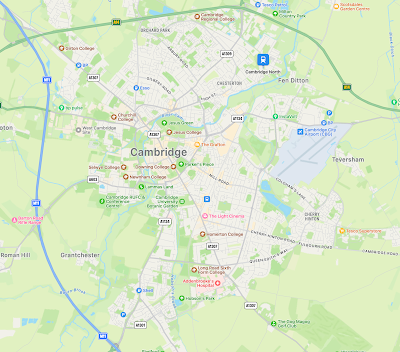


Cambridge

If the scheme were redrawn to be cordon based, or even zonal based, at peak periods only (and only in respective directions of travel) there would be a chance it could be focused on congestion and improving travel time reliability.  Cambridge has an awful road network for motorists seeking to avoid driving towards the centre to travel from one side to the other, (for example consider driving from the northwest to the southeast without following the city centre ring route) no doubt because local politicians didn't think that was important. It might help to think about the extent to which pricing should be focused on congested routes, particularly those with viable (or soon to be viable) competing public transport options.

A city centre cordon would be a reasonably elegant start, followed by a peripheral one that enabled vehicles exiting the M11 or A14 highways to avoid Cambridge altogether, or a few strategic charging points on bridges over the River Cam.  Pricing ought to reflect road space occupancy, so none of the 10x multiplier for HGVs, just make it 3x, with 2x for smaller trucks.  If pricing only operates at peak times there is less need for discounts and exemptions as well.

The use of revenue is important as well. Whilst Cambridge won't want to be seen to be replacing spending on maintenance with revenue from a congestion charge, it could consider whether deferred maintenance could be addressed or better yet, some small scale highly efficient road improvements that may make intersections work more effectively or address other localised bottlenecks or safety issues.  Using road pricing revenue for economically efficient road improvements is a net positive for the community, and with pricing there should be no concern about inducing demand, but rather improving the efficiency of the travel of those needing to use the roads. This means buses too, as well as light commercial vehicles, freight delivery and the like.

However, I fear that the ambition and the failure to recognise the need for road pricing to give something to those who pay has "poisoned the well" politically around the very philosophy of congestion pricing.  This is hardly surprising, as far too many of the advocates for pricing do so from an antipathy to private motoring, rather than seeing it as a tool to make roads operate more efficiently, and so be an opportunity to improve all travel.  It should not be a surprise to find that people who drive don't like paying more for what appears to be no benefit to them at all.  I would have thought the lessons of the failure to proceed with congestion charging in Edinburgh and Manchester 20 and 15 years ago respectively (and indeed the failure to even expand London's congestion charging scheme) should have been learned.

Monday, 29 May 2023

Consultation on Cambridge's Sustainable Travel Zone reveals widespread opposition

I wrote a couple of months ago about how poorly plans for a blunt congestion charge for Cambridge (UK) were going, in terms of public response, and this seems to be continuing following publication of the results of formal public consultation into what is being called a "Sustainable Travel Zone".

The Sustainable Travel Zone would be a single area charge (£5 for cars but much more for trucks) across virtually all of metropolitan Cambridge, which would operate 12 hours a day weekdays only. It would legally be a congestion charge, and would effectively emulate London, except for its scale of operation. Whilst the London congestion charge only affects a tiny proportion of greater London (separate from the Ultra Low Emission Zone), the Cambridge Sustainable Travel Zone would affect all of Cambridge. Why? It would appear to be to ensure that it would raise enough money to pay for the significant increase in bus services.

Rarely have congestion pricing schemes ever been publicly accepted if sold on the basis that it is about raising money (effectively a sophisticated form of tax) rather than reducing congestion. The record in the UK is that several cities have attempted to progress congestion charging on the basis that it would raise a lot of money for public transport (see Manchester and Edinburgh), and been rejected by the public.

By contrast, congestion pricing has been successfully advanced in Stockholm because it was about reducing congestion, whereas it saw considerable opposition in Gothenburg because that is about raising revenue. It is difficult, although not impossible to get support for such a scheme as a revenue raising instrument, but it would appear to be that people in Cambridge are not warm to the idea.

Cambridge News reports that although 70% of the population supported the transport improvements, 58% opposed the Sustainable Travel Zone/congestion charge. Only 34% supported the Sustainable Travel Zone as proposed. 

Another report breaks down the results in more detail:

61% of those aged 16-24 who responded to the consultation were in favour of the charge

64% of those aged 55-64 opposed the charge.

Of those living within the proposed zone boundary, 49% were opposed and 46% in favour.

Those living outside the boundary were 60% opposed, 32% in favour.

Key concerns expressed were those wanting more exemptions, thinking the £5 charge was too high and thinking residents should have an exemption.  Many wanted Addenbrooke Hospital excluded from the zone. 

So what now?

29 June is the date when the Greater Cambridge Partnership meets to consider what to do next. It could just plough on, but it may be better to think about some of the ideas I wrote about before on how to phase in charging.

  1. Just introduce it in the AM peak only at first, in part to demonstrate the effects, but also to encourage some time-of-day shift in travel (which many would rather do compared to shifting mode). It would also give some idea of the elasticity of demand in the AM peak for driving to better inform forecasts for revenue. Sure it won't be enough revenue longer term, but then the improved public transport package can be focused on the peaks instead. Expand it to the PM peak later, as that would capture more traffic likely to mode-shift, rather than inter-peak traffic. 
  2. Replace the blunt area charge with two cordons.  One in the city centre (whether it is a tight city centre or one bounded by the effective ring roads of the A1303, A1334, A603), one at the proposed outer boundary.  This means people won't be charged for simply moving their cars short distances, and will focus attention on entering Cambridge and then central Cambridge. 
  3. Have a shoulder charge (at half price) for the first and last half hour to encourage time of day shift and provide more options for motorists.
  4. Dedicate some of the net revenues to some improve road infrastructure this means fixing substandard intersections, and although there will be resistance to using the money for maintenance (as it would reduce funding from other sources), some of what motorists pay should benefit them.
It is plausible that the full Cambridge scheme could be introduced over time, but any combination of the above ideas can provide a pathway of phasing it in. Say an inner cordon could operate 0700-1900 (with a half hour shoulder fee), but the outer cordon only 0700-1000 and 1600-1900.  


Thursday, 9 March 2023

Cambridge (UK) announced plans for a congestion charge - and it is not going well

The Greater Cambridge Partnership has announced plans to introduce a congestion charge for the city of Cambridge. This has been mulled for some years, and of course the record of UK cities introducing congestion pricing, beyond London and Durham has been a failure - primarily because the public has been opposed, so it will be interesting to see how and whether this actually gets implemented.

The Greater Cambridge Partnership is a public sector body set up between five local authorities and the UK Government to implement a City Deal - which is a partnership for funding infrastructure and development for the city using a mix of local and central government tax income.

It would be fair to say that the proposal has been highly controversial, and with good reason. 

The congestion charge zone has been labelled the Sustainable Travel Zone. I'd question whether rebranding something achieves much, as the public's scepticism can only be enhanced when a euphemism is used to describe what it actually is - it's an area which will have road pricing. 

What's the objective?

The objective expressed first in the consultation document is to raise money to spend on subsidising a significant improvement in bus services. The second objective is to lower the level of traffic.  The implication is that there would be reductions in congestion, but it would be wrong to infer this is about improving travel times for those who drive.

Where's the money going?

The proposed improvement in bus services includes simpler fares, more routes and more services, with 10 minute headways, more evening services and more services to rural areas. It certainly looks like a huge uplift in service, but of course someone has to pay, and the Greater Cambridge Partnership wants motorists to. £50 million a year is proposed to be spent, and the congestion charge is not to be introduced until most of the bus service improvement have been implemented. 

A big uplift in cycling infrastructure and improvements to encourage more walking, including secure cycle parking.

What are the details?

Proposed Cambridge congestion charging zone


Thursday, 20 January 2011

Cambridge discusses congestion charging... again

Before the financial crisis and recession in the UK, several cities across the UK (outside London) were investigating congestion pricing to raise funds and manage congestion. It was partly because the government of the day was linking new funding for local transport with requirements for local authorities to introduce forms of travel demand management, specifically congestion charging or parking levies.

However, a series of events saw that interest fold. Manchester foolishly held a referendum on its proposals, and voters overwhelmingly rejected congestion charging. Other local authorities lost interest, and as the previous government sought to win the 2010 election, more funding was made available for a range of transport projects without conditions previously discussed. So politics and economics effectively saw discussions of new congestion charging schemes effectively disappear.

Even Cambridge considered a city wide area charge, but it was rejected by the council over a year ago.

However, all local authorities in the UK are legally empowered to introduce congestion charging schemes on their own roads (not national highways controlled by central government or the devolved national executives). With central government budget cuts to local authorities as the newly elected government attempts to abolish the UK’s structural budget deficit in five years, some in local government are seeking ways to make up the difference.

So give Councillor Nichola Harrison (independent, former Liberal Democrat) some marks for bravery in openly suggesting that Cambridge introduce congestion charging, less than two years after it had last been rejected.

Her proposal is for distance based charging, varying by time, place and emissions rating, and for it to generate £120 million (US$191 million) of net revenue for the council. Charging would include off peak periods, and would likely involve options of motorists choosing either GPS based distance charging or prepaying an access charge validated through automatic number plate recognition.

She even set up her own website about her ideas, suggesting a £20 a week cap.

“Councillor Harrison proposes that £50 million could be spent on bus subsidies to create new routes and more frequent services.

Another £15 million is earmarked for highways maintenance and £30 million would be used for infrastructure projects.”

However there are many opponents. Some believe the roads are “already paid for” as if they are assets that never need renewal. However, a more valid criticism is from those who note that road taxation in the UK (fuel and annual ownership duty) generate many times the money that central government puts into roads. Motorists already feel overtaxed, and like any consumers who believe they already pay too much and don’t get value for money, they will resist paying more.

My view is that it is good to have this debate, it is good to advocate fully funding roads directly from charges from users that vary by time, place and vehicle type. The argument that central government will do nothing in the next few years of budget cuts is a strong one. However, the question is whether motorists are willing to pay more, and if so, on what basis. I doubt that most motorists, already paying 5x what is spent on roads, are willing to pay substantially more. As a result, I doubt that a majority of local body politicians will embrace this in the UK context.