Showing posts with label Technology. Show all posts

Thursday, 26 October 2023

Reactions in Singapore to ERP 2.0

Following the announcement of the roll-out of ERP 2.0 in Singapore (using GNSS-based On Board Units for congestion pricing), there has been some comment in the media in Singapore about the new system and policy around it. Some of this is likely to be relevant to other jurisdictions considering mandating such technology into motor vehicles.

What do motorists and car dealers think?

The Straits Times published an article on 25 October by Lee Nian Tjoe on what motorists and car dealers think.

Dealerships generally said that they were ready for the rollout, as some had been establishing how to conceal wiring and have the equipment installed in their vehicles, but some still were awaiting information...

Ms Tracy Teo, marketing director of Komoco Motors, which represents Hyundai, Jeep, Ferrari, Maserati and Alfa Romeo in Singapore, said the company is awaiting information and instruction from LTA on the next steps.

One of the key issues is that getting such equipment installed in a wide variety of makes and models may present challenges for some varieties of vehicles. 

Comments from members of the public approached by the journalist were largely questioning with some concerns, such as the location of the OBU on the side of the passenger footwell.  One objected to the system having capability to have stored value cards inserted given how technology had moved beyond that. 

The article describes how a fleet operator was used to test installation of 500 devices in a pilot.

Should it have been rolled out in the first place?

A second article from the website Techgoondu is critical of the new system.

Author Alfred Siew describes it as:

the unwanted rollout of a costly project that has taken nearly 20 years to complete, if you count its early efforts. It is clearly outdated and inconvenient for users. Many questions have already been raised about this “next-gen” ERP 2.0 unit when it was unveiled two years ago. Most damning was why it was even necessary.

Part of this is unfair, as it is not a 20 year long project, but it is certainly was being thought about 10 years ago. Singapore needed a new system because "ERP 1.0" was creaky and obsolete, and needed replacement.  It would have been cheaper to go all ANPR (Automatic Number Plate Recognition) based, but certain features would not have been available, and it could have simply been an update of the current technology.  However, Siew notes correctly that the "next-generation" features around traffic information are largely available through apps such as Waze.  Smartphones are able to be used as the in-vehicle display is optional, so the question becomes what it would have taken to make smartphones work?  The key issues around reliability and linking it to the vehicle remain, but this is being trialled in Brussels now.

Siew describes the system as old technology, with the stored-value cards which are increasingly obsolete and an in-vehicle display reminiscent of pre-smartphone navigation systems.  Of course many cars have automaker installed telematics with some key elements of the ERP 2.0 system included, although not available for congestion pricing applications. Making Original Equipment Manufacturer (OEM) telematics systems available and suitable for road pricing is perhaps the "rosetta stone" for ubiquitous road pricing in the future.  Unfortunately efforts to do this so far have been very limited across the globe.

Siew finally criticises it for being a system with the capability to introduce distance based charging, but that capability is not to be used as of yet.  That doesn't mean that it won't  be and it is entirely understandable that a policy decision to do that would not be announced until the entire system is installed and proven, but unless it is used, it seems like an expensive solution to what is just an effort to replace an old system with one with less intrusive roadside infrastructure.

Of course LTA had signed the contract for the ERP 2.0 system some years ago and became committed to the project, so it had to be rolled out.  Hopefully it will all prove to be worthwhile and operate successfully for many years to come.

Distance-based pricing is unlikely anytime soon

Newspaper Today online published an article by Loraine Lee on 25 October saying that it was unlikely LTA would implement distance based pricing soon.

Key issues identified were:

  • How to apply it equitably, including the future of fuel taxes and vehicle registration/ownership taxes, so that those that travel the most are not paying disproportionately compared to what they do now.  
  • Questions over the location accuracy of the technology in parts of Singapore with tall building, and with tunnels (the latter is not a real issue, as systems elsewhere can clearly note when vehicles travelling on a road disappear and reappear at another location, that they must have been in the tunnel on that route). 
  • Need to consider the wider impacts of a shift towards distance-based charging on some road users.
The accuracy issues can certainly be addressed, as they have been in other GNSS-based road user charging systems in Europe, the United States and New Zealand, but the policy issues about Singapore's mix of taxes require some further work to disaggregate.  Clearly fuel taxation will be eroding due to the emergence of electric and hybrid vehicles, and a shift from ownership based taxes to usage based taxes is likely to increase car ownership, but reduce distance travelled by car and congestion, so some modelling will be needed to forecast the impacts on Singapore's traffic (and vehicle fleet size).  

The key point is the new system will provide options, and it would be a poor use of the technology to not have some form of distance based charging or at the very least use it to implement more 'virtual gantries' for pricing.  

Time will tell whether other cities will copy Singapore technologically (they should copy parts of it in terms of pricing policy), my suspicion is that the inclusion of a slot for stored-payment cards is unlikely to be replicated, nor is a in-vehicle display, but the core of the technology still has merits.  The options for using GNSS-technology for congestion pricing are:
  • Purpose built OBUs for professional installation in vehicles
  • Scaled down "self-installed" OBUs
  • OEM telematics 
  • Smartphones
Singapore has chosen the first, we will see if the next GNSS-based congestion pricing system selects an alternative.

Wednesday, 25 October 2023

Singapore launches ERP 2.0... finally

The Straits Times reports that Singapore has, finally, announced to roll out of its ERP 2.0 On Board Units (OBUs) over then next two years. Starting in November 2023, fleet operators will get OBUs installed in their vehicles, and from no later than April 2024, new vehicles will have the new OBUs installed.  Remaining vehicles in Singapore will be required to have the OBU installed based on date of registration over the subsequent two years.  

Installation is estimated to take three hours for a car.  All motor vehicles in Singapore will be required to have the new OBUs, including motorcycles (which have a smaller single unit OBU).  Installation will be free of charge if done within a two month window specified by the Land Transport Authority (LTA) (notified to the registered vehicle owner in advance). 

Payment options will remain the same including direct debit of credit or debit cards, or use of prepaid stored value cards (which can be inserted into the base unit of the OBU).

The car unit is in three components:

  • Processing Unit
  • Antenna Unit
  • Touchscreen Display
The image below is the official depiction of the ERP 2.0 installation.

Singapore ERP 2.0 OBU for cars

The touchscreen display is optional, as motorists can choose to use their smartphone which will deliver road pricing and traffic data through a choice of three apps. 

The report notes why the LTA did not choose smartphones as the processing devices:
  • Security for real-time charging transactions from prepaid stored value cards
  • Reliability, given the range of smartphone models and operating systems available (including older models)
  • Concern over ensuring whether an app is functioning, the smartphone is sufficiently charged and is connected to the mobile network.

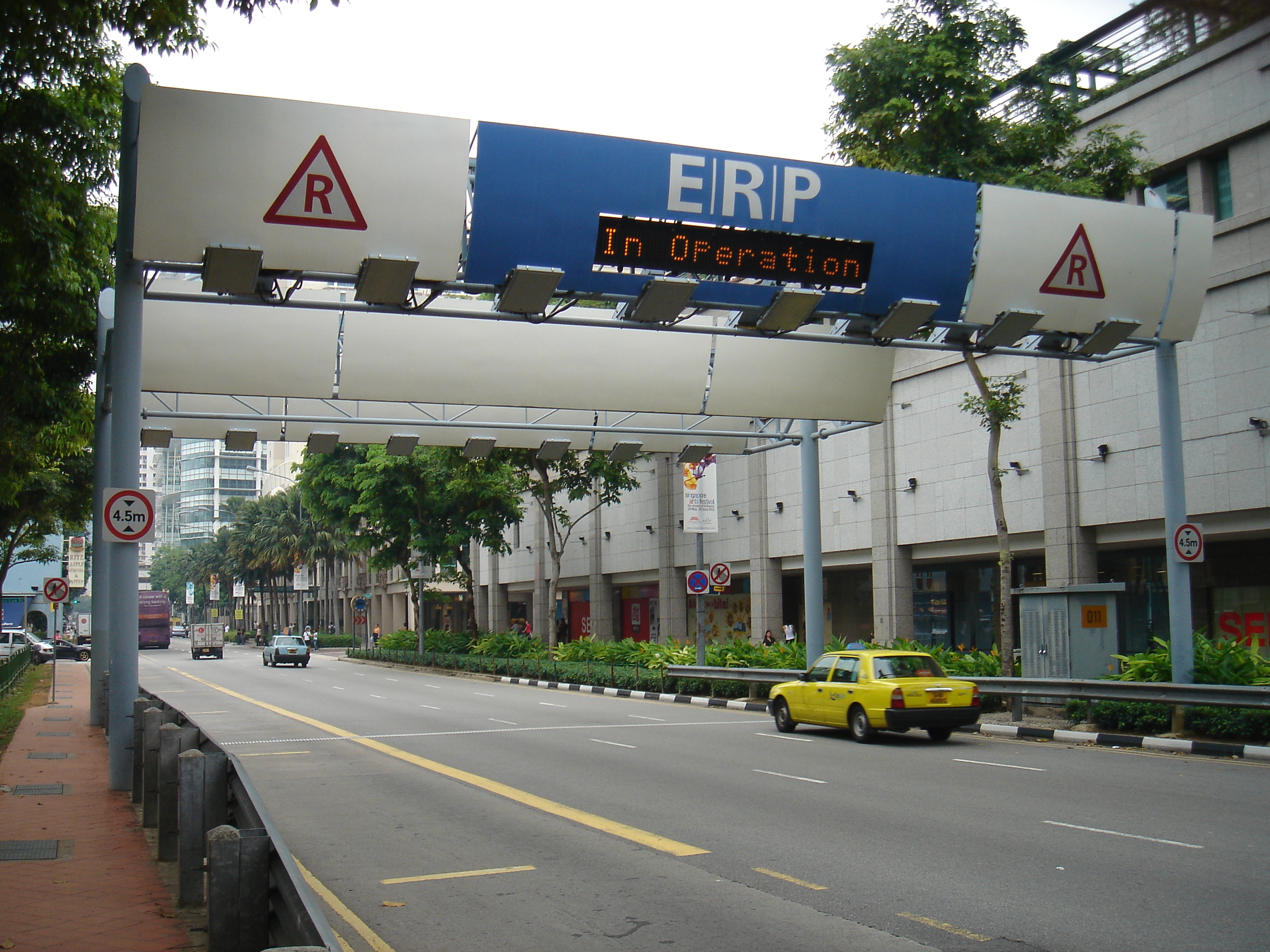
Singapore's highly intrusive ERP gantries will not be removed until the installation is completed, after which they will be progressively removed and replaced with signage, and in some cases Automatic Number Plate Recognition (ANPR) cameras for spot enforcement (and to ensure ERP 2.0 devices are not malfunctioning). 

Importantly, Singapore has no plans to change its policy on road pricing, and plans to keep charging at specific points on the network as it does now.


The installation of ERP 2.0 is three years later than originally planned by the Singaporean Government. It had been delayed by a combination of the effects of the Covid 19 pandemic, and subsequent chip supply shortages hindering the production of the new system.  In 2016 I wrote that Singapore was planning to have the new system up and running by 2020.  It is unclear if the budget for the system S$556m has been exceeded as a result.

What it does mean is that Singapore can be declared as having the world's first GNSS-based congestion pricing system.  It has the flexibility to charge by distance, but also the flexibility to introduce "virtual gantries" anywhere in the network, and with the installation of OBU 2.0 as compulsory, it means there needs to be only small-scale enforcement of whether the devices are installed and functioning, unlike cities with many vehicles visiting from other jurisdictions. Foreign vehicles in Singapore without an OBU are charged on a per day basis for the time spent in Singapore, at a rate of S$5 per day, regardless of the extent of use of ERP charged roads. 

Singapore's OBU 2.0 may provide a benchmark for other cities, although the need for three hours of installation time, and at least two components, is likely to be seen as expensive and intrusive for many other cities. Nevertheless, Singapore still remains the gold standard of congestion pricing systems internationally, and it remains notable that in a city-state that has relatively low levels of evasion and little difficulty in enforcing traffic offences, that it continues to be sceptical of the reliability and security of using smartphones for road pricing.  This might reflect the commitment it had already sunk into the new OBUs, but it has accepted the use of smartphones as a customer interface and information system.

This video has been published by Channel News Asia (of Singapore) about the new OBU:


Friday, 3 December 2021

Brussels City Region Congestion/Road User Charge might be implemented in 2024?

Around a year ago I reported that the Brussels Capital-Region Government (which is one of the federal regions of the Kingdom of Belgium) was planning to introduce road user charging (RUC), specifically a distance, time and location based RUC for all light vehicles registered in and driving in the Brussels Capital-Region. Prices would vary by engine size (and it wouldn't apply to heavy vehicles because Belgium already has a national heavy vehicle RUC system). That was to start with a pilot called Smartmove, but ultimately lead to replacement of the very high annual vehicle registration fees in Brussels, with RUC. Charges would be applied to all public roads except the ring motorway and some park and ride access roads at the periphery.

Brussels City-Region zone for RUC

It is interesting for three reasons:

  1. It is the latest attempt to introduce distance-based RUC for light-vehicles in Europe, replacing an existing tax (there have arguably been several attempts, notably in the Netherlands, Finland and the UK). So far no European jurisdiction has introduced distance-based RUC for light vehicles (but it does exist in two US states, one Australian state and New Zealand, in all cases for only a subset of the light vehicle fleet).
  2. It seeks to combine RUC with a form of congestion charging, by varying distance by time of day and location.  The time of day factor is intended to charge higher rates for peak time travel, and the location factor being that only distance travelled within the Brussels Capital-Region would be subject to a fee.
  3. Smartmove intends to pioneer using smartphones as a means of identifying and measuring vehicle trips. This has not been successful elsewhere to date, primarily because of the difficulties in ensuring that the phone is always linked to the vehicle, and the vehicle always has a smartphone operating to measure and report trip data. 
There is a project website, but in English (and Flemish and French) at least it still has dates that are now unrealistic.

Covid 19 has delayed progress, so that earlier this year it was reported in the Brussels Times that it would not be implemented until 2024, noting there is considerable opposition from neighbouring regions Wallonia and Flanders (primarily because RUC would apply to residents from those regions entering Brussels, but they would not receive a reduction in registration fees). Other regions feared variously that it would be a "tax grab" from their residents, and that it could creation additional congestion on the uncharged ring road (which seems unlikely, given it is likely to reduce overall demand for driving in Brussels - and experience in both Stockholm and London with exempting boundary or bypass routes is that the net effect on such roads is neutral). 

Delays have cost money, as the Brussels Government was anticipating €250 million per annum in net revenue from the programme from next year (which clearly indicates that even after drastically reducing vehicle registration fees, RUC makes more money because it is charging vehicles from outside the region), and is now having to make budget savings to make up the difference. 

There have been legal challenges, with the Council of State (Federal Government) authorising the Brussels City-Region to introduce RUC, but only after it has consulted with Wallonia and Flanders.  The Minister-President of the Region has indicated legislation to implement it would not be introduced during the current Parliamentary term.  Brussels is authorised to proceed only with taxes that are not already the competence of the Federal Government, but the Viapass heavy vehicle RUC system is already implemented by all three regions. Also with a congestion pricing element, it is not just about revenue.

Brussels must do "everything it can to reach a co-operation agreement" with the other regions to prevent or limit possible discriminatory situations. Obviously the easiest solution would be for ALL regions to implement a similar policy, but that's unlikely at present.  However, it is NOT mandatory for Brussels to reach such an agreement, according to an article in L'Echo (French).

All of this means it is far from certain whether it is proceed. The next regional election is 2024 and there is limited political enthusiasm for the policy in the current government. This leaves aside testing the technology and its feasibility.

My bet is that the odds are that, at most, this will be a trial, because until the trial is implemented and runs, there won't be enough political support.

Of course separate to all of this is the gradual erosion of Federal fuel tax revenue because of the growth in hybrid and electric vehicles, but none of that revenue goes directly to the Brussels City-Region Government.  However, that issue really does require all of the Regions and the Federal Government to co-operate.

Wednesday, 28 July 2021

Utah enables in-vehicle telematics to be used for road user charging

In 2020, Utah became the second US state to implement an optional road user charging (RUC) scheme for certain light vehicles. Optional in the sense that such vehicles could choose either to pay a higher annual vehicle registration fee or pay RUC instead. 

Utah's scheme is only available to electric vehicles, plug-in hybrids and conventional (petrol powered) hybrid light vehicles.  They each face a choice as follows:

Electric:    (US) $120 a year registration fee or US$0.015 per mile (up to a cap of $120)

Plug-in Hybrid: $52 a year registration fee or $0.015 per mile (up to a cap of $52)

Conventional Hybrid: $20 a year registration fee or $0.015 per mile (up to a cap of $20)

The reason for the lower fees for plug-in hybrid and conventional hybrid vehicles is to acknowledge that they all pay state fuel taxes in addition to these fees, although of course, this means that conventionally hybrids that are driven more than 1334 miles per annum, pay nothing more than fuel taxes at that point.  

The main technology option available to motorists has been to acquire an On Board Diagnostics (OBD-II) plug-in device that is inserted into the OBD-II port on the vehicle, which receives data generated by the vehicle's on-board systems, includes a GPS receiver and transmits the trip data via the mobile telecommunications network. In addition, the vehicle owner must download an app and take a single image of the vehicle's odometer at the point of registration, and then an annual odometer image is taken and transmitted to verify distance travelled.

However this has is supplemented by another option, which in its own way, is quietly revolutionary in the world of RUC. Whether it is called embedded telematics or Original Equipment Manufacturer (OEM) telematics, it is the telematics system built into a vehicle at the time of production.

What this means is that for vehicles able to use this option, no additional equipment is required, with the vehicle already equipped to record trip data by distance, location and time of day.  Tesla Model 3 cars do not have OBD-II ports, so a smartphone is used to connect with the vehicle's telematics system to access the trip data and transmit it to the service provider.  An API is provided to enable access of that data by the smartphone using the relevant app (Smartcar).  Of course this relies on the driver bringing the phone with the relevant app, pairing it with the vehicle and ensuring the phone remains powered throughout the trip.  It's not clear whether forgetting to carry the phone becomes a problem, because next time the phone is connected to the vehicle it could access such data once more. 

The system is intended to be expanded to other Tesla models, but would be greatly improved if the telematics system connected directly to the service provider rather than simply paired with a phone. There are likely to be some key enforcement challenges if it becomes phone dependent, because the incentives to connect your phone to the car for the purposes of paying RUC are not good.  

However, this IS a significant step forward. Most vehicles nowadays are built with embedded telematics, but until Utah, none have been used for RUC. There are considerable barriers to making it work, not least consent from the vehicle manufacturer, and the diversity of such systems on-board vehicles (some will not be sufficiently reliable, some won't be sufficiently secure). However, if these issues can be addressed, RUC would simply be another application for such systems to record and report trip data.

Without the need for any additional equipment, the capital costs of RUC drop considerably, and the operating costs are mostly around managing customer service and communications.  Have no doubt, there is a long way to go to enable this, and there are considerable barriers, but Utah has pioneered RUC using technology built into cars.  

Wednesday, 29 April 2020

Australia: Industry briefing of National Heavy Vehicle Charging Pilot Large Scale On-Road Trial Procurement

The Australian (Federal) Government's Department of Infrastructure, Transport, Regional Development and Communications has published a Notification of Industry Briefing, for its National Heavy Vehicle Charging Pilot.  The industry briefing will be held THIS FRIDAY 1 May from 0815-1030 Australian Eastern Standard Time (2215-0030 UTC/GMT 30 April-1 May) and then 1715-1930 the same day (0715-0930 UTC/GMT 1 May).  The first session is timed for Australian, New Zealand and North/South American interest, and the second one for Asian, European/African interest.

The text below is a verbatim extract directly from the notice:

The purpose of this industry brief is to provide information to, and obtain information from, potential tenderers for three planned solutions procurements for the National Heavy Vehicle Charging Pilot’s Large Scale On-Road Trial.

    Provision of telematics devices and services
    Provision of third-party invoicing services
    Provision of manual collection devices and reporting services

This briefing is not a procurement and does not form part of any Commonwealth procurement process. The Commonwealth will not select or exclude (from future participation in above procurements) any companies based on their attendance or non-attendance at the Industry Brief.

Following the Industry Briefing sessions, there will be a period in which the department will accept feedback submissions from industry on the proposed technical approaches to gathering data and generating invoices and mock permits.

The National Heavy Vehicle Charging Pilot (National Pilot) is an innovative industry partnership testing potential direct road user charging options for heavy vehicles. The Large Scale On-Road trial is anticipated to involve up to 100 participants providing more than 1000 vehicles across diverse industries and fleet sizes.  

Trial Participants will test several operational models for collecting and reporting distance travelled. Existing and charging-specific telematics systems will be tested, as well as non-telematics distance measurement technology (hubodometers).

No money will be collected from trial participants. Instead, the data collected will be used to generate mock invoices. The mock invoice will be used to calculate and compare alternate mass-distance and location-based charges with an estimation of annual registration and fuel-based road user charges (current PAYGO model) collected for each participant. 

END

Further details on the National Heavy Vehicle Charging Pilot are found on the Department's website. 

Disclaimer: D'Artagnan Pacific is technical advisor to the Department of Infrastructure, Transport, Regional Development and Communications

Friday, 22 April 2016

California's Road Charge Pilot Program progressing

The most exciting trial of road charging in the world today is the one that is about to start in California.  California is going to pilot 5000 volunteers, a mix of private and commercial vehicles, for five options that it seeks to appraise.  The policy intention is clear.  The intention is to replace the fuel tax with a new way of charging for road use.  Why? Because the significant growth of electric, hybrid and ultra-fuel efficient vehicles is eroding gas tax revenue, and even the existing proposal to increase the gas tax for the first time (and remove the current fuel tax swap) will not provide a sustainable solution to California's highway funding dilemma.

It is no exaggeration to say that the rest of the US is watching California.  If the California Road Charge Pilot is a success and there is broad agreement to implement it, then it is likely other states may follow.  Yes, Oregon was first, but California has the largest GDP of any state in the USA (indeed its economy is larger than Brazil, Italy, India or Russia).  

As California prepares for the launch of its road charge pilot program on 1 July, Caltrans has  announced the companies that will be managing the accounts for the 5000 volunteers during the pilot:

- Azuga (Azuga is already an account manager for the OReGO pilot in Oregon);

- Intelligent Mechatronic Systems (a Canadian company that supplies telematics and connected car technology);

- Arvato Mobility Solutions (a German company that provides outsourcing solutions for mobility); and 

- EROAD (a New Zealand company that is an account manager for the NZ and Oregon weight-distance road charging systems).

Azuga and Intelligent Mechatronic Systems (IMS) will offer mileage based accounts and Arvato will offer a state-run account management service.  EROAD will manage all heavy vehicle accounts for the pilot.

The pilot has an excellent website here which has useful information.  There are links to other information including this fact sheet (PDF).  Details on decisions on how the pilot will be implemented are here (PDF).

The following five charging options are to be piloted:

- Time permit: Purchase of unlimited use of the roads for a set period of time (similar to "vignette" systems in various European countries);
- Mileage permit:  Purchase of a set number of miles to use the roads, in advance.  Once the permit is exhausted, an additional permit would be required  (similar to New Zealand's manual Road User Charge system);
- Odometer charge: Pay for miles used based on periodic odometer readings, after they have been driven.  This is similar to manual weight/distance taxes in a few US states.
- Automatic mileage reporting including general location: Pay based on in-vehicle technology measuring distance travelled.  A third party service provider would receive this information and bill the account holder.  Location information would only be used to avoid charging out of state and off-road miles.
- Automatic mileage reporting without general location: Similar to the above example, but no geographic data is supplied.

All but the first option involve distance charging, but all but the last distance charging option would raise the issue of crediting for out of state or off-road miles.

Volunteers will not actually pay any charge, but will choose options of simulated charges to test the technology and participant responses to the various road charge options. Azuga, IMS and EROAD may provide value added services at no cost to volunteers as part of the pilot. Volunteers will choose an account manager in June.  The graphic below outlines what volunteers need to do to participate.

California road charge volunteer process


NOTE:  This is the 500th post of this blog.  I hope you enjoy reading the posts and find them interesting and informative.  I know I have covered some matters in past years that I have not covered more recently.  Rest assured I have more time to dedicate to blog articles, so there will be consistently fresh content every week.  Best regards, Scott

Wednesday, 13 April 2016

Tolling Review: Australia as the next frontier?

In the latest Tolling Review magazine, published with Thinking Highways, there is an article authored by me about the prospects for road pricing in Australia.  In short, I think it has good prospects for being the country that can progress it the furthest in the coming decade (and that was before this speech and this report).
Cover of the latest Tolling Review

You can read the whole issue here, my article is on page 20, but there are plenty of interesting articles in this issue including Justin Hamilton's article on page 12 about Russia's Platon heavy vehicle road user charging system, Bob McQueen's article about how the likes of Uber and Waze would run toll roads, Pedro Pinto's piece on Portugal's successful expansion of tolling.

So just download the whole magazine and read it.

Friday, 18 March 2016

Singapore will have world's first GNSS urban congestion pricing scheme by 2020

The world's most sophisticated urban road pricing system is going to become even more sophisticated as Singapore looks like being the first city to ever implement a full distance, time, location and vehicle type based road pricing scheme, using GNSS technologies. 

Singapore's Land Transport Authority announced the winning bid for its procurement of a GNSS based electronic road pricing (ERP) system on 25 February - a consortium of NCS and Mitsubishi Heavy Industries Engine System Asia. NCS holds the contract for maintaining the ERP system and Mitsubishi was responsible for developing the original ERP system.   NCS is a subsidiary of Singtel, Singapore's major telecommunications carrier, itself owned by Temasek,  the Singaporean Government investment company that invests in firms such as Singapore Airlines.

The cost is S$556m (US$407m) and implementation is expected in 2020, with development starting around April.  According to Channel News Asia, the existing ERP system will operate in parallel for an 18 month transition period.  Two other participating suppliers were ST Electronics, which bid the project for S$1.26b, and the consortium of Watchdata Technologies and Beijing Watchdata System which did not reach the bidding phase.  This enormous difference in bidding price must have been influential, as well as NCS/Mitsubishi's long standing experience and understanding of the current ERP system.

The winning consortium will build and maintain the next generation GNSS urban road pricing system.   Although it will primarily use GNSS systems to detect and measure distance, it is also reported that beacons may be used to supplement GNSS signals in some locations.  It is using 4G systems for communication, but according to Business Times intends to still be compatible with stored value cards - a first for GNSS charging systems (as no OBUs in use anywhere currently take payment cards).

Channel News Asia published this image depicting some value added services that the new system will bring, including real-time traffic and parking information, and payment systems for parking.  The OBU is intended to be "open to new applications" to enable the ERP system to be a telematics platform.  One feature will be warning in advance of a charged road, so that a road user can choose to divert elsewhere.

Singapore congestion charging based on GPS

Context

Since September 1998, Singapore has had the world's most sophisticated urban congestion charging scheme, which has directly targeted only segments of roads that are heavily congested and applies prices to those segments of road based on achieving a minimum "level of service" (operating speed).  Its prices vary by time of day and direction of travel, apply to virtually all vehicles (including motorcycles and buses) and are reviewed regularly to ensure they are appropriate - that means the prices rise if speeds drop below a set threshold, or are reduced if they go above another threshold.  The intention being to optimise the use of the network.

It goes back to the Area Licensing Scheme in 1975, which essentially introduced a pass based system of congestion charging for access into central Singapore, and the subsequent introduction of controls on the numbers of vehicles allowed to be licensed in the country (a policy that is more plausible in a city-state than in a larger country, let alone the individual liberties concerns in many countries).

Singapore has curbed car ownership by limiting the number of cars in the country, but it has not stopped the country building adequate road capacity.  12% of the land area is taken up by roads, although again, in a city-state it is hardly surprising, built up areas need access which means they need roads, and there is little room for farms or forests which can cover vast areas with little road access.

Transport Minister Khaw Boon Wan has a target of 75% of trips made by public transport by 2030 and 85% by 2050.  It is doing this by increasing the bus fleet by 35%, doubling the rail network, expanding cycling paths and quadrupling covered walkway distance (essential during Singapore's tropical downpours).  However, I wonder how much difference vehicle automation might make, as Singapore would appear to be well positioned to pilot incentivising automated vehicles to get better use out of the road network.

ERP today

An interactive map of all charging points which you can click to get the prices of reach vehicle class per time of day is here.  Most gantries operate at peak times only, but some charge during interpeak periods and some on Saturdays (e.g. Orchard Road in downtown Singapore).

Singapore ERP gantry points
Prices for cars at set times at one Singapore ERP charging point
Prices range considerably, with prices set to reflect vehicle type according to metrics of road space occupancy based on PCU (passenger car unit equivalent) Cars, vans and taxis are 1 unit, motorcycles are half, heavy goods vehicles and minibuses are 1.5 and the largest trucks and full sized buses are 2.  This is a measure of congestion impact and nothing else.

Rates are reviewed quarterly to ensure charges maintain average speeds of 20-30kph on main roads and 45-65kph on expressways.  If speeds drop below that at specific times passing by a gantry on a regular basis, prices for that direction of travel at that location are increased (to reduce congestion).  If they go above that, prices are reduced (as it is assumed prices are too high and are suppressing efficient demand).  This excellent article (PDF) published five years after ERP was introduced discusses Singapore's experience with the system and the results.  Violation rates are less than 0.5% of trips.

Singapore has long used what is now a rather dated tag and beacon system (DSRC) that is non-standard, and involves a two-way communication with vehicle on-board units (OBUs) by deducting prepaid credit from smart cards inserted into the OBUs.  To achieve the detection, the communication from the unit and back to the smart card (and provide back-up ANPR cameras for enforcement) has resulted in Singapore having very large elaborate gantries that many cities would see as unsightly (and which are increasingly controversial in Singapore itself).


Singapore ERP gantry

Wednesday, 3 December 2014

Dartford Crossing goes electronic free flow, but tolling politics still poorly handled

On 30 November 2014, manual tolling finally ended at the Dartford Crossing - the 4 lanes each way tunnel/bridge crossing of the Thames that connects the eastern ends of the M25 ring motorway around London.  Already the southbound toll booths that lead down from the QE2 bridge have been removed as is seen here in FleetNews, with the northbound ones to be removed in coming months

Dartford Crossing toll plazas at the southern side of the tunnels/bridge
The system that has been introduced is an electronic free flow system that relies on automatic number plate recognition, and requires all motorists using the crossing to either:

- Set up a pre-pay account that deducts the toll every time the vehicle crosses a tolling point;
- Make one-off payment via phone, online, retail outlet or by post no later than midnight the day after the crossing is made.

Of course, while the tolling has been automated, the booths have yet to be removed, which caused some chaos on the first day as many motorists stopped to try to pay for a toll at empty booths with barriers raised.  The problem being that, on weekends, most users are not regular enough to be aware in advance of the change.  I suspect also that there will be a deluge of penalty notices that might be sent out, although I suspect the operator would be wise to not send out any such notices for the first day, and subsequently focus enforcement on any repeat violators.

With full removal of the toll booths, there should be a significant improvement in the quality of service of the road, with congestion of 7-11 minutes on average being largely relieved. 

Tailbacks northbound at Dartford Crossing toll plaza should be no more


Why?

Because with congestion relieved, the toll prices are being increased by 20% (although there is a 13% discount for those with accounts) and there is no indication about what the money raised is for.  It is, in essence, being treated as a tax, or more accurately, as one of the government's most profitable ventures.

Dartford Crossing toll prices with discount for account holders

Although it is legally a congestion charge, the toll does not vary at peak times, or by direction (even though there is a reasonable case for doing this), although it does not operate for 8 hours a day (overnight) to encourage heavy commercial traffic in particular to use the M25 at night.

Friday, 4 April 2014

Taiwan moves to fully electronic tolling

ITS International reported in November 2013 that all 900km of Taiwan's toll highway network were to be converted to fully electronic operation by March 2014.  It actually happened on 2 January 2014.  It said:

The roads, which include three north-south routes with 22 toll points, carry out around 1.7 million transactions a day, generating some US$700 million of annual toll revenue.

Far Eastern Electronic Toll Collection is the company commissioned with operating the system.  According to the report, FEETC choose ISO 18000 6C sticker tags to be implemented, on cost grounds, and had achieved 85% takeup by November 2013.  The system is meant to be backed up by ANPR cameras to identify and charge vehicles without tag accounts.  Given Taiwan is an island, there is no issue of cross border traffic.  I had reported over three years ago that tolling tags were to be compulsory from 2012, but it appears the island has moved away from that for the implementation of fully electronic tolling.

Taiwan's tolled "freeway" network
Taiwan's toll system is based on distance, so vehicles are charged based on entrance and exit points onto the system.   The first 20km any vehicle travels every day is untolled, beyond that cars are charged at a rate of NT$1.2 (US$0.04) per km up to 200km, followed by NT$0.9 (US$0.03) per km for any after that on a calendar day.   Accounts are prepaid and need to remain topped up, otherwise bills are sent by mail to registered vehicle owners at a higher cost.  

Strictly speaking, Taiwan isn't a country (I wont fill this blog with the history of the Republic of China), so I wont say this is the first country in the world to have a fully electronic tolling network for all vehicles on its major highways.  However, that's the only reason why I wont say it.

Getting up to date information on how the Taiwanese system is going is difficult in English, so if anyone has reliable information about the Taiwanese system and reactions to it, they would be welcome.

Saturday, 25 January 2014

Intelligent parking in London and San Francisco, a future for market priced parking?

London smart parking

The City of Westminster, one of London's inner city boroughs (encompassing the West End and many of the locations in central London tourists are familiar with), is launching intelligent parking and Atlantic Cities has a good article about the upcoming system.

3000 sensors are being placed in parking bays (there are 10,000 in Westminster, which is rather low given the density of streets, reflecting the long standing policy to eliminate on street parking from many major roads and dedicate road space to bus and cycle lanes and expand footpaths. 

The report says the 3000 sensors are being installed at a cost of £650,000 (US$1.07 million).

It enables motorists to use mobile apps to check parking availability, including crucially disabled parking bays (often ignored in discussions about reducing motoring).  


USA- California - San Francisco intelligent parking


I reported over two years ago on San Francisco's intelligent parking trial.  According to SF Park the trial has come to a close, with the parking sensor devices having been switched off at the end of 2013.   SF Park says:

This means that the real-time information on parking space occupancy will not be available for mobile apps and similar uses. The SFpark data feed and app will continue to show meter parking rates, as well as real-time space availability and rates at parking garages. The SFMTA will continue to conduct demand-responsive rate changes to find the lowest rates possible to help ensure there is a minimum number of open parking spaces on each block to reduce circling and double-parking.

In other words, the system will no longer be useful for identifying occupancy on the kerbside, but it will be for parking garages.  Meanwhile, pricing at parking garages will appear to be variable, and there appears to be a continuation of some form of variable pricing for kerbside parks.

The results of the trial will be interesting, as dynamically priced kerbside parking has great potential to save time, fuel, reduce congestion and stress for those seeking to park, as well as pricing parking efficiently so that some may decide to drive at different times, use other modes of transport or (inevitably) go elsewhere (which is good for areas that have surplus capacity).

My opinion

Wednesday, 15 May 2013

The problems of measuring traffic congestion

Reuters has published an interesting article by Felix Salmon where he examines more closely the basis for the data behind TomTom's congestion indices.

Some of his points:

- TomTom's data comes from people who have its devices in their cars when they are turned on and being used.  Most peak time commuters are far less likely to be using satellite navigation services for their daily commute compared to occasional users of the road.  As such, both the driving habits, the speeds and the weighting of traffic volumes based on the presence of such devices will be skewed away from regular users.  

Now I think that over time, this may change as these systems also advise on traffic conditions more reliably.   Anything that encourages people to always have the system on will help, but for now it is at least questionable as to whether the sampling of peak users is representative.

- TomTom doesn't have any measure of confidence levels in its data, because it hasn't actually measured the congestion by any other means.  That makes the indices curious, but hardly a sound basis for major public policy decisions.

- Measures of congestion on a percentage basis distorts delays for short trips relative to longer ones.  A half hour delay on a one hour journey would be seen as less of a delay than a 10 minute delay on a 15 minute journey, which it is, in one sense.  Yet, 10,000 people enduring a half hour delay is more significant than a 10 minute delay.

What this all means is that, beyond individual corridors, it is astonishingly difficult to generalise about cities accurately, comparing performance between cities.  That doesn't mean TomTom should be pilloried for what it has done.  It is interesting what it has compiled, but it isn't much more than that.

Friday, 10 May 2013

News Briefs - Australia, Canada, Ireland, South Africa, USA

Australia – Survey says distance based congestion charge would change behaviour

According to AAP, reported by Perth Now, a survey from the University of Sydney has indicated that a distance based congestion charge of A$0.05/km (US$0.08 mile) at peak times could see 22% of peak commuters driving at different times (assuming a charge between 0700-0930 and 1630-1830) and 13% to shift to public transport.

The survey comprised 1000 adults. 66% said they had no flexibility to change travel times for commuting, but the other 34% said they did.

Obviously a survey isn’t a wholly reliable measure of behaviour, but what I find telling is the potential for time shift. Far too many think congestion pricing is about mode shift, when there is as much (if not more) to gain from changing time of travel to periods when there remains spare road capacity, which means getting optimal use of the network.

Canada - British Columbia debates road pricing

According to Straight.com, British Columbian Green Party leader, Jane Sterk, has come out in favour of "pay-as-you-drive" road pricing for Vancouver, to reduce congestion and raise revenue to pay for public transport.  The same article notes that the current Minister of Transportation and Infrastructure for the province, Mary Polak (Liberal), says the issue is up to the cities to come up with a proposal and convince the provincial government that it has public support, whilst the Opposition spokesman Harry Bains prefers to consider other measures first.  The general election for British Columbia is on 14 May.

Meanwhile, the Delta Optimist has published an opinion piece by Ted Murphy who says that road pricing is likely to be the best option:

It stands to reason those who put the greatest strain on the system, and those who are most likely to benefit from any improvements, should be the ones that pay the largest share of the tab.

Conversely, it doesn't make much sense for homeowners, who are an easy mark but don't necessarily tax the transportation network, to continually be gouged every time TransLink is in need of more cash.

There's much to be worked out when it comes to road pricing, and there will undoubtedly be resistance to the idea of paying to traverse roads that up to now have been free, but at the end of the day I suspect it will be the favoured option.

It's not a question of if, but how, they're going to extract more money from us, so they might as well do it in the fairest way possible.

It isn't clear as to whether British Columbia voters think the same way.

Ireland - manual toll booths add costs to trucking firms

The Independent in Ireland reports that toll booth barriers cost them on average an extra (Euro) 0.99c each time (US$1.30) in wasted fuel.  This is with DSRC toll tags that enable automatic payment, but require trucks to slow down to a crawl to trigger the lift of the barrier.

This is crazy of course. The M50 toll road in Ireland was converted to electronic free flow a few years ago, largely because of congestion (it being the ring road for Dublin).  There ought to be a transition towards at least a mix of free flow lanes and barrier lanes.

South Africa - 24 years to repay debts for Gauteng Freeway Improvement Project

Eyewitness News reports that the South African National Roads Authority Ltd has said that it will take 24 years of toll revenues to repay the debts incurred to build the Gauteng Freeway Improvement Project. This is based on the (R)30c/km (US$0.05 per mile) rate agreed by the Government.  The maximum monthly that can be charged is R550 (around US$61).


USA - Maryland - Intercounty Connector exceeds forecasts

At a time when there are more than a few examples of toll roads that have demand well below forecasts, it is perhaps good news to report on the InterCounty Connector in Maryland (Maryland Route 200), a fully electronic toll road that opened in 2011.  According to the Washington Examiner, estimates of 30,000 daily users by June 2012 have been exceeded on the western end of the road by September 2012 (to 35,000) and not far behind on the eastern end (26,000).  The road raised US$19.7 in the year ended June 2012 compared to projections of US$18.7 million.

Thursday, 9 May 2013

Singapore assessing GPS based urban congestion charging

The Star Online reports that the Singapore Land Transport Authority has been trialling a GPS based electronic road pricing system on one road for a year, with the intention being that such a system might replace the existing gantry based electronic road pricing scheme.

According to Yahoo:

"Kapsch TrafficCom, MHI Engine System Asia and NCS, ST Electronics (Info-Comm Systems) and IBM Singapore, and Watchdata Technologies and Beijing Watchdata System were awarded the tender" in 2012 to develop a system within 18 months as replacements for the ERP system, each getting S$1 million (US$812,000) to do so.

Singapore's existing system has been the benchmark for urban congestion charging since it was introduced in 1997.  It charges different prices by location and time of day at all of the charging points, enabling differentiated pricing.  Prices are reviewed regularly up or down, depending on congestion levels, with the intention being to maintain minimal levels of service speeds.  As a result, congestion on Singaporean roads is relatively rare for a city of its size.   It is efficient pricing par excellence, and a far cry from the very blunt charge in London, and the slightly less blunt charge in Stockholm.  Revenue is not a relevant influence on prices.

If successful, the GPS trial could mean 80 gantries currently used for Singapore's congestion charging system would be replaced, and vehicles equipped with the existing prepaid card based tag system would need new charging equipment installed.

However, the report doesn't include good news for those with concerns about privacy, as it says it will be used to enforce other laws:

like catching speeding vehicles and those which beat red lights, spotting illegal parking or tracking hit-and-run drivers.  It can help find stolen cars, assist police in solving certain types of crimes, and aid in tracking offenders.

Singapore's authoritarian reputation appears to be the chief concern.

Some bigger questions arise, as such an all pervasive system that would charge for every kilometre travelled could replace the punitive ownership taxes, by focusing on usage.  Singaporeans seem to treat the ownership taxes as just another cost for owning a car, although the other deterrent to ownership is the limit on the number of cars that are registered - people buy and sell and bid for a limited number of permits to own a car that can double the cost of owning a car.  The result, according to the article, is only 12 in 100 own a car in Singapore, compared to 24 in 100 in Hong Kong, a similar city "state", which does not have restrictions on car ownership and punitive taxes (but car parking is largely provided by the market, which prices parking at a premium in this territory with land scarcity in its inner city areas).

Odds are that Singapore will transition to distance, time and location based urban congestion pricing within the next few years.

In the meantime, the Singapore Land Transport Authority is now assessing the outcomes of the trials to consider the next stage, which may be a tender for full implementation.  However, there is currently no deadline for implementation of a next generation ERP system.

Friday, 3 May 2013

News Briefs - China, India, UK, USA

China - Poll rejects congestion pricing

China Daily reports that an online poll (yes I know) by China Youth Daily saw around 75% of respondents oppose congestion charging for Beijing, preferring to support "improving the city's planning process, the road repairing projects, and the traffic management mechanism" to reduce congestion.  Good luck with that then.

Hong Kong - Hopewell retains BBB- Fitch rating

Reuters reported in October 2012 that Hong Kong based toll road investor, Hopewell, retained its credit rating with Fitch.  Hopewell Holdings owns 68% of Hopewell Highway Infrastructure Limited, and Fitch reported:

Hopewell Highway Infrastructure Limited (HHI), continued its stable performance in the financial year ended June 2012 with a 5% increase in revenue. An overall increase in traffic volume is driven by continued economic growth in the Guangdong province, and improving connections to local road networks and strategic locations. In particular, the West Route enjoys synergies from completion of Phase II, and average daily traffic grew by 39% in FY12.

A new tariff framework effective from June 2012, as well as the "Holiday Toll Free Policy" effective from October 2012 will adversely affect cash flow generation capacity of the toll road portfolio. Fitch expects the toll road portfolio's EBITDA to decrease by around 15% as a result in FY13. 

Hopewell is in joint ventures with Chinese companies over five toll roads in the Pearl River Delta area of Guangdong province in China.

India - Toll tags may be mandatory

A report from the Deccan Herald quotes N R Gokarn, CEO, National Automotive Testing and R&D Infrastructure Project (NATRIP), a government led project, as saying that "RFID tags" that identify vehicles are likely to become compulsory across India.  This would help with identifying vehicles more generally, as well as facilitating a shift towards electronic free flow tolling.  The National Informatic Centre (NIC) contains data on over 90 million vehicles including owners and insurance details, and it is intended that any such system enable ready access to that database for tolling.

India - IRB acquires MVR


IRB's corporate profile states:

The company, along with its subsidiaries has constructed or , operated and maintained around 8,000 lane kms of road length so far and one of the major road developers in the country. The aggregate size of all our BOT projects (both completed and under execution) is around Rs. 170,552 Million (US$3.1 billion).

MVR Infrastructure and Tollways is a construction and toll road management company based in Tamil Nadu.


UK - Manchester still not interested in congestion charging


A rather odd little news report from the Manchester Evening News notes that a survey recently conducted by the AA indicates 80% of those polled oppose congestion charging for Manchester.  A referendum in 2008 saw a 79% "no" vote for a proposed congestion charging scheme that was to raise money to pay for major public transport improvements.

This is hardly surprising.  People wont vote for what they see as a new tax, especially since central government decided to give Manchester the money for some of the public transport improvements anyway, presumably as an election sweetener, and Manchester local authorities borrowed money to pay for the rest.  Meanwhile, Manchester was hit by the recession, and traffic volumes have not increased since 2008.  Any deal for congestion charging needs to offer something in terms of improvements to roads or reductions in other taxes to have any chance of being supported.

UK - Birmingham's transport authority wants private toll road nationalised

I've written about the M6 toll road before.  It was fully privately financed and built, and runs at a loss, without a penny contributed by taxpayers.   It is heavily under-utilised, in part because tolls are highly priced (but revenue maximising) and in part because the travel time savings are not high, except at peak times when the untolled parallel motorway is congested.

This upsets the planners at Centro - the West Midlands Transport Authority - which is responsible for transport planning in the wider metropolitan region surrounding Birmingham.  Centro has no authority over the motorways, but according to the Birmingham Post, Chief Executive, Geoff Inskip wants central government to buy the M6 toll road, reduce or eliminate the tolls, and so relieve the existing untolled road.  It even suggested tolling the existing untolled road at peak times, to help pay for the purchase.

Now I'm no fan of nationalisation, but tolling the existing route at peak times would provide some "competitive neutrality" between the routes.  One idea is that vehicles are charged to use both routes through fuel tax, but none of that fuel tax goes to the owners of the M6 toll road.  If a deal was done to reduce tolls by a proportion reflecting that contribution, it might make a small difference.

USA - New York - Citizens' Budget Commission recommends higher tolls

Capital New York reported in October that the lobby group "Citizens Budget Commission" proposed that 25% of funding of the New York public transit system should come from tolls:

The commission argues that not only should drivers' tolls cover the upkeep of bridges and tunnels, which they do now, but they should also underwrite a quarter of mass transit services, thanks to all of the "harmful consequences" that drivers cause but do not pay for, like "noise, congestion, air pollution and greenhouse gas emission."

To that end, the commission would raise tolls on M.T.A.-controlled bridges and tunnels to as much as $9 in cash. Right now, drivers pay $6.50. Once the 2013 and 2015 hikes go into effect, drivers will pay $7.50.

Further, the commission proposes raising vehicle registration fees, which are now amongst the lowest in the country, and the gasoline tax.

The CBC also says congestion pricing should also be considered, again.

It also proposes fare increases for public transit.   This doesn't mean tolls on untolled crossings, but raises the obvious question as to why not, as the inequities of only charging some crossings simply becomes exacerbated.

Wednesday, 3 April 2013

North Carolina's Triangle Expressway strictly penalising late payment

North Carolina's Triangle Expressway is the state's first toll road and the first fully electronic free flow toll road in the US built from scratch (i.e. built as a free flow electronic toll road, not converted).  

According to the News Observer, some motorists are facing penalty fees for non-payment that are many multiples higher than the original toll.  This, of course, is hardly unusual.   Fully electronic free flow tolling needs to be strict on enforcement, and bill payment.  However, it is shocking some of those who neglect toll bills of less than US$1. 

48% of users are registered with DSRC "Quickpass" transponders, automatically debiting tolls.  The remainder are identified by number plate and get sent bills in the mail.  For many the bills are so low (US$0.45 for example) they forget them, until there is a US$6 late fee added for each month it isn't paid, and another US$25 after the second month.  That adds up and the report mentions some users who now face paying over $40 for a one off usage of the road.  

In 10 months since the road opened, it levied US$1.42 million in surcharges for tolls worth US$771,000.  This is lucrative of course, but given the road only opened at the beginning of 2012, there is always going to be a period of users becoming familiar with how fully electronic free flow tolling works.   I'd give it two years to settle down, and by then there ought to be more like 75% transponder usage, and 90% of bill by mail users paying within one month.

North Carolina Department Of Transportation (NCDOT) wants to encourage motorists to get transponders and to pay on time, so is treating this as a chance to deter late payment.  However, one interesting element is how it gets information to bill out of state motorists,

It is easy to get number plate data for North Carolina of course, and the state has arrangements with five other states (and negotiating them with others), yet this means that vehicles from 44 states can, in effect, drive toll free on the road.  5% of users currently come into that category.  Yet, NCDOT is not being complacent, and if the numbers of users for individual states become worthwhile to pursue, it will seek arrangements with those states.  This is going to become more common, and I'd suggest states need to think about some sort of outsourced clearing house arrangement to minimise the costs of doing this, and to enhance the reliability of the data they all have on vehicles, owners and owners' contact details.

There is also interesting data that has been published on payment rates for the expressway after 10 months:

- 72% of those sent bills by mail pay within the one month billing period;
- 83% of bill by mail users are registered North Carolina vehicles;
- 12% of bill by mail users are with the four other states with NCDOT has a data sharing agreement with (California, Florida, Ohio, Texas and Virginia).

I've written a couple of pieces on some of the teething problems of this road, all of which ought to be object lessons in toll road developers actually taking experience from free flow toll roads elsewhere before developing systems and business rules from scratch.  None of the problems faced by North Carolina are especially new, except to that state, and I wager perhaps the designers?  I would have thought the experiences from Canada and Australia at least ought to have been easy to replicate here, or is it the problem of some that they simply don't believe that experience from "lower ranked" countries is worth applying in the United States?

The two issues reported on the expressway recently are:
- Double billing of motorists with two tags that are interoperable on the road; and
- Mistaken enforcement due to misreading of a character of a number plate.

I wish NC DOT all the best in what is a relatively risky endeavour, but one that will pay off, and hopefully what it is learning about enforcement, the hard way, will make it far easier to do more new free flow toll roads in the future.

Thursday, 14 March 2013

News briefs - Australia, New Zealand, South Africa, UK, USA

Australia - Transport Reform Network calls for treating highways as utilities

Supply Chain Review reports that the cross-sector lobby group, Transport Reform Network (TRN), is calling for roads to be managed more like the electricity and water sectors, as a utility.  It was commenting in the context of a lack of funds to address problematic railway level crossings.  TRN suggests that any reform needs to look comprehensively at ownership and fuel taxes as well as tolls,  it is more concerned that talk of road pricing isn't about "bolting on" a solution to existing structures, but is part of a more comprehensive reform of highways across Australia.

This is quite enlightened and actually far beyond how most commentators, lobbyists and governments think of roads.

New Zealand - NZTA enforcing tolls against recidivist violators

The NZ Herald reports that the New Zealand Transport Agency (NZTA) successfully enforced a prosecution against a man who failed to pay NZ$5000 (US$4109) in tolls on the Northern Gateway toll road north of Auckland (the only state highway toll road in the country).  

Robert Masaberg was convicted in North Shore District Court of 20 charges of failing to pay a toll and was ordered to pay $1156 in fines, court and prosecution costs.He owes $5181 in unpaid tolls for the Northern Gateway Toll Road, unpaid administration fees and additional costs connected with attempts to get him repay his debt.

It was reported nearly two years ago that no one had been prosecution for non-payment, it is clear this policy has changed.  Three other prosecutions are to be pursued for evaders.   NZTA says the non-compliance rate for the toll road is 4%, which after four years of operation remains perhaps higher than would be expected.

South Africa - Times reports on allegations of poor practices by SANRAL

The Sunday Times of South Africa reports on a court case that claims the South African National Roads Agency Limited (SANRAL) has implemented the Gauteng toll system unlawfully, and in a way that is "disproportionately and unjustifiably expensive".  It undertook a three month investigation that raises questions about procurement practices that seem to favour certain suppliers, including a consultancy (TolPlan) that it claims has a vested interest in the promotion of projects as it works on the feasibility studies, tenders for development and engineering work on the projects.   It also claims that Kapsch won the tender for the toll system based on a minimum level of "black empowerment" shareholding of the firm set up for the contract, but has bought out most of that black shareholding (and will receive more revenue as a result).   Noting that the Kapsch led firm will receive around 25% of the tolling revenue (which if true, is comparatively high).   

The story is that it is a "cozy club" which implies a potential element of either corruption or sloppy mismanagement by SANRAL.  SANRAL CEO Nazir Alli admits that it "looks" like Tolplan had a conflict of interest by adjudicating on tenders and then working on the projects themselves, and another manager noted that SANRAL accepts consultancy recommendations "99%" of the time.

Clearly allegations of this kind raise opposition to tolling in the country, if the sense is that those promoting tolls are doing so out of personal financial interest.  The more that looks like being the case, the more damage is obviously done to plans to expand tolling the country, and damage both to SANRAL and those companies which engage in such practices with full awareness of what is going on.

UK - MP suggests tolling road to pay for maintenance

Whilst government considers reform of the highway sector, the Bournemouth Echo reports that one MP has floated tolling an existing road, that needs a £26 million (US$39m) major repair which is currently unfunded.  The MP is Chris Chope, who represents Christchurch and is from the Conservative Party. The road is the A338 Bournemouth  spur road, the main road from the east and north into the city.  The idea has been scorned, no less than because it would mean motorists paying to use an existing road, and risks substantial diversions of traffic onto parallel routes or dissuading visitors altogether.

USA - Pennsylvania - fully electronic tolling open option for congestion pricing

The self-styled "liberal" news-site Keystone Politics comments approvingly about the Pennsylvania Turnpike Commission's plan to convert manual tolls to fully electronic tolling, saying the key advantage (beyond removing people from "dehumanizing" work) would be to allow for higher tolls at peak times, to reduce congestion and encourage public transport usage.  The plan is to replace all toll booths over five years, and frankly the sooner the better.  

USA - Texas - toll tag options

The Waco Tribune has a useful article on toll tag account options in Texas.  It outlines how there are three toll road authorities in the state, each offering toll road accounts that are effective on all toll roads in Texas (TxTag, provided by Texas DoT. TollTag, provided by North Texas Tollway Authority.  EZ Tag, provided by Harris County Toll Road Authority.  It describes how non-tag toll prices can be between 33-50% more than tag product prices.