Showing posts with label Asia. Show all posts

Thursday, 16 May 2024

Japan planning introduce time and location based pricing on expressways nationwide

 Japan's nationwide expressway network is run by a series of private businesses. In 1956, the Japan Highway Public Corporation was formed to build and operate a national highway network, using tolls and accessing private financing. At the time, only 23% of Japan's national highway network was sealed including only two-thirds of the Tokyo-Osaka highway.  Tolling was extensively used, and for sections of highway that did not gain private finance, the government guaranteed the loans. Tolling revenue was pooled to cross-subsidise parts of the network that did not generate enough toll revenue to pay for construction (details on the history of highway in Japan is available here (PDF). 

In 2005, the Japan Highway Public Corporation was split and privatised into multiple companies, including the Japan Expressway Debt Repayment Agency (to use toll revenue to repay the considerable debt that remained for the development of the network) and six regional expressway companies. They are:

  • East Nippon Expressway Company Limited;
  • Central Nippon Expressway Company Limited;
  • West Nippon Expressway Company Limited;
  • Metropolitan Expressway Public Corporation (Tokyo);
  • Hashin Expressway Public Corporation (Osaka-Kobe-Kyoto); and
  • Honshu-Shikoku Bridge Authority.
Tolls were authorised to be collected until 2050, recently extended to 2065.  The privatisation was driven by several concerns, in particular:
  • As Japan's network had essentially been completed, there was concern about public ownership enabling politicians to authorise new construction that favoured the construction industry, even if projects were not viable. 
  • The pooling of toll revenue nationwide was seen to enable this cross-subsidisation where there was no need for new infrastructure. Residents objected to paying higher tolls in their area for projects that were far away from them and of dubious economic value.
  • Interest in improving the efficiency of administration and encourage innovation in operations of the network.
  • Interest in enabling comparisons between the performance of companies so encourage more productivity and lift standards across the sector.
  • Concern about the levels of debt government was taking on for the expressway company, and privatisation was seen as a way to put discipline on costs, debt and the scale of capital spending.

Map of Japan's expressways and major highways

The national expressway network is 9050km long. Tolls in Japan are generally set to reflect distance travelled between interchanges, and vary by vehicle type. Most toll roads still have a mix of electronic and manual toll lanes.

So the announcement in the Japan Times in the past week that the Ministry of Land, Infrastructure, Transport and Tourism will be introducing the ability for expressway companies to introduce time-of-day varying tolls, based on location, to manage congestion, is a significant step for the history of expressways in Japan.  It was trialled during the 2021 Tokyo Olympics with a higher daytime charge, and discounts after midnight, but the idea is that time periods and variations in toll fees will depend upon the specific route and the conditions on it. This is NOT dynamic tolls, but rather targeted congestion pricing to enable more free flowing traffic and reduce pollution.

Also announced was the enabling of commuter passes for high frequency users of toll roads in particular areas, to encourage greater use of expressways to remove traffic from untolled parallel local roads.

What will be of interest is how congestion pricing (which is what it is) will be applied to urban tolled expressways as there is an obvious risk that it could divert some traffic onto parallel routes, and it would not take much of a diversion to severely impact such routes. Although most urban expressways offer significant improvements in travel time, there may be localised points of networks to avoid tolls that could cause worse congestion on the local network (which is not the responsibility of the expressway companies).

Thursday, 26 October 2023

Reactions in Singapore to ERP 2.0

Following the announcement of the roll-out of ERP 2.0 in Singapore (using GNSS-based On Board Units for congestion pricing), there has been some comment in the media in Singapore about the new system and policy around it. Some of this is likely to be relevant to other jurisdictions considering mandating such technology into motor vehicles.

What do motorists and car dealers think?

The Straits Times published an article on 25 October by Lee Nian Tjoe on what motorists and car dealers think.

Dealerships generally said that they were ready for the rollout, as some had been establishing how to conceal wiring and have the equipment installed in their vehicles, but some still were awaiting information...

Ms Tracy Teo, marketing director of Komoco Motors, which represents Hyundai, Jeep, Ferrari, Maserati and Alfa Romeo in Singapore, said the company is awaiting information and instruction from LTA on the next steps.

One of the key issues is that getting such equipment installed in a wide variety of makes and models may present challenges for some varieties of vehicles. 

Comments from members of the public approached by the journalist were largely questioning with some concerns, such as the location of the OBU on the side of the passenger footwell.  One objected to the system having capability to have stored value cards inserted given how technology had moved beyond that. 

The article describes how a fleet operator was used to test installation of 500 devices in a pilot.

Should it have been rolled out in the first place?

A second article from the website Techgoondu is critical of the new system.

Author Alfred Siew describes it as:

the unwanted rollout of a costly project that has taken nearly 20 years to complete, if you count its early efforts. It is clearly outdated and inconvenient for users. Many questions have already been raised about this “next-gen” ERP 2.0 unit when it was unveiled two years ago. Most damning was why it was even necessary.

Part of this is unfair, as it is not a 20 year long project, but it is certainly was being thought about 10 years ago. Singapore needed a new system because "ERP 1.0" was creaky and obsolete, and needed replacement.  It would have been cheaper to go all ANPR (Automatic Number Plate Recognition) based, but certain features would not have been available, and it could have simply been an update of the current technology.  However, Siew notes correctly that the "next-generation" features around traffic information are largely available through apps such as Waze.  Smartphones are able to be used as the in-vehicle display is optional, so the question becomes what it would have taken to make smartphones work?  The key issues around reliability and linking it to the vehicle remain, but this is being trialled in Brussels now.

Siew describes the system as old technology, with the stored-value cards which are increasingly obsolete and an in-vehicle display reminiscent of pre-smartphone navigation systems.  Of course many cars have automaker installed telematics with some key elements of the ERP 2.0 system included, although not available for congestion pricing applications. Making Original Equipment Manufacturer (OEM) telematics systems available and suitable for road pricing is perhaps the "rosetta stone" for ubiquitous road pricing in the future.  Unfortunately efforts to do this so far have been very limited across the globe.

Siew finally criticises it for being a system with the capability to introduce distance based charging, but that capability is not to be used as of yet.  That doesn't mean that it won't  be and it is entirely understandable that a policy decision to do that would not be announced until the entire system is installed and proven, but unless it is used, it seems like an expensive solution to what is just an effort to replace an old system with one with less intrusive roadside infrastructure.

Of course LTA had signed the contract for the ERP 2.0 system some years ago and became committed to the project, so it had to be rolled out.  Hopefully it will all prove to be worthwhile and operate successfully for many years to come.

Distance-based pricing is unlikely anytime soon

Newspaper Today online published an article by Loraine Lee on 25 October saying that it was unlikely LTA would implement distance based pricing soon.

Key issues identified were:

  • How to apply it equitably, including the future of fuel taxes and vehicle registration/ownership taxes, so that those that travel the most are not paying disproportionately compared to what they do now.  
  • Questions over the location accuracy of the technology in parts of Singapore with tall building, and with tunnels (the latter is not a real issue, as systems elsewhere can clearly note when vehicles travelling on a road disappear and reappear at another location, that they must have been in the tunnel on that route). 
  • Need to consider the wider impacts of a shift towards distance-based charging on some road users.
The accuracy issues can certainly be addressed, as they have been in other GNSS-based road user charging systems in Europe, the United States and New Zealand, but the policy issues about Singapore's mix of taxes require some further work to disaggregate.  Clearly fuel taxation will be eroding due to the emergence of electric and hybrid vehicles, and a shift from ownership based taxes to usage based taxes is likely to increase car ownership, but reduce distance travelled by car and congestion, so some modelling will be needed to forecast the impacts on Singapore's traffic (and vehicle fleet size).  

The key point is the new system will provide options, and it would be a poor use of the technology to not have some form of distance based charging or at the very least use it to implement more 'virtual gantries' for pricing.  

Time will tell whether other cities will copy Singapore technologically (they should copy parts of it in terms of pricing policy), my suspicion is that the inclusion of a slot for stored-payment cards is unlikely to be replicated, nor is a in-vehicle display, but the core of the technology still has merits.  The options for using GNSS-technology for congestion pricing are:
  • Purpose built OBUs for professional installation in vehicles
  • Scaled down "self-installed" OBUs
  • OEM telematics 
  • Smartphones
Singapore has chosen the first, we will see if the next GNSS-based congestion pricing system selects an alternative.

Monday, 20 December 2021

Jakarta includes congestion pricing in its Transportation Master Plan

According to Tempo, 18 Jakarta roads are to progressively have congestion pricing introduced, cover 174 kms of road.  Jakarta has been discussing congestion pricing for over eight years, and has trialled it with some success, but has not been able to develop sufficient support to introduce it in full.  Jakarta maintains its "odd-even" policy for number plate access into the central part of the city in the meantime.

Meanwhile, Jakarta has made tremendous efforts to improve the quality of alternatives to the private car in  recent years, spending a great deal on footpaths adjacent to key corridors and installing cycle lanes (63km by 2020) and major new public transport networks. This includes lanes for bus rapid transit, expansion of the city's metro and major upgrades of its long neglected commuter passenger rail network. It also integrated fares for most public transport including a flat fare for travel between modes.

This saw Jakarta win a sustainable transport award at the end of 2020. This matters because for congestion pricing in Jakarta to be a success, it needed capacity for alternative options and the city was particularly poor for active travel, but with Covid, there has been a significant increase in cycling and walking. 

There remain challenges for congestion pricing, including enforcement based on number plate recognition, but if implemented well, it could see a significant transformation for a city plagued by congestion, pollution and previously with very poor alternatives to driving.

Thursday, 2 December 2021

Singapore delays next-generation congestion pricing due to supply chain issues

It was five years ago when I wrote about how Singapore was planning to have the world's very first GNSS technology based congestion pricing scheme from 2020.  Thanks initially to Covid this was put off to this year with full roll out in 2023, now it is being delayed further, apparently due to supply chain issues. 

Roll out is now reported by Asia One and the Straits Time that the start of installation won't be until mid 2023, with the key issue being the supplier's inability to access enough chips.  Bear in mind Singapore is looking to equip almost all vehicles in the city state with the new On Board Units (OBUs), which requires 987,450 units (as of October 2021 according to ZDNet).  The time to install is estimated to take 18 months, as all are to be professionally installed.

It's worth remembering that despite having a system that is 24 years old (and having had congestion pricing in one form or another since 1975), Singapore still has the world's best performing congestion pricing system.

The reasons why?

  1. Its sole objective is to improve road network performance by managing congestion down to efficient levels of traffic flow. It isn't about revenue, it isn't about emissions, but it certainly generates revenue and reduces emissions.
  2. To achieve this objective it targets, precisely, by location and time of day, parts of the road network that have demand exceeding road capacity, with rates varying by specific point, direction of flow and by the hour.  There are charges when demand is high, but not when it is low.
  3. Rates are varied quarterly based on actual road network performance, not goals around revenue or political whim. If congestion grows, prices are raised to increase speeds, if traffic demand drops too far, prices are lowered to get better use of the network. So motorists understand it is a finely tuned pricing tool, not a punitive measure.
  4. It started as a cordon, then another cordon and is now a corridor and cordon scheme. Singapore has added charging points as demand justified it. 
  5. There are few exemptions. Only emergency vehicles and vehicles that don't use public roads regularly don't pay. Cars, trucks, buses and motorcycles all pay, all proportionate to the road space they occupy. Buses? Sure, occupying precious road space imposes costs, so the cost of providing bus services takes it into account.
Also worth noting that Singapore is introducing GNSS telematics for congestion pricing NOT to shift towards distance based congestion pricing (although it certainly could), but to replace an ageing, increasingly unreliable system and deliver an authoritative source of traffic and travel data into vehicles. This is to encourage drivers to take alternative routes and modes, to advise of disruptions, accidents and the prices of charging points.  An interactive map of Singapore ERP charging points is here.  Further details on how the system works are here (it is often described as using toll tags or DSRC, but these are interactive OBUs which deduct payment from prepaid cards, not simple toll tags seen widely elsewhere).

Singapore ERP (congestion pricing) charge points

A consortium of Mitsubishi Heavy Industries and NCS (a subsidiary of Singtel) won the contract to implement "next-generation ERP (Electronic Road Pricing)" in 2016 at a cost of S$556 million (US$408 million), including supply and installation of OBUs for all vehicles registered in Singapore (replacement OBUs would need to be paid for by the vehicle owner).

Wednesday, 31 July 2019

Will Jakarta get congestion pricing?

The Jakarta Globe claimed that Electronic Road Pricing (ERP) will be operational on some roads in Jakarta by March 2019, but clearly this hasn't happened. What has gone wrong?

I've written a lot about Jakarta's attempts to introduce congestion pricing in recent years.  In order from 2010 to 2016:


Coconut Jakarta said Inrix's most recent report indicated Jakarta has the world's 12th worst traffic.

Jakarta Deputy Governor Sandiaga Uno now says it will be implemented after the Mass Rapid Transit (MRT - metro) line along Jalan Jenderal Sudirman to Jalan Medan Merdeka Barat is opened.  Coconut Jakarta also reports that Greater Jakarta Area Transportation Management Agency (BPTJ) head Bambang Prihartono has suggested charging for non-Jakarta registered vehicles to enter the city.  That may have some obvious appeal, although it would encourage commercial vehicles to register in Jakarta to avoid this (and provide a possible path for avoidance of private individuals registering vehicles through Jakarta based companies).  However, he is right to talk of ERP as the long term solution, that would enable mode shift to public transport if it is expanded sufficiently.

Where now?

Singapore's Straits Times says that 50% of vehicles in Jakarta come from outside the city, and that the first phase of the ERP scheme will be to charge for use on one road between two roundabouts - Jalan Jenderal Sudirman.  Phase Two would be an extension north along Jalan MH Thamrin.  Jalan Jenderal Sudirman already has bus rapid transit lane along much its length, and the MRT line is also under construction following that route.


Phase One (blue) Phase Two (orange) of Jakarta ERP (2018)
The choice of this route appears to be because it will parallel public transport options, as well as being a particularly congested corridor.  Care may need to be taken to ensure charging points minimise opportunities for diversion, otherwise nearby routes.    

However

The last report on the plan was to await installation of congestion pricing until Jakarta's metro system opens. The first phase opened on 24 March 2019 (the Red Line), but there are wider problems with implementing congestion pricing in Jakarta.

Jakarta's MRT (metro)

The main issue is that the tendering process for the system has been undermined by two of the three shortlisted bidders withdrawing (namely QFree and Kapsch, both well known for their experience in installing tolling systems) leaving only the Indonesian firm PT Bali Towerindo Sentra remaining.  One can only speculate about their reasons for withdrawing, but in doing so there is clearly insufficient confidence from the authorities to proceed.

The Governor of Jakarta has since indicated that it is "more important" to upgrade public transport than to introduce ERP, yet it is fairly obvious that the latter could help the former.  Even just introducing the single ERP corridor charge would make it much easier to introduce more rapid and frequent bus services on that corridor, and raise revenue to to improve transport infrastructure more widely.  The public transport goal is to get 90% of residents able to access either the metro (MRT) or bus rapid transit, with the current position being around 20%, but they could be introduced hand in hand.

There is another issue which is not getting much publicity, but is more fundamental to the success or failure of congestion pricing - the quality and reliability of automatic number plate detection to enforce ERP.

False number plates, and poor data linking vehicles to owners' addresses is a problem in Indonesia, which would make enforcement of ERP in Jakarta difficult.  This is a responsibility of the Police, who understandably are less enthused about addressing a problem which is more about traffic management than crime.

If the fundamental problem of fake number plates and an unreliable database are not addressed, then congestion pricing can't be implemented.  Simple as that.  As I've said before, if Jakarta can't implement free flow tolls on its existing tolled road network, it is not going to reliably introduce congestion pricing. 

No doubt reforming and upgrading both the number plate system, the enforcement of number plates and the database and processes for changing data on vehicle number plates is not easy in Jakarta, but it is going to be key to moving forward.  Whilst Jakarta embarks on upgrading its public transport network, it should move ahead on reforming this, use it to replace manual tolls on existing toll roads (which in itself will ease congestion on and approaching those roads), giving it a modern vehicle management infrastructure to introduce ERP.

Monday, 9 April 2018

Congestion pricing for Delhi?

Delhi's congestion is chronic, as incomes have risen, car ownership has risen and by no means has Delhi been able to increase road capacity to meet this demand. Neither TomTom nor Inrix have data for congestion in Delhi, but the Centre for Science and Environment in India reports:

Average traffic speed on 13 arterial roads 50-60 per cent lower than their design speed and 35-48 per cent lower than the regulated speed of 40-50 km/hour 
No non-peak hour now on main arterial roads -- virtually no difference in time taken to travel between peak and non-peak hours 

The Hindustan Times claims that Delhi needs to replicate the success of Singapore in charging for road use.  This is a fair assessment, although I would caution simply thinking that what Singapore did could be replicated in Delhi.  For a start, Delhi needs to have a reliable motor vehicle registration database correlated to number plates for enforcement purposes.  It isn't clear that it does.  Without that, there simply cannot be a congestion pricing system at all. Secondly, there would need to be effort made to ensure that basic steps are made to ensure alternative modes are able to function appropriately.  That means making it easier to walk and cycle, as well as bus priority measures which are rigorously enforced.  Finally, there is a need to ensure that the solution for Delhi is implemented incrementally.  Don't try to replicate any other city's ideas wholesale, but look at charging a handful of locations initially at the most seriously congested periods, to see what the results are.

Yet Delhi has a network of toll roads, which use manual as well as electronic tolling.  The obvious first step ought to be conversion of all existing toll roads in Delhi to fully electronic free flow operation.  India has already mandated the National Electronic Toll Collection programme for national highway, so this provides a good starting point.  That's not to mean that the same system should be used.   There are sound reasons for thinking about competitive service delivery in terms of accounts, but if Delhi wants to move quickly, its existing toll roads provide a starting point to test charging without any barriers, and to also test charging higher at congested periods.

Delhi has tried demand management of road use

The odd-even number plate test in January 2016 was a success according to The News Minute.  This pilot meant that from 1 January-15 January, from 0800-2000 only odd-numbered cars could drive 


Delhi's Odd-Even number plate tria

Indian Express reports speeds went up 5.4%, particulate pollution decreased by a relative 10-13% on average, with notable results either side of the period the test was in force.  In other words, pollution declined after 0800, and increased again after midnight (because a new rule on truck traffic restricts much of that traffic to the midnight-0800 period).  

An odd-even policy isn't a very good idea though, primarily because it rewards those who can afford two cars and can encourage those with one car to buy a cheap, old, more highly polluting vehicle to avoid the restriction.  However, the policy did prove that influencing traffic demand in Delhi can improve results.  (More details on the results of the test are available here PDF). 

Criticisms need to be addressed

An article in Outlook India by Dinesh Mohan (Honorary Professor at IIT Delhi) basically indicates scepticism that it is the solution for Delhi.

quotes a number of academics to put some doubt about the efficacy of congestion pricing, yet none of these offer any evidence.  He quotes Professor Peter R. Stopher of the University of Sydney as saying “that charging motorists a politically acceptable amount will probably still not make significant impact on overall system congestion, while the potential for serious impacts on the economy become large if the charges are made sufficiently high or the area covered is made sufficiently large.”  Yet this seems to presume that charging means some sort of cordon or area charge.  There has never been a scheme to date that charges congestion on a system-wide basis.  Singapore is the closest, but is still far from being a network charging system.  What IS clear is that there are positive results where charging has been applied appropriately, such as in Singapore and Stockholm.

He then quotes Brian Taylor from UCLA as saying congestion is a "sign of success", which is not what many road users think.  The analogy with restaurants is hardly appropriate when people have choices between thousands of restaurants in a city, and the restaurants that are most successful can either raise prices to increase profits, or expand locations to cope with demand.

Mohan's claim that "there has been little consensus among thinking traffic experts on how to think about urban traffic congestion and how to deal with it. This is why there are very few cities the world that had the courage to experiment with the concept of congestion charging" is quite wrong.  There is widespread consensus that pricing of road use would reduce congestion, the reason pricing has been applied in few cases is a mix of political will, lack of innovation in the development of options for pricing and the inability to communicate to a sceptical and untrusting public that paying to drive on some roads at peak times will improve conditions for them.

Certainly Delhi is different from all other cities that have introduced congestion charging, but the claim that it is very expensive to implement is simply wrong. The costs of Automatic Number Plate Recognition (ANPR) technology have dropped significantly in the past 15 years and improved in reliability.

Delhi needs a congestion management strategy

I don't doubt that there are many other ways to address congestion in Delhi that need to be explored as well.  Enforcement against illegal parking and considerable work to improve the design of existing roads could help ease congestion, along with enforcement of behaviour that promotes congestion (such as poor lane behaviour).  Delhi needs a congestion management strategy, this would consider a wide range of measures including:
  • Design of existing road infrastructure, including traffic signals, roundabouts, intersections, lanes, parking restrictions. 
  • Enforcement of traffic and parking offences.
  • Provision of adequate facilities to ensure walking and cycling can be undertaken safely and easily for short trips.
  • Public transport provision, including priority for public transport.
  • New road capacity where appropriate.
  • Road pricing.
Road pricing should be a part of this, but objectives need to be clear. Delhi still has a significant population that does not drive, but may be expected to want to own a car in the next 10-20 years. Although it's unreasonable to expect this desire in owning a car to be curtailed, that isn't a reason to not ensure that low cost alternatives are not made as reasonably attractive as they can be (walking and cycling), and that corridor space is set aside for bus transit to be developed (as Delhi also grows its underground metro system).  Delhi may also seek to wrestle control of its commuter railway system from Indian Railways, so that money can go into enhancing system capacity, whether by track, signalling or rolling stock (and to try to capture the growth in fare revenue to pay for these improvements).

For road pricing, Delhi should get its road management right more generally, and after converting existing toll roads to free flow tolling, with peak charges to help spread demand, pilot charging on critical parts of the highway network where diversion can be minimised.  Singapore does have an effective approach to reviewing and updating charges, and incrementally Delhi can develop a network of charging, that generates revenue that will be needed to fix intersections, corridors and other parts of the road network that need modernisation.

Thursday, 28 April 2016

Jakarta abandons 3-in-1, moving to 4-in-1 as congestion charging is delayed again

You may wonder what is going on in Jakarta as it seems on the cusp of introducing a Singapore style  ERP (Electronic Road Pricing) system, but as I wrote on 5 April, it has temporarily suspended its existing high-occupancy vehicle rule (known as 3-in-1, which is self explanatory) until May 14 because of concerns of child exploitation.

Now a website called Coconuts Jakarta (a new online news website chain that started in Bangkok) has suggested that 3-in-1 may be replaced by 4-in-1 in part because of the time that would be taken to implement congestion pricing in the city (the website suggests 1.5 years, which is a reasonably minimum in my view).   The Deputy Head of the Jakarta Transportation Agency,  Sunardi Sinaga, is quoted as saying it is one option once the 3-in-1 suspension is over, but 4-in-1 would only apply in the afternoon peak (presumably because the congestion is more severe during that time).  

As the report points out, unless the Police enforce laws against people paying others to sit in their vehicles (known as jokis - (jockeys)), which was a source of concern in the first place (as it is some of Jakarta's poorest seeking to make money from this, and some either rent their children out for this role or abandon them unaccompanied whilst they "jockey"), it wont make much difference.

Meanwhile, according to the Jakarta Post, the city has banned motorcycles on one area (Hotel Indonesia Traffic Circle from Jl. MH Thamrin to Jl. Merdeka Barat), which is surprising, as they are not the least efficient vehicles from road space terms, but has refuted rumours it may expand this ban further.  The report said the tender for ERP will be released later this year for implementation next year (which still seems ambitious to me).

It is not yet clear whether reliability of number plate recognition and accuracy of vehicle registration database details for enforcement have been addressed yet.

Thursday, 14 April 2016

Hong Kong congestion charge looking more likely? 是交通拥堵费可能为香港?

Harbour Times (Hong Kong) reports that the Government of Hong Kong looks like it is more determined to introduce Electronic Road Pricing (ERP) than ever before. The genesis of road pricing in Hong Kong goes back to a study in the 1990s that included some of the first trials ever of using GPS technology to measure distance, with a technology pilot located at the former Kai Tak Airport site.  Politics have got in the way of implementation in the past, and they are still an issue, but given experience that has been built up in Europe, Asia and elsewhere, it would seem easier to introduce a congestion charge in Central and Wan Chai on Hong Kong Island than ever before.

The report says that local think tank Civic Exchange supports introducing congestion pricing and it made a submission to that end.   Civic Exchange claims that 90% of trips in Hong Kong are made by public transport (I'm not so sure, as I would have thought walking would have a reasonable share), but nevertheless it is seen as indicating that there is no problem substituting car trips for public transport for most trips.  It supports minimising exemptions, except for emergency vehicles.  That means charging buses, but since they can spread charge costs among multiple occupants, it should not be a problem.

The proposal from the Government is a pilot in Central and the consultation document and background materials can be downloaded here.

The consultation questions are shown below:

Hong Kong ERP consultation Questions 1-6
Hong Kong ERP consultation Questions 7-13

As you can see there is discussion about geography, whether an area (charging all movements within) or cordon (charge entry-exit only) scheme is preferred, what charging periods should be, the basis for charges, exemptions, technology options (focusing on DSRC and ANPR only), privacy protection and any complementary measures.  These are all good questions, for what it's worth I think that give what is being discussed, a cordon scheme with charging that varies by time of day, with minimal exemptions (emergency vehicles only) and charging based on road space occupancy would be the most effective.   

The intention is for the ERP pilot to cover an area bypassed by the soon to be completed Central-Wan Chai Bypass, illustrated below:

Hong Kong Central-Wan Chai Bypass
This would enable east-west traffic to bypass the concentration of activity in central Hong Kong and Wan Chai, and get access to the Cross Harbour Tunnel (which itself is congested as it has the lowest toll of the three tunnels to the mainland, suggesting that raising that toll should also be a congestion management measure at peak times).

Tuesday, 5 April 2016

Jakarta's congestion pricing programme is further delayed: HOV rule to be temporarily suspended

The Jakarta Globe reports that ERP (Electronic Road Pricing) for the city remains a "pipe dream" even though only a couple of months ago it appeared the city was ready to procure a congestion pricing system that would pioneer the policy for Indonesia.  I've written extensively about it here.

The report says:

Jakarta Governor Basuki Tjahaja Purnama said the regulations and payment procedures for ERP, where cars pay to pass certain streets using an onboard unit, were still not ready, though the technology and infrastructure are available.


However, it would appear it isn't just regulations and payment procedures (which should not be difficult):

"It's okay to suspend the three-in-one system, as long as a replacement is ready," the Jakarta Police's traffic unit head Adj. Sr. Comr. Budiyanto said. "But the problem is, there are still so many things to prepare for the [implementation of] ERP, including human resources, infrastructure, the legal aspects and databases related to it."


In other words, without either the Automatic Number Plate Recognition (ANPR) systems to reliably identify Indonesia's less than easy to read number plates, nor a database with sufficient accuracy to identify the names and addresses of vehicle owners (and to update this when ownership changes),  it is difficult to implement electronic road pricing.   This sample number plate from Wikimedia has various dimensions that reduce the reliability of ANPR technology, which should achieve accuracy levels of between 83% and 98% in the latest implementations of such systems.  The small numbers at the bottom of the plate are likely to prove difficult to read, and with a light on dark plate, with characters close to the rim increase the scope for inaccuracy compared with this UK sample plate.  

I wrote about this several times before, and it astonishes me that Jakarta hasn't focused on addressing this issue and the number plate database issue.

Meanwhile, the Jakarta Post reports that the city appears about to abandon its "3-in-1" rule temporarily, which essentially make two major roads in central Jakarta all high occupancy vehicle (HOV) routes (that's the whole road, not just a lane).   It applies from 0700-1000 and 1630-1900 weekdays.
Jakarta 3 in 1 network highlighted

The purpose of the rule is to reduce congestion, by requiring cars to carry three people, but it has spawned an informal industry of people who queue up near the boundaries to be paid to fill cars.   The proposed ERP congestion pricing system is meant to replace the rule, but "3 in 1" is accused of spawning child exploitation, as "joki" (jockeys - people who hire themselves as passengers) are blamed for running child begging, street performance and rental rackets.  

It is to be suspended for a week for city officials to assess the impacts, both on child exploitation and traffic.  The Jakarta Globe says the problem is that a few jokis are drugging their young children whilst undertaking their trade, and carry them to increase the chance of being picked up by drivers (drugging the children means they are not a nuisance).  They get US$1.50 per trip, which in Indonesia is more than the average hourly income.  Australia's ABC has more on this. However, the Police oppose the trial because of the impact on traffic congestion, although it will enforce bus lanes to ensure they continue to operate relatively freely.

UPDATE: Antara reports that the 3 in 1 policy is being replaced by enforcement of the odd-even number plate policy (which rewards those with two cars), but also claims that the Governor now wants ERP implemented.

It describes implemention of ERP geographically as follows:

According to the plan, the ERP implementation area will be divided into three sections. Area I will cover the Blok M-Kota Station, Jalan Gatot Subroto (Kuningan-Senayan), Jalan Rasuna Said-Tendean Tendean-Blok M, and Jalan Asia Afrika-Pejompongan.

Area II will comprise Dukuh Atas-Matraman-Manggarai-Jatinegara-Gunung Sahari and Kampung Melayu-Casablanca-Jalan Prof. Dr.Satrio-Tanah Abang.

Meanwhile, Area III will include Grogol-Roxi-Harmony, Tomang-Harmoni-Pasar Baru, Cempaka Putih-Senen-Gambir, Cawang -Pluit -Tanjung Priok, Cawang-Tanjung Priok, and Sunter-Kemayoran.

Tempo reports that the ERP rates "will" start at  30,000 Rp (US$2.28) raising to 50,000 (US$3.80) if congestion remains, although it could be free if traffic is temporarily diverted into ERP charged areas.  A 200,000Rp (US$15.21) deposit for the vehicle OBU will be required.

Of course, the problem of enforcement remains, the question of what happens when someone doesn't have an ERP OBU has to be addressed.

Monday, 21 March 2016

Jakarta congestion pricing facing problems by charging only main roads

The Jakarta Post reports that the city's planned Electronic Road Pricing (ERP) congestion charging system has been delayed, for governance reasons.  It had previously wanted to introduce the proposal by the end of 2015, which seemed ridiculously ambitious. 

The "ERP management unit" (with the acronym BLUD) has to be set up first, which of course makes perfect sense, and it apparently will be established in July.  Following that establishment, tenders for the design, installation and operation of the congestion pricing scheme will be let.

However, I'd urge some caution.  It would make sense for the ERP management unit to be bedded down and establish its objectives and procurement strategy before jumping into procurement.

As part of that the report notes

Korlantas chief Insp. Gen. Condro Kirono said police were gathering vehicle data for the ERP electronic registration and identification (ERI).

“We have held workshops with police offices and have supervised their digital data collection,” he said. 

A key element of any congestion charge will be reliable identification of number plates and associating plates to owners who can be billed/fined as appropriate. This is already proving to be a problem. 

The proposed congestion pricing scheme fits into the vision of Jakarta as a "Smart City" although that "Asia One" article weirdly thinks that 4,800 CCTV cameras will help this, when it really has little to do with it (except perhaps a related function of monitoring traffic volumes)

A substantial public marketing campaign is proposed to be launched in September/October, but it does have some major problems as Asia One news reports (includes TV report in English):

One of the challenges facing the implementation of ERP concerns motorists using small shortcut roads. Jakarta has a complicated network of roads which includes small shortcut roads.

The provincial government is well aware that motorists may try to bypass the ERP by using shortcut roads. But while taking such a route may save some money, it may not save time because during peak hours shortcut roads are even more congested.

This of course, is the key problem with proposals to charge only main roads.  There effectively needs to be a cordon put in, or parallel charges introduced for alternative routes.

In addition to pricing, it is useful to take some of the advice from Widya Anggraini, a Jakarta-based urban planner, in this article by City Metric, particularly addressing sexual harassment on public transport and ensuring pedestrian and bicycle access is improved.  This is clearly an important mode now and Jakarta should avoid the mistakes of some other developing country cities in letting these modes be neglected, which of course helps to encourage car use.  Walking and cycling for short trips is an obvious answer both in encouraging efficient use of road space, but also reducing pollution and improving the liveability of the city.  Development does not mean abandoning active modes.


Friday, 18 March 2016

Singapore will have world's first GNSS urban congestion pricing scheme by 2020

The world's most sophisticated urban road pricing system is going to become even more sophisticated as Singapore looks like being the first city to ever implement a full distance, time, location and vehicle type based road pricing scheme, using GNSS technologies. 

Singapore's Land Transport Authority announced the winning bid for its procurement of a GNSS based electronic road pricing (ERP) system on 25 February - a consortium of NCS and Mitsubishi Heavy Industries Engine System Asia. NCS holds the contract for maintaining the ERP system and Mitsubishi was responsible for developing the original ERP system.   NCS is a subsidiary of Singtel, Singapore's major telecommunications carrier, itself owned by Temasek,  the Singaporean Government investment company that invests in firms such as Singapore Airlines.

The cost is S$556m (US$407m) and implementation is expected in 2020, with development starting around April.  According to Channel News Asia, the existing ERP system will operate in parallel for an 18 month transition period.  Two other participating suppliers were ST Electronics, which bid the project for S$1.26b, and the consortium of Watchdata Technologies and Beijing Watchdata System which did not reach the bidding phase.  This enormous difference in bidding price must have been influential, as well as NCS/Mitsubishi's long standing experience and understanding of the current ERP system.

The winning consortium will build and maintain the next generation GNSS urban road pricing system.   Although it will primarily use GNSS systems to detect and measure distance, it is also reported that beacons may be used to supplement GNSS signals in some locations.  It is using 4G systems for communication, but according to Business Times intends to still be compatible with stored value cards - a first for GNSS charging systems (as no OBUs in use anywhere currently take payment cards).

Channel News Asia published this image depicting some value added services that the new system will bring, including real-time traffic and parking information, and payment systems for parking.  The OBU is intended to be "open to new applications" to enable the ERP system to be a telematics platform.  One feature will be warning in advance of a charged road, so that a road user can choose to divert elsewhere.

Singapore congestion charging based on GPS

Context

Since September 1998, Singapore has had the world's most sophisticated urban congestion charging scheme, which has directly targeted only segments of roads that are heavily congested and applies prices to those segments of road based on achieving a minimum "level of service" (operating speed).  Its prices vary by time of day and direction of travel, apply to virtually all vehicles (including motorcycles and buses) and are reviewed regularly to ensure they are appropriate - that means the prices rise if speeds drop below a set threshold, or are reduced if they go above another threshold.  The intention being to optimise the use of the network.

It goes back to the Area Licensing Scheme in 1975, which essentially introduced a pass based system of congestion charging for access into central Singapore, and the subsequent introduction of controls on the numbers of vehicles allowed to be licensed in the country (a policy that is more plausible in a city-state than in a larger country, let alone the individual liberties concerns in many countries).

Singapore has curbed car ownership by limiting the number of cars in the country, but it has not stopped the country building adequate road capacity.  12% of the land area is taken up by roads, although again, in a city-state it is hardly surprising, built up areas need access which means they need roads, and there is little room for farms or forests which can cover vast areas with little road access.

Transport Minister Khaw Boon Wan has a target of 75% of trips made by public transport by 2030 and 85% by 2050.  It is doing this by increasing the bus fleet by 35%, doubling the rail network, expanding cycling paths and quadrupling covered walkway distance (essential during Singapore's tropical downpours).  However, I wonder how much difference vehicle automation might make, as Singapore would appear to be well positioned to pilot incentivising automated vehicles to get better use out of the road network.

ERP today

An interactive map of all charging points which you can click to get the prices of reach vehicle class per time of day is here.  Most gantries operate at peak times only, but some charge during interpeak periods and some on Saturdays (e.g. Orchard Road in downtown Singapore).

Singapore ERP gantry points
Prices for cars at set times at one Singapore ERP charging point
Prices range considerably, with prices set to reflect vehicle type according to metrics of road space occupancy based on PCU (passenger car unit equivalent) Cars, vans and taxis are 1 unit, motorcycles are half, heavy goods vehicles and minibuses are 1.5 and the largest trucks and full sized buses are 2.  This is a measure of congestion impact and nothing else.

Rates are reviewed quarterly to ensure charges maintain average speeds of 20-30kph on main roads and 45-65kph on expressways.  If speeds drop below that at specific times passing by a gantry on a regular basis, prices for that direction of travel at that location are increased (to reduce congestion).  If they go above that, prices are reduced (as it is assumed prices are too high and are suppressing efficient demand).  This excellent article (PDF) published five years after ERP was introduced discusses Singapore's experience with the system and the results.  Violation rates are less than 0.5% of trips.

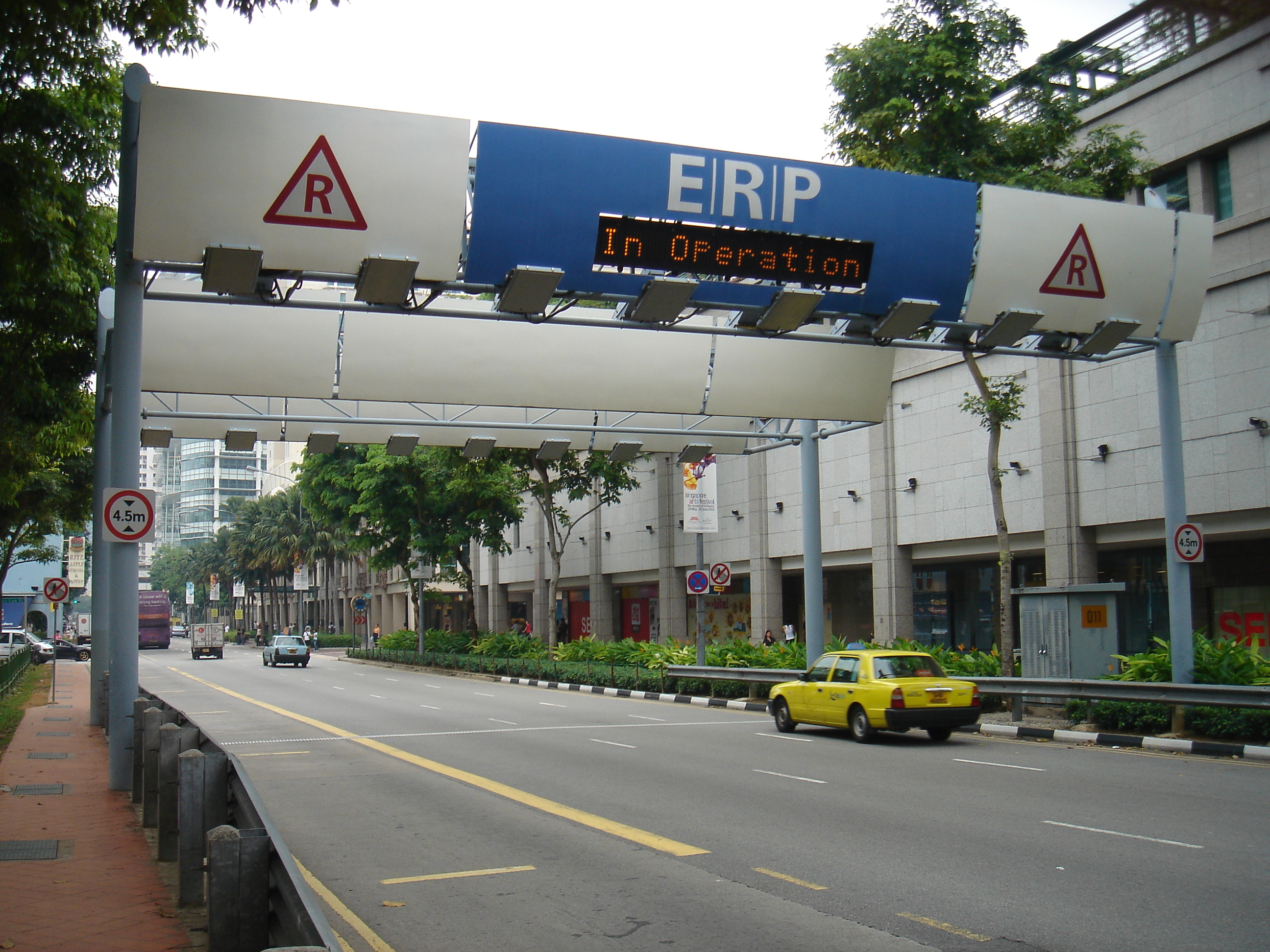
Singapore has long used what is now a rather dated tag and beacon system (DSRC) that is non-standard, and involves a two-way communication with vehicle on-board units (OBUs) by deducting prepaid credit from smart cards inserted into the OBUs.  To achieve the detection, the communication from the unit and back to the smart card (and provide back-up ANPR cameras for enforcement) has resulted in Singapore having very large elaborate gantries that many cities would see as unsightly (and which are increasingly controversial in Singapore itself).


Singapore ERP gantry

Thursday, 11 February 2016

Jakarta ERP (congestion charging) update: GPS under consideration

I've written several times about the plans for Jakarta to have what it called ERP (Electronic Road Pricing) very much modelled on the Singaporean approach.  There is broad political agreement of the merit of introducing charging on existing roads to manage congestion, to replace the current high occupancy rule (a minimum 3 occupants) for certain main roads.  That system gets abused as people offer themselves "for hire" to make up the numbers on roads approaching the "HOV road" zones.   After trials it was intended that the first stage of an operational system would be in place this year, with the law having already been amended to allow for its implementation.

Jakarta embarked on a trial of two DSRC systems, one with Kapsch and another with Q-Free reported here.  One of the big issues was non-standard number plates being difficult for ANPR cameras and systems to recognise.  

The two trial DSRC charging gantries are in place at Jl Jenderal Sudirman and Jalan Rasuna Said (installed by Kapsch and Q-Free respectively).

Jakarta ERP trial corridors
In October 2015 it was reported in Tempo that the Jakarta Governor was considering moving beyond DSRC type technology and embracing GPS systems to trial for the proposed electronic road pricing scheme.    His chief concern is the cost of installing gantries vs. installing GPS based OBUs, saying that each gantry costs 1 billion rupiah (US$73,000), implying it would be cheaper to implement distance based charging.  

So now it appears the programme has been delayed not least because of the Governor's interest in investigating the viability of using GPS technologies, but also because of concerns over how enforceable the system would be with the current generation of number plates in Indonesia.  The Jakarta Post reported a month ago that implementation has been delayed until 2017 with a decision on supplier by the end of 2016 (a rather short implementation time which would tend to preclude a large scale implementation geographically.  

The minimum charge is expected to be 30,000 Rupiah (US$2.21) to use charged roads at peak times. 

Proposed Jakarta congestion charging / ERP routes
The Google Earth image above depicts the routes proposed for full implementation of congestion pricing, covering major inner city corridors.

I said it's about number plates!

The Governor was quoted as saying:  “The main obstacle is legal enforcement — how to catch vehicles with non-Jakarta STNK [vehicles registration fee documentation] that violate the ERP. However, I think it will be easy to monitor it through closed-circuit television [CCTV]".  

So the issue is having number plates that are non-Jakarta issued, which is really about access to databases for others.  Yet he is wrong to say it can be monitored through CCTV reliably or cheaply.  CCTV is not ANPR, and would be unlikely to deliver the clarity of resolution for effective enforcement.  

I had highlighted number plates and databases for number plates as an issue on this blog a few years ago.  Indonesia (like many other countries) needs to establish key enablers for such systems, which includes either mandating electronic vehicle ID or having a number plate system that can be detected and corresponds with a high level of accuracy to the names and addresses of vehicle owners to allow for enforcement.

Thursday, 14 May 2015

Hong Kong to consult on congestion pricing, rejects raising fuel tax or promoting car-pooling

Hong Kong newspaper The Standard reports that the Hong Kong Transport Secretary, Anthony Cheung Bing-leung, has announced that there is to  be public consultation on the introduction of an electronic road pricing scheme on Hong Kong Island to combat congestion.

The reason for doing so is concern that the public "does not have a clear understanding" of the "proposed scheme", despite it being clear from past studies that there could be considerable merits from introducing congestion pricing for the city.

The Transport Secretary has already stated his support for the 12 proposed measures to relieve congestion from its Report on Study of Road Traffic Congestion in Hong Kong (PDF). These measures included short to medium term steps to:

- Manage the growth of the total motorised vehicle fleet size;
- Better manage efficient use of limited road space (including planning for a pilot congestion charging scheme, and increasing fees at metered kerbside parking places)
- Introduce stringent penalties and enforcement of traffic offences.

Long term measures proposed include:

- Review parking policies around planning (which appears to mean reducing minimum parking requirements);
- Introduce technology to provide real-time information about availability of off-street car parking places;
- Encourage on-street loading/unloading at off-peak times, considering options to use road pricing to incentivise this;
- Provide more park and ride facilities at new towns and developments further out of central Hong Kong.

It is notable what was not recommended such as:

- Introducing a Singapore style vehicle quota system for vehicle ownership;
- Vehicle rationing systems such as applies in Beijing (odd number/even number permits to use roads on certain days);
- Increasing fuel tax;
- Promoting car-pooling/sharing for cross-harbour tunnels;
- Contracting enforcement of traffic offences to the private sector.

There is little explanation as to why increasing fuel tax and encouraging car-pooling were rejected, except that the former has a blunt impact that affects the whole region, and isn't particular effective at targeting congestion, and that the latter is not expected to have much impact.  However, it is considered that once concessions expire for two of the tolled cross harbour tunnels, tolling may be varied between them to help manage demand across the three tunnels (the central one is typically the most congested).

The proposed zone for introduction of a scheme is similar to one investigated in the past, and comprises the area known as Central and Wan Chai, which will be bypassed by a new highway currently under construction.

Possible Hong Kong congestion charge zone

It is not clear what a pilot would look like. I'd say that some sort of trialling of variable peak tolls on the harbour tunnels would actually be a low-risk obvious start, although it would cost money to compensate and negotiate with the concessionaires that own the Western and Eastern crossings. However, the concession on the Eastern Harbour Crossing purportedly ends in 2016 (although the Western Harbour Crossing concession continues to 2023), so there may be some scope to vary tolls to increase utilisation of the Eastern Crossing compared to the Cross Harbour Tunnel.   However, such variations are likely to have to await completion of the Central-Wan Chai Bypass which can more readily distribute traffic on the island side.

Beyond the crossings, a pilot could operate in a small sub-set of central Hong Kong at peak times only, and would be easy to trial.  

Of course, Hong Kong has a history in studying this, having launched trials with GPS technology on vehicles at the closed Kai Tak Airport site over 17 years ago.  It would be a great leap forward for Hong Kong to finally move from that to a pilot.  I can only hope that the consultation and information provided in Hong Kong to the public can be positive, and perhaps it needs to answer one of the biggest questions asked when pricing is offered to the public - what is the money going to be used for?

The answer to that question is far from clear, but perhap therein, lies the scope for more work to be done and for options to be presented to motorists.

Thursday, 26 February 2015

Talk of Beijing congestion charging creates opposition

Typically, narratives around government policies in China are dominated by the false belief that if a Chinese Government body says something is going to happen, then nothing can be done about it.  The truth is much more subtle, and besides indicating - in this case - that congestion charging needs to be considered carefully if it is to get public support - it also indicates that China has moved from the stereotype of the Maoist single-minded unity, to one where there is public discourse about policy.

The (Hong Kong based and owned) South China Morning Post reports on a delegate from the Beijing Municipal Commission of Transport saying that congestion charging was being considered for city.  However, the public response on weibo (Chinese equivalent of Twitter) was mostly negative. 

The report says:

Opinions posted on weibo accounts were almost one-sidedly negative, with some accusing the government of being "lazy", "brutal" and "greedy".

Nie Sheng, a resident of Daxing who drives to work in Haidian, said a congestion charge would not solve Beijing's traffic jams, judging by past experience.

"In recent years, the government has restricted sales of cars, raised parking fees in the city centre and banned non-local vehicles from the city, but the traffic has only got worse," he said.

Nie also worried that the charge would penalise low income and middle class drivers while sparing the rich and powerful, who could either afford the charge or used government cars.


It shows that if a charge is to be introduced, it needs to be part of a strategy that complements it, not just a tax.  One comment from a government body expresses concern that a congestion charge could affect retail sales, but professor of urban traffic management at Beijing Jiaotong Univeristy, Chen Xumei says one reason why so many use cars is the attitude to public transport:

Most people drive because they feel no dignity on public transport, which is inconvenient, congested, uncomfortable and dirty," she said. "The money collected from the congestion charge should be used to improve public transport"


Indeed, a package to make public transport more user friendly and able to meet a wider range of demand would also make a difference. 

Thursday, 19 February 2015

Hong Kong report proposes electronic road pricing

Congestion pricing in Hong Kong seems like a no-brainer, and the authorities in Hong Kong, both before and since the "hand-over" back to China, have acknowledged this formally and informally. Both the north side of Hong Kong Island and Kowloon (the parts of Hong Kong that weren't formally part of the lease from China, but were acquired by the UK effectively through conquest) have such high-densities of people (and public transport usage) that pricing those roads would appear to deliver enormous benefits from reduced congestion and pollution, with alternatives (certainly for people movement) obvious.  The added benefit in Hong Kong is that most public transport does not require subsidy, as the network of bus and mini-bus services operates commercially, all with integrated smartcard ticketing, so growth in demand is met by operators investing themselves.  Even the metro system pays for itself, and there has been ongoing investment to expand it, supported by revenue from the property development at station sites.

Options for road pricing in Hong Kong were comprehensively considered in the late 1990s, to the point that the closed Kai Tak Airport site was used for technology trials including GPS for distance, time and location based road pricing.  Options were revisited twice since then, but on both occasions the Hong Kong Government has rejected the idea for political reasons.  New roads and metro lines have continued to be built, but a report in December 2014 from the Transport Advisory Committee recommends that road pricing be looked at again.

The full report is available here (PDF) and states that average road traffic speeds have fallen by 11% in 10 years and air quality has worsened, which is partly attributable to congestion.

The report concluded that traffic congestion has five recurrent causes in Hong Kong:

- Physical and spatial constraints to expanding road infrastructure make it impossible to add capacity to meet demand, with scope for additional capacity becoming severely limited (expecting around 0.4% per annum expansion in road length by 2020);

- Size of the vehicle fleet continues to grow, at a rate of around 3.4% per annum in recent years;

- Competing use of road space generates network delays, such as the loading/unloading of trucks, pick up/set down of buses, taxis and cars, and vehicles circulating for kerbside parking.  All of these activities interfere with smooth traffic flow;

- Illegal parking and stopping, exacerbated by parking fine penalties not increasing by inflation;

- Road works, whether to maintain the highway or in relation to infrastructure underneath the highway.

Measures proposed to address it run across the whole range of road pricing measures, including ownership taxes, fuel tax, parking charges and road pricing itself:

- Increase the First Registration Tax (for all newly registered vehicles) and Annual Licence Fee, including for "Environmentally Friendly Petrol Private Cars"(which have a concession) to reduce the growth in vehicle ownership.

- Tighten up the category for "Environmentally Friendly Petrol Private Cars" reflecting that they still contribute to congestion (this can be done by continually lifting the standard to reflect the latest technology);

- Fuel tax on diesel should be reintroduced, as diesel is tax free, but petrol taxed at HK$6.06 per litre (US$0.78 per litre).   This incentivises a shift to diesel, which should be removed.

- Increased parking meter charges (as these have not increased in 20 years, but inflation in that time would have added 40% to them) as they are significantly underpriced compared to commercial parking facilities, and encourage circulation of vehicles seeking for parks.  

- Central District of Hong Kong should be a pilot site for a congestion charge pilot scheme, following completion of the Central-Wan Chai Bypass, with early public engagement on how it should be implemented.

Wednesday, 18 February 2015

Jakarta finally proceeding with urban congestion charging

As has been discussed previously on here, Indonesia's capital has been looking at replicating the success of its neighbour, Singapore, in introducing urban road pricing, even using the same terminology - Electronic Road Pricing (ERP).  It has been getting serious consideration for over four years now, but has been subject to some delays in part because the aspiration and ambitions for road pricing were clearly too big, especially given the timescales proposed for introduction.

Jakarta itself has an enormous congestion problem, with a population approaching 10 million, it has suffered from poor public transport and rapid economic and population growth.  Jakarta is probably the largest city by population with no urban metro rail system (although it does have a commuter rail system, it largely uses secondhand rolling stock from Japan, and carries around 700,000 passengers per day).  

The Jakarta Post now reports that tenders will be called to supply an electronic road pricing system (just like Singapore called the ERP), with the hope being that it can be in operation before the end of 2015 at pilot sites.

The city has already involved Kapsch and Q-Free in technical trials since 2014.  The proposed pilot charge will be applied to two corridors.  I've indicated these out below, both appear to just cross the inner ring tollway.  

Jakarta ERP pilot corridors
However, these are only short corridors in the context of greater Jakarta as can be seen below, so it really is a pilot:

Greater Jakarta with proposed pilot congestion priced roads in blue
The law passed two years ago to support the introduction envisaged a first stage that was somewhat larger:

Proposed first full stage of Jakarta congestion pricing
This would focus on one of the busiest corridors into central Jakarta and some parallel routes. The system is intended to replace the "three-in-one" effective HOV requirement for such roads, which means that at peak times it is compulsory for cars on those roads to have a minimum of three occupants.  That will increase the flexibility in using the roads, but should also better target compliance based on payment.  It also will avoid the current abuse of the HOV system whereby entrepreneurial "jockeys" charge motorists Rp 25,000 (US$1.95) to Rp 30,000 (US$2.34) to make up the number in their cars (even when roads aren't market oriented, market solutions to individual problems appear).

Successful technology trials to expand

Technology trials using  conventional DSRC technology have been successful, with 95-98% accuracy reported, although given DSRC ought to achieve 99% it is unclear why it should be so low.  The claim is that with very heavy congestion, number plates are not always detected, although it should not be a problem for virtually all DSRC vehicle tags to be detected.  One of the key issues for Indonesian number plates is the lack of a standard typeface or "font" used for the numbers and letters.  This is a classic example of one of the enabling issues that I've referred to before that needs resolution before such systems can be introduced.

Up to 50 vehicles were installed with equipment from Kapsch, Q-Free and Watch Data for a technology trial last year.  The trial will relaunch on the pilot routes in March 2015 with equipment from only Kapsch and Q-Free according to the Jakarta Post report.  Kapsch and Q-Free are widely known in the tolling industry, both being well known and established suppliers of electronic free-flow tolling systems using DSRC technology.  

This report from ITS International also indicates that the trial included a system from Q Free that is more sophisticated than the standard DSRC tag and beacon operation familiar in many other countries, but involved deduction of credits from a prepaid smartcard.   This parallels the Singapore ERP system, which enables motorists to pay anonymously, as long as the smartcard in the onboard unit has sufficient credit to cover the toll. 

Strategy to use surplus revenue to expand public transport

A separate management unit within the Jakarta Transportation Agency has been created to manage the revenues.  I would hope that it spends considerable time development the enforcement and compliance system, which can be the weakness for any such system.

Net road pricing revenue will be used to increase public transport services, which in Jakarta suffer from the lack of any underground metro (although one is now under construction), and so is focused on bus services and a series of commuter rail lines.

It's notable that the Jakarta Post report includes comments from various freight haulage and courier business representatives which oppose ERP, because they can only see the cost involved.  However, this is where some effort needs to be put into ensuring the pricing and implementation actually deliver improvements to travel times, and so significant savings for road users.  

There is clearly potential for Jakarta to have a network of priced roads, combining both the existing toll road network (which includes manual toll booths) and charging existing roads, but to make it successful it will need to be careful in setting prices and how it uses the net revenues.  I'd suggest that some of the latter should be put into targeted congestion relief projects whether it involves roads, public transport or even improving the environment for pedestrians and cycling traffic.  

What's next?

Further trials, but a tender will be developed for implementation of an actual pilot that will involve users having to pay to use at least part of the roads I have highlighted above.  In due course it may expand step-by-step, like the Singapore system, but first it has to be piloted with real users, to see what the reaction is and to prove it can be successful.  I can only hope that Jakarta gets the pricing right, the products right, the network planning right and the compliance/enforcement right to prove the concept in practice.  Introduction by January 2015 may yet be too ambitious.

Earlier proposals for a network of charged roads in Jakarta
Footnote: Curiously, one measure that will have a long term impact on congestion is that Indonesia abolished virtually all subsidies on fuel on 1 January 2015, taking advantage of rapidly declining oil prices (Indonesia, once a major oil exporter is now an importer).  The drop in prices has meant that even after the abolition of subsidies, retail prices remain lower in January than they were in December.  As prices rise over time, then growth in traffic can at least reflect market prices for fuel.