Showing posts with label A14. Show all posts

Thursday, 5 December 2013

UK A14 highway project to proceed toll free, due to public opposition

So it is not to be.  It appears that the proposed A14 toll road is going to be built - but not as a toll road.

In the Autumn Statement of the British Government it is to be announced that the major upgrade of the A14 will proceed, but as a conventional highway project funded by Treasury, according to the BBC.

I've written extensively before about the project:


A lonely toll road that wouldn't come remotely close to paying for itself

So this is a story of some wishful thinking, which I'll admit, I agreed with at the time.  It was right to investigate whether tolling could usefully help pay for a project.

A very large highway project, involving mostly new capacity, was ready to go.  Then came the General Election in 2010, and a change of government.  It faced a fiscal crisis and had to rein in some major spending commitments by the previous government to address the budget deficit, and freezing development of this highway project was one way to do that.

The road itself is considered critical because it is frequently congested and carries high volumes of truck traffic linking the West and East Midlands (including the city of Birmingham) to the ports in Suffolk and Essex at Felixstowe and Harwich.  About a quarter of the traffic involves HGVs, which makes it a critical freight corridor.  It suffers from peak congestion as commuters travel between various towns, with Cambridge as a key attractor.  Whilst some efforts have been made to promote rail freight (successfully) and public transport, it is not considered likely that mode shift can alleviate the remaining regular congestion, and the route is considered to be a bottleneck on the development of the Midlands, given it provide the primary port access for the region's towns and cities.

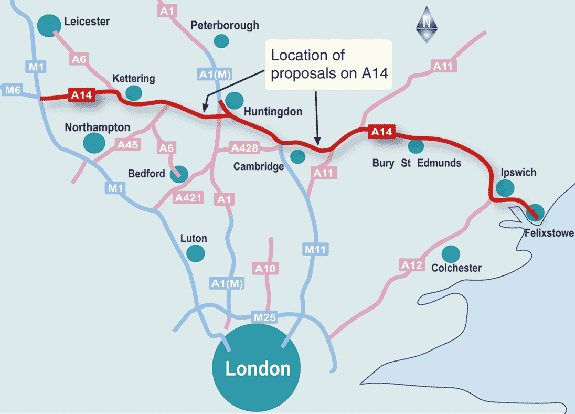
The A14 upgrade project in detail
The map above is a detailed description.  The upper part depicts the Huntingdon Southern Bypass (which looked like it could be tolled) , the lower part the doubling of capacity on the A14 northwest of Cambridge from 2 to 4 lanes each way, and then the widening of the Cambridge northern bypass (with a series of junction and link improvements.

Wednesday, 18 September 2013

A14 project to have one tolled section

With the announcement of the Investing in Britain's Future programme for infrastructure investment, the UK Government has essentially decided to fund all of the prospective projects on the Highways Agency's books in the coming years, included the long mooted A14 upgrade.  That project is expected to cost £1.5 billion and involves 25 miles of upgraded and new highway, with new lanes and a new bypass.

Full A14 upgrade project, only the orange section will be tolled.
I've written previously about proposals to toll parts of that project.  It now seems that the idea of building a new expressway parallel to the existing road, and tolling it, has been dropped.  Now it is just the Huntingdon Southern bypass that will be tolled, so that only a relatively small proportion of the project's total costs will be recovered directly from road users.


proposed Huntingdon Southern Bypass toll road
So it will be a new section of road that is likely to be tolled, at fairly modest levels (£1-£3 between 0600-2200, with no tolls at other times).  The technology planned to be used is an Automatic Number Plate Recognition system, presumably with prepaid and postpaid accounts (although details have not yet been developed).

Alternative untolled routes

The new tolled route will be superior to alternatives, not least because part of the existing route is to be demolished (the bridge over the railway at Huntingdon).  This is likely to be controversial as it will mean the untolled alternatives will be substantially inferior to the current option (which will be gone).   The reason for that is entirely to ensure the new tolled route generates enough revenue to justify the toll.  I'll leave it to others to determine if that fits into the "only toll new capacity" position of the Government, when the old capacity is substantially reduced.

It looks like this will be the UK's next new toll road on the strategic road network, with construction to start in 2016.  At the moment, this final proposal is out for public consultation (the full consultation pamphlet is available here), but I expect it to proceed in full.


Thursday, 9 August 2012

News briefs: Australia, Florida, Mexico, UK, Virginia

Australian Federal Opposition suggests more tolls

Australia's Federal Shadow Treasurer (Opposition Finance spokesman) Joe Hockey (LIberal Party) has suggested to the Western Australian State Government that it should consider tolling, pointing out how successful it has been in New South Wales.  According to the Australian Broadcasting Corporation he said:

"From a federal government perspective there is limited money available for infrastructure"

implying that states that adopt tolling are more likely to be considered sympathetically for future funds compared to those that do not, presumably because tolling states have shown greater willingness to get motorists to pay directly for their infrastructure.

Both major parties in Western Australia continue to oppose tolls, but how long they can do so is questionable.  There are no toll roads in Western Australia, but there is a growing number of major highways around Sydney, Melbourne and Brisbane with tolls.  Given much of Australia's highway infrastructure is partially funded from the Federal Goverment paid for by fuel taxes, the inevitable question will be whether states which don't seek to recover whatever they can from tolls should be entitled to the same share of revenue from that tax.

Brisbane's new toll road impresses - but it's free for now

Finally, Brisbane's long awaited AirportLink toll road is opened and media reports indicate that motorists are impressed with the time savings it offers.  That bodes well, the more that try it out for free, the more who will think it is worth paying for, so the owners are hoping.  I profiled the road before, noting that the first month it will be completely toll free, and the subsequent two months it will also be free but users will need to have signed up for an account.  After that, tolls will increase sharply in 6 monthly intervals.   Time will tell if this strategy works.  I suspect it will at first, but such rapid inflation in pricing will put people off too soon, and it may be wiser to wait for a year before making such significant price hikes.   Curiously one report states people queued for "hours" to be the first on the new road.  Does the prospect of a new toll road generate that much excitement and patience elsewhere?

Meanwhile the HeraldSun reports that Brisconnections is trying to avoid the mistakes made around the nearby Clem7 toll tunnel, by being friendlier towards customers with better signage and clarity around speed limits (there was a higher than average level of speed fines on Clem7, with some violators claiming they didn't know the speed limit).

Florida to study shifting toll tariffs towards congestion based pricing

TV station WFTV9 reports that in Florida "Taxpayers are funding a study that could help set even higher toll prices during peak hours on the Florida Turnpike, State Road 528 and State Road 417". ..

The Turnpike Authority received a $400,000 grant from the federal government to study the concept in Florida's three metropolitan areas including, Orlando, South Florida and Tampa. 

The reason for the study is to manage demand on sections that are too expensive to widen, but there is local concern about traffic diversion.  Presumably the study should also consider lowering tolls at off peak times to counteract peak tolls, that is assuming toll revenue is adequate to cover infrastructure costs.  No information about the proposed study is on the Florida Turnpike Authority website.

Mexico - Libramiento de Matehuala highway has steady growth in demand

Standard and Poors affirms the BBB debt rating on the Libramiento de Matehuala toll road in Mexico according to Reuters.  The road is a 14.2 km long toll highway between Mexico City and Monterrey which bypasses Matehuala, on the San Luis Potosi-Saltillo highway.

The report continues:

For the 12 months ended June 30, 2012, traffic increased 4.1% due to the stable economic conditions in the country. Also, revenues grew 9.6% because of higher traffic and tariffs in line with inflation, and a favorable traffic mix, with trucks making up almost 60% of the vehicles on the road. We expect traffic to grow at an average rate of 3% throughout the term of the debt, which reflects the road's vital trade link between Mexico and the U.S. as part of the NAFTA corridor.
The report claims it requires minimal maintenance given its construction is in hydraulic concrete.  Demand is highly dependent on commercial activity and it faces toll-free alternatives.  It has been open since 2004 and carries around 8,579 vehicles per day (low for a toll road).  Tariffs are listed here (in Spanish) ranging from US$1.45 for a car to US$7.24 for the largest trucks.  The concession allows tariffs to be increased in line with inflation.

UK - Lukewarm reception for A14 toll idea

I wrote before about the UK Government's plans to help fund one of its largest highway projects with help from tolling.  It would be fair to say that enthusiasm for tolling is weak at best.  Local newspaper Peterborough Today reports that local businesses are concerned about tolling increasing their costs or that motorists will avoid the tolled route increasing traffic on local roads.   The local Chamber of Commerce head says it might be a "necessary evil".  Clearly there is a lot of work to do to convince people that accelerating a long delayed road project is better than not doing anything at all, but more importantly that the tolling plan envisaged wont make traffic worse.  The key will be to demonstrate that people can either choose to drive the existing route (in one form or another) untolled or have an improved route that is tolled.   Meanwhile, anti-road lobbyists the "Campaign for Better Transport" and "Sustrans" are opposed, because they don't believe in major highway improvements at all - suggesting rail freight improvements would be preferable and that building a toll road will induce additional demand.  It would seem that using pricing to manage demand is considered unacceptable if it means new capacity is funded by it.

Virginia - Dulles Greenway credit rating maintained

Owner of the Dulles Greenway, Toll Road Investors Partnership II, has had its credit rating of BBB- confirmed by Fitch according to Reuters.  TRIP II is 50% owned by Macquarie Atlas Roads.


Key points reported about the toll road (which is just over 20km long from the end of the Dulles Toll Road to the Leesburg Bypass in Virginia):
- From 2013 through to 2020 tolls can escalate annually at the highest of (i) CPI + 1% (ii) Real GDP, or (iii) 2.8% per annum;
- Year on year traffic increased 1.8% by May 2012, but tolls had increased by 6.7% in January 2012 resulting in a 10% increase in revenue year on year;
- This is only starting to offset a year on year decline in traffic since 2005, due to a combination of the economic situation and improvements to parallel routes.


Thursday, 19 July 2012

UK government adds new (A14) toll road project to programme

The UK Department for Transport has announced that a "major new scheme" has been added to the Highways Agency programme for development, specifically being a remodelled version of the deferred A14 Ellington to Fen Drayton upgrade which I wrote about here.  In essence, this was one of the largest projects on the Highways Agency books that was indefinitely deferred because of cost, now it has been revived in a modified form, with tolls.

The official statement says:

Study work has confirmed that funding for these can be generated in part through tolling a length of the enhanced A14, featuring around 20 miles of new or widened road. However, more work will be taken to determine the best tolling solution, including what length the tolled section should be, how users would pay and what the tariff should be.

What does the new proposal involve?

There are no published maps yet of the preferred option, but many options presented in earlier work undertaken for the DfT.

The project has three core segments:

1.  Widening of part of the Cambridge Northern Bypass.
2.   Construction of new parallel local roads to the A14 from Cambridge to southeast of Huntingdon, and upgrading the existing A14 (perhaps elevating it to motorway status);
3.  Construction of a bypass of Huntingdon on the southern side to the A1.


The first segment is almost certainly not going to be tolled, as it involves simply extra lanes.  Tolling these lanes would generate little revenue and usage, because the distances are too short, and tolling the entire road is out of the question, as it would partly defeat the purpose of the bypass in keeping traffic out of urban Cambridge.  

The third segment  is conceptually easy to toll, as it is a new road, and so should be able to generate some revenue from motorists avoiding delays on the existing one.  However, on its own, it wouldn't be expected to generate much revenue.

The second segment  is the most interesting.  It is government policy to only toll new capacity, and what is proposed is that the current road be retained and enhanced, but disconnected from the interchanges along most of its length.  In parallel, new local roads will be built either side (presumably one way each way) that are connected to the interchanges, essentially performing the function of the current A14 for local traffic.

That allows for the option to leave the new local route untolled, whilst tolling the new one, meaning that local residents wont be disadvantaged, whereas through traffic pays for the new capacity.

It would make sense for this segment of the A14 to be redesignated into motorway as it would have no interchanges of any kind.  With the removal of local traffic it would not need to be widened to six lanes, as there could be four lanes of untolled parallel road for such traffic. 

In short, a rather innovative approach has been proposed that means building a new road, with the same capacity as the existing road, for local traffic which will be untolled, whilst treating the existing road as the "new capacity" for tolling purposes as it will be literally an expressway between the Cambridge northern bypass and M11 and the Huntingdon bypass.

This option appears to correspond to the tolling assumptions made in the report to DfT on options published earlier in the year which states:

• tolling is only possible where a viable alternative for local traffic is available (Achieved);
• when a toll is levied only strategic traffic would use the new sections and hence incur a charge (Achieved);
• the charge would be levied in peak periods only (3 hours in AM and 3 hours in PM) (this is interesting);
• the charge is made for each passage of the route; and
• freight vehicles are charged at a toll twice that of private cars ( the assessment has been undertaken based on a toll of £3/£1.50 respectively).


It is unclear if it is now proposed that tolls be for peak periods only and at such low rates.   Opponents to road building, the Campaign for Better Transport, suggest that £370 million could be raised from tolling (disapprovingly), which is a sizeable contribution to a project likely to cost around £1 billion.

Summary

It is important to emphasise that this project is not going to be fully funded from tolls, and it isn't clear what proportion of funding will be generated from tolls (and that will be dependent on the scale and level of tolls).  However, the mere fact that tolling is being encouraged is promising for projects on this scale, albeit there are few such projects in England (bear in mind, tolling is only a matter in England, as Scotland, Wales and Northern Ireland have devolved governments that have their own policies on this).

It is more important to note that it hasn't been approved for funding yet.  No doubt it will be a prime candidate for private investment in highways, whether it be through a renewed Private Finance Initiative (PFI) programme, or a more innovative and far-ranging move to privatise some highways (e.g. one can envisage the A14 being leased off to a private company for 40 years in exchange for undertaking this upgrade work and operating the road).   

This could be the first step on an interesting journey for the future of highways in the UK. 

However it is most important to emphasise that my interpretation of what could be tolled may not come to pass.  The Huntingdon bypass segment is likely to be considered easiest to toll, and I expect the tolling of the Cambridge-Huntingdon segment will create some controversy.

Hopefully it will be packaged up as potentially the UK's first serious highways privatisation, with a mix of toll funding and service payments from central government.   However, reports that construction couldn't begin before 2018 demonstrates that one of the biggest bottlenecks is the planning process.  It takes far longer to plan and select options, and gain approvals to build a road, than to actually build it.

What should happen now?

There will be consultation on the options, but already the AA is opposing the idea of tolling the existing road beside a new parallel untolled road (with the same capacity as the existing road).   What's going to be important is the detail.

The Huntingdon bypass being tolled will be relatively uncontroversial as long as the current route is not downgraded, such as imposing speed restrictions.

The Cambridge to Huntingdon bypass segment will be controversial, especially if the new parallel local route is a substantial reduction in standards compared to the current road.  If it isn't dual carriageway and isn't grade separated, or is significantly speed restricted, then it will be disliked, as motorists will have to use the existing road - tolled - with no interchanges - to maintain the same level of service.   Yet if the new road is similar to the existing road, will it mean little use of the tolled "express lanes" as the existing road will become? 

The previous reports on A14 options considered tolling only at peak times.  That may actually be one of the keys to making it more acceptable, but will it be unduly restricting revenue?
 

Thursday, 20 October 2011

A new toll road for Britain? UPDATED

One of the largest new road project proposals in the UK is a £1billion proposal to upgrade the A14 highway.  The project has the following components:
  • A new dual carriageway to the south of Huntingdon between Ellington and Fen Drayton with three lanes in each direction (except between Ellington and the A1, where only two lanes would be needed);
  • Widening of the existing A14 to at least three lanes in each direction between Fen Drayton and Fen Ditton;
  • Local access roads alongside the widened A14 to separate local and strategic traffic;
  • Major interchanges with the A1 at Brampton, the existing A14 at Fen Drayton and the M11/A428 at Girton.
The importance of the A14 may not be obvious, but it is essentially the key link between the busy port of Felixstowe (and the nearby port of Harwich) and the West Midlands, including Britain's second (equal) largest metropolis - Birmingham.  The West Midlands is the location of a lot of logistics, warehousing and distribution points for England, so this route is busy with a lot of trucks.

Public funding for the proposal was suspended by the British government in October 2010 because of pressures on the UK’s budget deficit that saw almost all areas of public spending subject to review in order to cut spending.  The project is currently suspended.
Where Britain's next toll road might be - A14 in the East Midlands

As a result, the then Transport Secretary Philip Hammond has been considering transferring the entire highway (127 miles) from Felixstowe to Leicestershire to private ownership according to the East Anglian Daily Times. The intention being that the upgrade work could be undertaken, but with toll funding.  A final report to government on alternatives to 100% public funding is expected in June 2012.

However, the idea has not been embraced by many local residents, nor by local politicians even though they are from the ruling Conservative Party.  Local MP Dr Therese Coffey (Conservative) has expressed concern, whilst another local MP, Daniel Poulter (Conservative), is concerned about people avoiding the toll using roads through towns, increasing congestion.

It is understandable, given that tolling would almost certainly have to include the existing road, and so would have to be priced to avoid such diversion. Given the dearth of major highway toll roads in the UK, the likelihood is that more motorists would avoid the toll than would be economically rational, as the perception of the cost of paying a toll when one is not used to it, is likely to be higher compared to a situation where tolls are common.   The only other toll roads in the UK are crossings, except for the M6 toll (which bypasses a section of untolled motorway that is periodically congested).   I suspect modelling of demand for the A14 upgrade as a tolled route will be sensitive to the maximum amount of revenue possible vs. the costs of diversion.

Certainly full points for the British government for being innovative, but given the UK has some of the highest fuel taxes in Europe (with the equivalent of less than 20% of that revenue spent on roads), it will be unsurprising if tolling an existing road in itself is unpopular.

UPDATE: More details released on the preferred concept for tolling the A14

Tuesday, 30 November 2010

UK investigates more tolling and private finance

Cambridge News reports on how the UK Department for Transport is to investigate whether tolling can be used to help pay for a proposed new A14 highway.  The £1.3 billion (US$2 billion) A14 widening and realignment project was deferred by the recently elected Conservative/Liberal Democratic coalition government as it cut spending to reduce the UK's burgeoning budget deficit.  Alternative ways of funding the project are being investigated, which if tolling was to be included, would mean building an entirely new route (so that the tolled route would be entirely separate).  This is likely to be part of a wider investigation into whether tolling can be used to fund new routes in the UK.

Odds are it wont make much difference, because the biggest problem the UK has with tolling is the very high price motorists already pay for as a part of road use.  £0.5819 per litre on unleaded petrol (plus VAT) is one of the highest levels of fuel tax in the world, none of which is hypothecated to road spending (and if new road projects were calculated on the basis of revenue generated from their use it would be interesting).  Still there is scope for more toll routes in the UK, the bigger issue is whether the UK can get over the planning barriers, NIMBYism and disbelief in road building that has hindered much highway development over the last 20 years.