Showing posts with label India. Show all posts

Monday, 9 April 2018

Congestion pricing for Delhi?

Delhi's congestion is chronic, as incomes have risen, car ownership has risen and by no means has Delhi been able to increase road capacity to meet this demand. Neither TomTom nor Inrix have data for congestion in Delhi, but the Centre for Science and Environment in India reports:

Average traffic speed on 13 arterial roads 50-60 per cent lower than their design speed and 35-48 per cent lower than the regulated speed of 40-50 km/hour 
No non-peak hour now on main arterial roads -- virtually no difference in time taken to travel between peak and non-peak hours 

The Hindustan Times claims that Delhi needs to replicate the success of Singapore in charging for road use.  This is a fair assessment, although I would caution simply thinking that what Singapore did could be replicated in Delhi.  For a start, Delhi needs to have a reliable motor vehicle registration database correlated to number plates for enforcement purposes.  It isn't clear that it does.  Without that, there simply cannot be a congestion pricing system at all. Secondly, there would need to be effort made to ensure that basic steps are made to ensure alternative modes are able to function appropriately.  That means making it easier to walk and cycle, as well as bus priority measures which are rigorously enforced.  Finally, there is a need to ensure that the solution for Delhi is implemented incrementally.  Don't try to replicate any other city's ideas wholesale, but look at charging a handful of locations initially at the most seriously congested periods, to see what the results are.

Yet Delhi has a network of toll roads, which use manual as well as electronic tolling.  The obvious first step ought to be conversion of all existing toll roads in Delhi to fully electronic free flow operation.  India has already mandated the National Electronic Toll Collection programme for national highway, so this provides a good starting point.  That's not to mean that the same system should be used.   There are sound reasons for thinking about competitive service delivery in terms of accounts, but if Delhi wants to move quickly, its existing toll roads provide a starting point to test charging without any barriers, and to also test charging higher at congested periods.

Delhi has tried demand management of road use

The odd-even number plate test in January 2016 was a success according to The News Minute.  This pilot meant that from 1 January-15 January, from 0800-2000 only odd-numbered cars could drive 


Delhi's Odd-Even number plate tria

Indian Express reports speeds went up 5.4%, particulate pollution decreased by a relative 10-13% on average, with notable results either side of the period the test was in force.  In other words, pollution declined after 0800, and increased again after midnight (because a new rule on truck traffic restricts much of that traffic to the midnight-0800 period).  

An odd-even policy isn't a very good idea though, primarily because it rewards those who can afford two cars and can encourage those with one car to buy a cheap, old, more highly polluting vehicle to avoid the restriction.  However, the policy did prove that influencing traffic demand in Delhi can improve results.  (More details on the results of the test are available here PDF). 

Criticisms need to be addressed

An article in Outlook India by Dinesh Mohan (Honorary Professor at IIT Delhi) basically indicates scepticism that it is the solution for Delhi.

quotes a number of academics to put some doubt about the efficacy of congestion pricing, yet none of these offer any evidence.  He quotes Professor Peter R. Stopher of the University of Sydney as saying “that charging motorists a politically acceptable amount will probably still not make significant impact on overall system congestion, while the potential for serious impacts on the economy become large if the charges are made sufficiently high or the area covered is made sufficiently large.”  Yet this seems to presume that charging means some sort of cordon or area charge.  There has never been a scheme to date that charges congestion on a system-wide basis.  Singapore is the closest, but is still far from being a network charging system.  What IS clear is that there are positive results where charging has been applied appropriately, such as in Singapore and Stockholm.

He then quotes Brian Taylor from UCLA as saying congestion is a "sign of success", which is not what many road users think.  The analogy with restaurants is hardly appropriate when people have choices between thousands of restaurants in a city, and the restaurants that are most successful can either raise prices to increase profits, or expand locations to cope with demand.

Mohan's claim that "there has been little consensus among thinking traffic experts on how to think about urban traffic congestion and how to deal with it. This is why there are very few cities the world that had the courage to experiment with the concept of congestion charging" is quite wrong.  There is widespread consensus that pricing of road use would reduce congestion, the reason pricing has been applied in few cases is a mix of political will, lack of innovation in the development of options for pricing and the inability to communicate to a sceptical and untrusting public that paying to drive on some roads at peak times will improve conditions for them.

Certainly Delhi is different from all other cities that have introduced congestion charging, but the claim that it is very expensive to implement is simply wrong. The costs of Automatic Number Plate Recognition (ANPR) technology have dropped significantly in the past 15 years and improved in reliability.

Delhi needs a congestion management strategy

I don't doubt that there are many other ways to address congestion in Delhi that need to be explored as well.  Enforcement against illegal parking and considerable work to improve the design of existing roads could help ease congestion, along with enforcement of behaviour that promotes congestion (such as poor lane behaviour).  Delhi needs a congestion management strategy, this would consider a wide range of measures including:
  • Design of existing road infrastructure, including traffic signals, roundabouts, intersections, lanes, parking restrictions. 
  • Enforcement of traffic and parking offences.
  • Provision of adequate facilities to ensure walking and cycling can be undertaken safely and easily for short trips.
  • Public transport provision, including priority for public transport.
  • New road capacity where appropriate.
  • Road pricing.
Road pricing should be a part of this, but objectives need to be clear. Delhi still has a significant population that does not drive, but may be expected to want to own a car in the next 10-20 years. Although it's unreasonable to expect this desire in owning a car to be curtailed, that isn't a reason to not ensure that low cost alternatives are not made as reasonably attractive as they can be (walking and cycling), and that corridor space is set aside for bus transit to be developed (as Delhi also grows its underground metro system).  Delhi may also seek to wrestle control of its commuter railway system from Indian Railways, so that money can go into enhancing system capacity, whether by track, signalling or rolling stock (and to try to capture the growth in fare revenue to pay for these improvements).

For road pricing, Delhi should get its road management right more generally, and after converting existing toll roads to free flow tolling, with peak charges to help spread demand, pilot charging on critical parts of the highway network where diversion can be minimised.  Singapore does have an effective approach to reviewing and updating charges, and incrementally Delhi can develop a network of charging, that generates revenue that will be needed to fix intersections, corridors and other parts of the road network that need modernisation.

Tuesday, 17 February 2015

The "war on cars is winnable" doesn't need to be "a war"

An interesting, but lengthy article by Carlin Carr on a Scroll.In website puts forward the case for how cities can avoid being heavily congested by cars, and makes some valid points.

For Japan, yes here is a country with dense rail transport, albeit much in dense cities where such rail is profitable.  This has meant that rail travel is very normal for residents in major cities and between cities, bearing in mind distances between many of the major cities are not large, lending themselves well to fast rail travel.

What missing about the analysis around Japan is two key factors. The ruling Liberal Democratic Party (which literally monopolised government in Japan until the 1990s) has always been closely aligned to the construction industry, which was largely relaxed as to whether vast amounts of money were poured in roads, railways or airports.  In truth, Japan has overbuilt much of its infrastructure, with there being more than enough road and railway capacity outside metropolitan areas.  While the original Shinkansen lines have demonstrated positive economic results, more recent lines have not, as they simply reflect a belief that building infrastructure is good in itself.  It isn't, and Japan is, in part, paying for this now, with public debt in excess of 200% of GDP, and a stagnant economy.  It's worth noting Japan's railway system is privatised, and has always has an element of competition even before that.  The second point is alluded to in that all major national highways are tolled, and urban routes may also be tolled, but the national highway network is Japan is privately owned (under a PPP lease).  As such, the roads are managed commercially and tolls set to recover maintenance costs and the cost of the lease of the assets, so tolls have to cover costs and generate a return.  Yes the shaken (regular safety inspection and tax) does incentivise lower levels of car ownership, but it also incentivises rapid turnover of the fleet, with old vehicles not remaining in the fleet in large numbers because of the costs of them meeting safety and emissions standards.

Singapore remains the world's most sophisticated example of urban road pricing.  No other city charges by route, direction of travel and time of day with differential pricing based on congestion, and it works very well.  Yet many will point out that Singapore has specific characteristics that make it special.  One is that housing density is high, as a city-state, it is easy to develop the densities of travel that make public transport viable.  Singapore's metro, for example, does not require subsidies for operation and renewals.  Secondly, is that Singapore has a combination of a highly credible judicial system and public bodies for enforcement, and a culture of compliance that means it is easier to implement such a radical solution in the city-state. 

As far as solutions are concerned, there is plenty of merit in developing cities in countries like China and India providing heavily for pedestrians and cyclists, so that these options for short trips remain preferred, and then to focus on enforcing parking laws and in rationing parking by price.  Beyond that, regardless of whatever planning options are chosen, the future for rationing road space belongs to road pricing.

Of course, to do that requires some key elements to be in place, which includes the ability to robustly track down violators and to enforce violations meaningfully, which isn't always possible in countries where number plates and databases of owner records are haphazard.

However, my main point is that it shouldn't be seen as a "war" on cars.  Cars have a role in cities, it is just about how cities ration precious road space so they pay for it appropriately.  Of course not everyone can use their car at the same time, it's not physically possible and when they try, it creates negative externalities for others.

Rationing road space rationally!

Yet, if you pay to park and pay to use the roads, at a price that ensures an efficient flow of traffic, then it should be fine to use your car.  Disabled motorists might be given preferences or discounts to recognise that alternatives for them may not be viable, but overall the roads can be managed so that, like other scarce resources, their use gets rationed by price.  

The first step to doing this is to ration road use by basic enforcement of requirements around safety - that drivers have licences, that vehicles are safe to be on the roads, and for regular violators of safety related laws to lose licences.  It requires that parking laws be enforced where they interfere with road safety and capacity, but after that a rational approach to rationing road space used for parking and loading should be considered.  Charging for access, time limiting access for loading, setting aside spots for disabled vehicles and bus stops, all of these sound basic to those with well developed highway rules, but need to be the first approach for many developing countries.

Intelligent technology makes dynamic parking charges all the more possible, and from then we go to pricing.  Whether it be tight city centres, or major new capacity, or charging cordons, zones or by distance, it can be introduced in steps, and what it is about, is not just thinking about mode choice but route choice and time of day choice,

No planner can second guess the best option for anyone on a particular trip whether it be for themselves, family or for goods, but by pricing roads and parking rationally, these choices can appear, and can come from either using roads differently, or using other modes.

It's not about a war, it's about applying a rational approach to rationing a scarce economic resource, 

Tuesday, 1 April 2014

Congestion charging in Mumbai? More mundane reforms needed first

DNA India reports on growing congestion in Mumbai and how congestion charging has been raised as a possible solution.  The city has faced a 7% increase in vehicles in each of the past seven years and has been mulling various demand management options including a 200% tax on a second family car.  Whilst it is clear Mumbai can't sustain every increasing growth in vehicle usage and ownership, the point is that it will stop eventually, and having blanket taxes on home ownership will open ample opportunities for evasion.  The obvious one will be to register vehicles at addresses of family members without cars.

The article does talk about congestion charging elsewhere, not representing the examples it uses well (Singapore has moved well beyond the Area Licensing Scheme and "value pricing" in the US is HOT lanes, which offers little in this context).

Certainly there is wider interest at the central government level in India about congestion charging, but it is a local matter and as such it seems unlikely that this will be implemented in advance of other measures, and in fact I wouldn't do it before the other measures given how important they will be in helping address the problem.


Friday, 7 June 2013

News Briefs - Hungary, India, USA

Hungary - Budapest unlikely to introduce congestion charge in short term

Following on from the report last year that the Hungarian Government had suspended development of a congestion pricing scheme for Budapest (which had received money for its metro system from the European Commission contingent on introduction of such a scheme), Caboodle reports that the Budapest Public Transport Centre, CEO David Vitezy, says that it wont happen in the next two to three years.

He says that until there is more public transport capacity, it can't be done.  He wants the fourth metro line (under construction) and some new tram lines built first.  I'm slightly curious about this, given Budapest functioned for many years with the existing public transport network and much less car traffic, and has had relatively static/declining public transport usage for some years.

However, I suspect the politics around this are too difficult for now.

India - Andhra Pradesh state may establish hypothecated roads fund

According to The Hindu, the Andhra Pradesh Road Development Corporation (APRDC) is considering replicating what has been done in four states (Assam, Kerala, Maharashtra and Uttar Pradesh), by setting up a dedicated roads fund which would receive revenue from motoring specific taxes.  The primary reason being to allow for better quality and longer term funding decisions on road infrastructure, than ad hoc annual funding decisions competing with other public spending.   In addition, it is intended to support the autonomy and accountability of the APRDC in delivering improvements to the network.   Taxes on motor vehicle ownership and fuel, tolls, and other revenue sources may be dedicated to the roads fund.  A key priority is to fund major safety improvements to reduce the high accident and road fatality rate on the state's roads.

USA - Texas - article on tolling

The Texas Tribune has an excellent four part series of articles on toll roads in the state.

- Part One. Includes an interactive map of toll roads in Texas, which looks like not much given the size of the state, but are clustered around major cities.
- Part Two.  Describing the rise of tolling in Texas.  Noting that fuel taxes have not risen in Texas in 20 years, that more than 150 miles of toll roads have been built in the past six years and the growth in private sector interest in building, owning and operating such roads.
- Part Three. Focusing on HOT and other toll lanes in Texas.
- Part Four.  On the failed Trans-Texas Corridor proposal and what came after.

Friday, 3 May 2013

News Briefs - China, India, UK, USA

China - Poll rejects congestion pricing

China Daily reports that an online poll (yes I know) by China Youth Daily saw around 75% of respondents oppose congestion charging for Beijing, preferring to support "improving the city's planning process, the road repairing projects, and the traffic management mechanism" to reduce congestion.  Good luck with that then.

Hong Kong - Hopewell retains BBB- Fitch rating

Reuters reported in October 2012 that Hong Kong based toll road investor, Hopewell, retained its credit rating with Fitch.  Hopewell Holdings owns 68% of Hopewell Highway Infrastructure Limited, and Fitch reported:

Hopewell Highway Infrastructure Limited (HHI), continued its stable performance in the financial year ended June 2012 with a 5% increase in revenue. An overall increase in traffic volume is driven by continued economic growth in the Guangdong province, and improving connections to local road networks and strategic locations. In particular, the West Route enjoys synergies from completion of Phase II, and average daily traffic grew by 39% in FY12.

A new tariff framework effective from June 2012, as well as the "Holiday Toll Free Policy" effective from October 2012 will adversely affect cash flow generation capacity of the toll road portfolio. Fitch expects the toll road portfolio's EBITDA to decrease by around 15% as a result in FY13. 

Hopewell is in joint ventures with Chinese companies over five toll roads in the Pearl River Delta area of Guangdong province in China.

India - Toll tags may be mandatory

A report from the Deccan Herald quotes N R Gokarn, CEO, National Automotive Testing and R&D Infrastructure Project (NATRIP), a government led project, as saying that "RFID tags" that identify vehicles are likely to become compulsory across India.  This would help with identifying vehicles more generally, as well as facilitating a shift towards electronic free flow tolling.  The National Informatic Centre (NIC) contains data on over 90 million vehicles including owners and insurance details, and it is intended that any such system enable ready access to that database for tolling.

India - IRB acquires MVR


IRB's corporate profile states:

The company, along with its subsidiaries has constructed or , operated and maintained around 8,000 lane kms of road length so far and one of the major road developers in the country. The aggregate size of all our BOT projects (both completed and under execution) is around Rs. 170,552 Million (US$3.1 billion).

MVR Infrastructure and Tollways is a construction and toll road management company based in Tamil Nadu.


UK - Manchester still not interested in congestion charging


A rather odd little news report from the Manchester Evening News notes that a survey recently conducted by the AA indicates 80% of those polled oppose congestion charging for Manchester.  A referendum in 2008 saw a 79% "no" vote for a proposed congestion charging scheme that was to raise money to pay for major public transport improvements.

This is hardly surprising.  People wont vote for what they see as a new tax, especially since central government decided to give Manchester the money for some of the public transport improvements anyway, presumably as an election sweetener, and Manchester local authorities borrowed money to pay for the rest.  Meanwhile, Manchester was hit by the recession, and traffic volumes have not increased since 2008.  Any deal for congestion charging needs to offer something in terms of improvements to roads or reductions in other taxes to have any chance of being supported.

UK - Birmingham's transport authority wants private toll road nationalised

I've written about the M6 toll road before.  It was fully privately financed and built, and runs at a loss, without a penny contributed by taxpayers.   It is heavily under-utilised, in part because tolls are highly priced (but revenue maximising) and in part because the travel time savings are not high, except at peak times when the untolled parallel motorway is congested.

This upsets the planners at Centro - the West Midlands Transport Authority - which is responsible for transport planning in the wider metropolitan region surrounding Birmingham.  Centro has no authority over the motorways, but according to the Birmingham Post, Chief Executive, Geoff Inskip wants central government to buy the M6 toll road, reduce or eliminate the tolls, and so relieve the existing untolled road.  It even suggested tolling the existing untolled road at peak times, to help pay for the purchase.

Now I'm no fan of nationalisation, but tolling the existing route at peak times would provide some "competitive neutrality" between the routes.  One idea is that vehicles are charged to use both routes through fuel tax, but none of that fuel tax goes to the owners of the M6 toll road.  If a deal was done to reduce tolls by a proportion reflecting that contribution, it might make a small difference.

USA - New York - Citizens' Budget Commission recommends higher tolls

Capital New York reported in October that the lobby group "Citizens Budget Commission" proposed that 25% of funding of the New York public transit system should come from tolls:

The commission argues that not only should drivers' tolls cover the upkeep of bridges and tunnels, which they do now, but they should also underwrite a quarter of mass transit services, thanks to all of the "harmful consequences" that drivers cause but do not pay for, like "noise, congestion, air pollution and greenhouse gas emission."

To that end, the commission would raise tolls on M.T.A.-controlled bridges and tunnels to as much as $9 in cash. Right now, drivers pay $6.50. Once the 2013 and 2015 hikes go into effect, drivers will pay $7.50.

Further, the commission proposes raising vehicle registration fees, which are now amongst the lowest in the country, and the gasoline tax.

The CBC also says congestion pricing should also be considered, again.

It also proposes fare increases for public transit.   This doesn't mean tolls on untolled crossings, but raises the obvious question as to why not, as the inequities of only charging some crossings simply becomes exacerbated.

Wednesday, 13 March 2013

India's Ministry of Urban Development promoting congestion charging

The New Indian Express reports that the Ministry of Urban Development Secretary, Sudhir Khrishna (who is a professional civil servant, not a politician, for the sake of clarity), has written a letter to Chief Secretaries of State in the country calling on them to consider introducing congestion charging in cities.

The letter urges a range of TDM approaches, including promoting public transport, cycling and walking (the latter two are far too often neglected in cities), but that resolving congestion can be difficult and needs to involve managing excessive use of private vehicles, specifically recommending cities consider what has been done in Singapore and London.

The article suggests that the original Singapore Area Licensing Scheme, which involved vehicles having paper permits pre-purchased and manually inspected for access into city centres, may have particular potential.

Positively, he seems to be promoting congestion charging as a simple economic concept, whereby those who value a scarce resource the most pay to use it.

India has many toll roads, but has a major problem before it can introduce congestion charging

Tolling isn't new to India, but it is focused on new expressway corridors between cities.  However, they have suffered because tolling is done manually, creating bottlenecks of their own at manual toll booths.   Indeed, India has a whole host of problems around incentives in its PPP toll road programme, which seems to be ripe for some more fundamental reforms, and is a victim of private concessionaires seeking to transfer risk to public entities ill equipped to manage them.

The fundamental problem being the difficulties of enforcing any form of road pricing in India based on tracing violators through number plates.


Without some concerted efforts at federal or state levels to address standardisation of number plates, reliable ownership data and systems for maintaining the accuracy of that data (and facilitating effective debt collection), India can't seriously introduce congestion pricing as is seen elsewhere.

It can and should price and enforce parking appropriately in the interim, as this is a far cheaper and obvious first step.  It can consider a paper based permit system, enforced through parking or at traffic signals, but that has its own limitations.

Moreover, if one of the problems is a lack of decent arterial routes to bypass built up areas, then those routes need to be completed as well.   It is the usual list of issues that cities that are rapidly developing need to address, but a focus on what needs to be done to facilitate congestion charging may help catalyse a look at that. 

Focus needs to be on vehicle identification and enforcement

Brazil is taking an ambitious path, by essentially making DSRC tags mandatory on all vehicles by 2014, which is one way of identifying vehicles and linking them to accounts.  India might do the same, or could simply choose to reform its vehicle registration and number plate system.   All of this requires a lot of effort and cost, but does need to be managed professionally and independently, and backed up by the powers to enforce a standard process on vehicle owners, buyers and sellers.  

Failing to do that will mean calls to introducing congestion charging will be just that.  For unless an electronic system can easily identify, trace and charge or fine a vehicle by itself, and do so accurately and reliably, you simply cannot introduce a modern congestion pricing system.

Monday, 21 January 2013

News Briefs - India, North Carolina, South Africa, UK

Apologies these are a couple of months late

India - GMR Infrastructure looking to sell down toll road investments

GMR Infrastructure owns six highways in India, and according to MyDigitalFC it is looking to sell between 50 and 74% of its stakes in three toll roads.

The report says:

GMR Highways has three toll roads and three annuity roads under operation spanning around 421 km. Also, there are three annuity-based assets under development, totalling around 309 km.

Overall, the company has spent around Rs 1,800 crore (US$332 million) on these projects till now.

Besides there are two toll roads under development in Tamil Nadu and Karnataka aggregating to around 260 km.

The company plans to use the funds raised from the stake dilution to finance the Rs 8,000 crore (US$1.4 billion) Kishangarh-Udaipur-Ahmedabad mega highway project and also partially pare debt in the highways business.


North Carolina - Environmentalists oppose toll roads, because they are opposing new roads

NewsObserver reports that environmental groups are legally challenging new toll roads in North Carolina on the grounds that the need for them has yet to be demonstrated, and that new roads by definition cause environmental damage.

South Africa - Toll operator saves tree

The Witness reports that TRAC (Trans African Concessions), the private concessionaire, that owns and operates the N4 toll road, to relocate 1km of road away from a 200 year old tree.  The gist being that the company was willing to pay R1million ( US$112,000 ) to respond to public concern about the tree.


UK - Conservative Party MP floats reducing fuel tax replacing it with tolls

Andrea Leadsom, MP for South Northamptonshire, has proposed that there be more widespread use of tolls in the UK, and that such tolls should enable a reduction in fuel excise duty, according to the Daily Telegraph.  She is a member of the Free Enterprise Group of Conservative backbenchers who themselves support a more market oriented approach to highways.

Some statements from MPs include:
- Kwasi Kwarteng, MP for Spelthorne  said "Our approach is you should reduce fuel duty, which should reduce its impact. Getting private finance into this makes sense. To expect the taxpayer to pay for our roads without making any distinction between those who do and don’t use it is unfair. I think if there was a real debate we could see a cultural shift.”
- Charlie Elphicke, MP for Dover was reported saying ""The M6 toll has been relatively successful,' he said. Mr Elphicke added that private finance should not only be used for new roads but tolling should be considered where existing roads are widened. "While public finances are in the state they are in, it is something worth looking at."
- Mark Pritchard, MP for The Wrekin said: "Toll roads have a part to play in a mixed economy of of providing new roads as long as there are safeguards about the financial viability and the prices are kept affordable.”

Of course I agree, but it needs to be more strategic, a more comprehensive new deal for motorists that engenders trust in pricing, which simply doesn't exist now.

Thursday, 8 November 2012

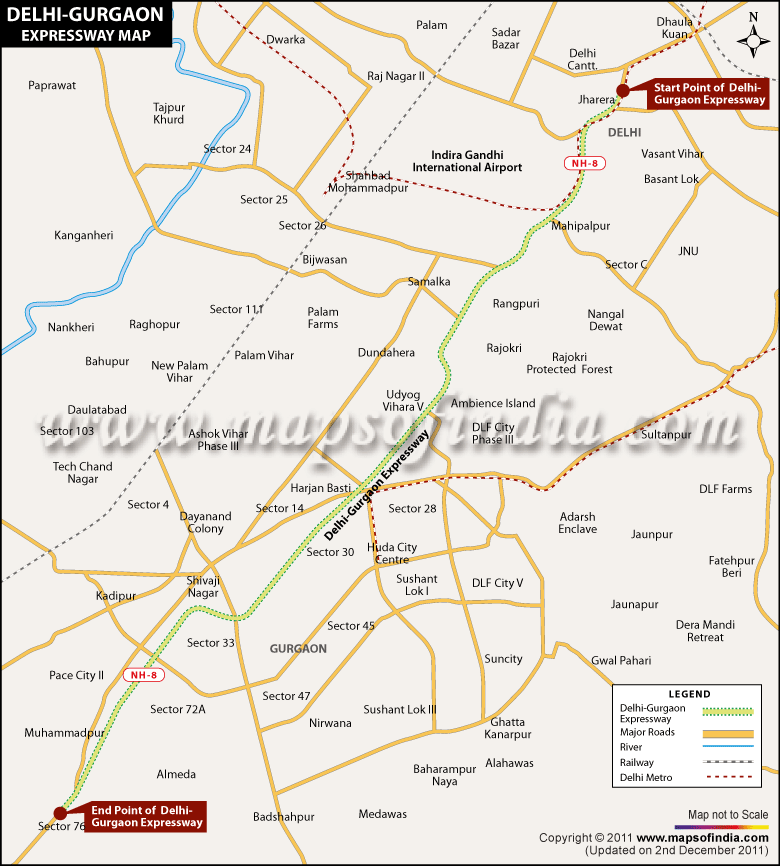
Delhi-Gurgaon Expressway woes

I've written before about the Delhi-Gurgaon expressway, which has one major problem - its toll plaza is chronically congested.

The reasons for this are clear.  The plaza is too small, throughput is inefficient and there is insufficient use of modern tolling technology.  So how is it going to be fixed?  Well the government thought it could be solved by going to court, so operator DS Construction was facing a court case brought by the National Highway Authority of India.  An out of court settlement sees the operator return about US$70 million to five public sector banks that provided loans for the road.  

DS Construction has since been asked by the Punjab-Haryana High Court to prepare a report on how to improve traffic flow according to Hindu Business.

Ideas include the following:
- Waiving the US$29 fee for tag users, and cutting the monthly account charge by a third;
- Adding four reversible lanes at the congested toll plaza;
- Introducing toll collectors walking with hand held devices along queues to accelerate payment;
- Penalising non-tag users who enter tag lanes.

The Hindu Business Line says that an out of court settlement has been reached about the road.   Charges for prepaid users are to be cut by a third, which will encourage a shift from cash to account payment.  Smart cards will also be available for faster payment in cash lanes.

Meanwhile, Rohit Baluja,  President, Institute of Road Traffic Education in an article in the Times of India claims the problem is because of a lack of indigenous Indian traffic engineering capability  There has been a total lack in the application of traffic engineering. Most developed countries have traffic engineering centres in cities as well as for the highways. But India hardly has any functional or scientifically operated traffic engineering centres, as most of such services are outsourced to consultants.

Of course this isn't a clear explanation, what is more important is being able to procure concessionaires and specify service standards that require them to get consultants to deliver outcomes that are sought.  

He is right in saying that technology and engineering could help solve the issues on the expressway, but  this is a governance matter.  He is also right that traffic management needs to be integrated and development of new highways must also be reflected in works on the roads that they connect with.

India's rapid growth in traffic will mean both the new tolled routes and the routes they bypass will need to be upgraded, which means having an approach to highway funding and governance that radically changes the relationship between government, concessionaires and road users.  There is a path forward, it is not ad hoc changes to meet individual cases, but a strategic approach to the long term maintenance, construction and operation of national strategic highways.

Meanwhile, The Times of India has published a rather odd review of electronic tolling technologies that briefly considers Singapore, Dubai, France and Toronto.  It is largely correct as far as it goes, but it should have considered technologies rather than locations.  For example, there are a wide range of electronically operated barrier systems, fully free flow DSRC based electronic systems (with variations between passive and battery powered systems), automatic number plate recognition based systems and (completely ignored in this case) GNSS based tolling.   What will happen in the future is likely to see vehicles equipped with communications and vehicle ID technology at source, and for smartphones and vehicles to be connected to better enable automated options for toll collection.

Thursday, 27 September 2012

Delhi to focus on parking before congestion pricing

The Economic Times (of the Times of India) reports that the Delhi Government has decided to implement a number of measures short of congestion charging to address growing congestion in the city.

Parking fees are to be increased, and enforcement of minimum emissions and safety standards of vehicles will be toughened significantly.  The expectation is that this will remove a number of vehicles from the road, as well as having positive impacts on emissions and safety.  The only problem is that this will undoubtedly target the lowest income owners of motor vehicles (who by Delhi standards are still middle income households).  

Certainly this approach makes sense, as without the ability and willingness to effectively enforce laws against vehicle owners, it is doubtful that a Delhi congestion charge could be enforced either.   A sustained effort over six months to fine or remove vehicles that don't meet laws on safety or emissions would help stem the growth in traffic.

On parking, it is also reasonable and relatively low cost to adopt robust policies on restrictions and pricing that will help traffic to flow freely and to let parking pricing be market led.  Whilst Delhi may not yet be ready for the sort of radical parking pricing now seen on trial in San Francisco and Los Angeles, a focus on parking should be the key for the immediate future, although it will not be sufficient.

There are 6.5 million vehicles in Delhi today, a number that increases on average by about 1,000 a day (the report notes there were 562,000 vehicles in 1981).  Ownership will continue to increase, and whilst public transport can be enhanced (and walking and cycling should not be neglected) and parking addressed, the fundamental problem of traffic congestion is demand exceeding supply, without the price instrument to manage it.

If Delhi can demonstrate that it can effectively enforce laws against vehicle owners on safety, emissions and parking, it shouldn't be hesitant about more detailed consideration of congestion pricing, even if it is likely to be the last policy instrument taken to help relieve traffic in the city.

Wednesday, 12 September 2012

News shorts - Florida, India, New York, North Carolina, Ohio and Texas

Florida pursuing tolled upgrade of existing highway

The Florida Times-Union/Jacksonville.com reports that the Florida Department of Transportation is to commission an upgrade of the First Coast Outer Beltway that will see it widened to a grade separated four lanes highway with tolls.  Tolling will be done on a segmented basis, with rates of US$0.20-US$0.60 for cars per segment, effectively creating a distance based toll along the highway.  Florida Turnpike Enterprise (a business unit of Florida DoT) will finance the project estimated to cost US$230 million which will be recovered from tolls which will be entirely electronic free flow using the established SunPass system.

Despite criticism from some quarters, based on a vote in 1988 that saw Jacksonville abolish tolls in favour of a small sales tax (an economically regressive and irrational measure) "Florida Transportation Secretary Ananth Prasad said the current sales taxes and gas taxes that fund transportation are not sufficient to build something like the Outer Beltway"

Potholes on Indian toll road highlights poor incentives

The Times of India reports that "The Ghoti-Padhga toll-way stretch on the Mumbai-Agra national highway has been ridden with potholes, for nearly the past one month, making it difficult for motorists to drive through the affected sections".

Apparently, the company responsible is simply uninterested in maintenance with the report continuing:  "maintenance was looked upon as a part of expenses rather than looking towards it as re-investment for earnings and hence the proposal had not received a response till date".

Such scant regard for some basic standards on a toll highway indicates an appalling failure on behalf of the procurement and contracting regime for the road.  However, a market led approach would suggest that motorists will increasingly abandon this toll road on the basis that it isn't worth the money.  On the other hand, if the development of PPPs for toll roads in India is on the basis that the private sector will maintain minimum standards of service, then there need to be constraints on such behaviour built into concessions.

New York - Governor "considering" Sam Schwartz's tolling plan

The New York Observer reports that Governor Andrew Cuomo is apparently "reviewing the proposal" of former New York City Department of Transportation Commissioner Sam Schwartz to reform tolling on crossing adjacent to the city in the state.  I wrote extensively about the proposal, which is adamantly NOT called congestion pricing, because it effectively delivers an integrated approach to tolling of major crossings in New York, reducing the prices for trips more distant from Manhatten and introducing tolls on untolled East River crossings.

The article rightly says it is far too early to say whether it will get support, but it is encouraging that the Governor at least appears to be open minded on the issue.  It has the potential to raise more revenue and help reduce traffic congestion, but it also will balance support from those who will pay less on some crossings and those who will pay more or start to pay on others.

North Carolina story shows importance of quality control in enforcement

TV station WRAL, Raleigh North Carolina reports on the case of Jerry Hester, a man who was pursued for enforcement of an unpaid toll bill for the Triangle Expressway, because of human error that mistook the letter N for the letter M.   It appears it took the intervention of a consumer advocacy TV programme (5 On Your Side) to get it resolved with "NC Quick Pass" - the operational arm of the North Carolina Turnpike Authority.

Electronic free flow tolling is being rolled out across the US, although it is some years behind the likes of Australia which has had it now for well over a decade.  Unfortunately, some key lessons learned from free flow systems elsewhere don't always seem to have been embraced.  In this case, it should have been easy for enforcement appeal staff to double check the number plate image and eliminate the penalty altogether, rather than it remaining in the escalating bureaucracy of enforcement.

It certainly shouldn't take a TV programme to highlight such a problem.  This is standard best practice in the tolling industry.

Ohio Turnpike Director advocating wider use of revenues

Columbus Morning Call reports that the Ohio Turnpike Director Richard Hodges is advocating a law change to allow surplus revenues from the toll road to be spent on transportation projects in the state further than 1 mile away from the road.   It appears to be driven by concerns about the growing reserve in the accounts of the Turnpike, which could reflect a lack of useful projects that can be funded from surplus revenues.  Of course, if the turnpike is privatised, this will effectively be the return on the capital asset value that could be distributed to shareholders.

The report also summarises the financial position of the road:

The turnpike, which has $50 million in its reserve, expects to generate $270 million in revenue this year, the newspaper reports. Its operating expenses stand at about $122 million and the turnpike will spend about $90 million on capital projects this year.

Ohio Turnpike thwarts trucking scam

The Trucker reports on how the Ohio Turnpike has stopped a scam whereby truckers avoided paying the full toll price by lying about "lost" toll tickets.  Being a closed toll system (whereby toll tickets are issued at the start, and used to calculate the total toll price depending what exit the vehicle departs from), there was scope to cheat, as described on the website below:

The scam worked this way: A trucker taking a ticket at the turnpike's entry near Indiana would travel across Ohio and claim the ticket was lost when he hit the last interchange before Pennsylvania.

The trucker would pay $44 for the "lost" ticket, the same he'd pay if he had turned in the ticket. After delivering his load to the east, the trucker would head back on the turnpike.

Instead of crossing the state and paying another $44, the trucker would leave the turnpike several exits before the Indiana border and feed the "lost" ticket to an automated fare machine. Toll tickets don't designate east or west travel.

To the machine, the trucker had traveled only a short distance from the Indiana border and would pay, depending on the exit, a toll less than $10, turnpike officials said.

Of course the state is contemplating privatising this toll road, which would raise the incentive to plug any potential holes in revenue, most likely by better incentivising electronic tolling accounts.

Texas concerns about enforcement of free flow tolls against Mexican vehicles

The Texas Tribune reports that officials in El Paso, Texas and some other Texas authorities are increasingly concerned about the inability to enforce violations of tolls on electronic free flow toll facilities on vehicles registered in Mexico.

In short, this is an issue that has been an emerging concern in Europe which faces much of the same issues around cross-border enforcement of such offences.

At the moment Mexican vehicles appear to be a very small proportion of vehicles on Texan roads, but the fear is that more free flow tolling offers opportunities for free-loading.  One idea proposed by El Paso Mayor  John Cook would be the ability to impound vehicles with such fines - effectively the London approach to those who persistently evade the congestion charge.

The report notes:

The situation that some El Paso officials fear is already emerging in a border community more than 800 miles away. The first portion of State Highway 550 opened in Cameron County last year. When completed, the toll road will connect the Port of Brownsville to U.S. Highway 77.


Cars from Mexico on the road, minimal so far but expected to increase, are not being billed, said David Garcia, the assistant coordinator for the Cameron County Regional Mobility Authority

One option would be to enable the border crossing to also be a check for such liabilities, but enabling that is likely to be far from easy.

Tuesday, 21 August 2012

News Briefs - Australia, Brazil, China, India

Australia - Melbourne's car park congestion tax to stay despite low impacts

Public broadcaster ABC reports that the Victorian Government is likely to keep the tax on inner city car park spaces intended to reduce congestion, despite a study that claims it has had little effect on congestion.

Inner city parking taxes are often cited as low cost alternatives to implementing congestion pricing.  50,000 car park spaces in downtown Melbourne are subject to such a tax which is either A$650 (US$682) or A$910 (US$956) a year depending on the location.  The tax was introduced in 2006 and raises A$46 million (US$48 million) a year in revenue for the Victorian State Government.

A Monash University study indicated that part of the tax was being absorbed by car park operators and that there was minimal impact on congestion, it suggested that a better option would be a cordon based congestion charge, although motorist lobby group the RACV (Royal Automobile Club of Victoria) rejected that in a report in the Herald-Sun newspaper claiming motorists are already over taxed, preferring more money to be spent on transport projects.

Brazil - Expiring toll road concessions to be retendered

Nasdaq reports that according to the Estado de S Paulo newspaper, the Brazilian government has decided that when the first toll road concessions expire in 2015 it will re-tender them with the intention that rates of return should be lower.   It will also specify that tolls can only be charged after a certain proportion of improvements to highways have been undertaken by a concessionaire.

"To ensure that 5,700 kilometers of two-lane highways are expanded into four-lane highways by 2018, the government will stipulate that operators start charging tolls only after 10% of the lane-duplication process is already executed" ..."As part of a package to improve transportation infrastructure, the federal government plans to license 7,500 kilometers of highways to private operators for a 25-year period".

Concessionaires have expressed concern that environmental licencing imposes a cost on development that will slow down the period between when they start work on a project and can start charging tolls.


China - Beijing traffic plan includes concept of congestion pricing

Global Times reports that Beijing is to get congestion charging included in its latest traffic plan, although there are no details about what congestion pricing will look like for the city.  The article has comments from an academic who says Beijing also needs more rail and congestion is inevitable with fast growth, but also a local resident who uses public transport and supports the idea.  I wrote some time ago about potential options for congestion charging in Beijing.

India - Macquarie SBI buys into Indian concessionaire

According to NetIndian News Network, Australian/Indian joint venture Macquarie SBI Investment Fund (MSIF) (comprising Macquarie Capital Group and the State Bank of India) has announced it is investing US$150 million into Ashoka Concessions Ltd (ACL) of India, along with SBI Macquarie Infrastructure Trust.  It would appear likely that the reason for the MSIF (and SBI Macquarie Infrastructure Trust) is that Macquarie Capital is restricted from investing in its own right in Indian infrastructure because of foreign ownership limit laws (and the State Bank of India is keen to use foreign capital and expertise).

ACL is a 100% subsidiary of Ashoka Buildcon Ltd (ABL), an Indian engineering and construction firm.  ACL reportedly owns 7 concession toll roads comprising 3,018 lane km (630 length km). ABL itself has a portfolio of 12 Build Own Transfer (BOT) road projects in India (with 6 under construction) excluding its portfolio of footbridges.  Not all of these projects are tolled.

ACL's projects have a construction cost of US$1.5 billion.  78% of the traffic is commercial.  Average remaining concession period is 22.7 years.  This is MSIF's first road investment and will comprise 13% of MSIF's portfolio value.

Macquarie SBI published a presentation with more detail about the investment.

Thursday, 16 August 2012

News Briefs - Brazil, China, India, Indonesia, Philippines, Portugal

Brazil - Canada's Brookfield and Spain's Abertis invest in Obrascon

The Globe and Mail reports that Brookfield Infrastructure Partners LP and Spain's Abertis have formed a joint venture (49/51) to buy a 60% shareholding in Obrascon Huarte Lain Brasil SA.  The price for the consortium is around US$1.72 billion, and the consortium is willing to purchase the remaining 40% if required.  Canadian Business reports:

OHL Brasil is one of the largest owners and operators of toll road concessions in Brazil with more than 3,200 kilometres of roads in states that account for approximately 65 per cent of Brazil's gross domestic product and are home to nearly two-thirds of the country's 70 million vehicles.

The deal means that Obrascon's Spanish shareholders, Obrascon Holdings Ltd, acquire 10% of the stock of Abertis (it already has 5%) raising its shareholding to 15%.  Obrascon effectively maintaining an indirect interest in the Brazilian toll road business.  OHL Brasil has nine toll road concessions.

 
China - public holidays to be toll free

The Wall Street Journal reports that the Chinese Government has announced that cars should be able to drive toll-free on public holidays.  This includes all privately owned toll roads.   The measure is designed as a popularity move as car ownership soars, but most car trips are relatively localised as car owners baulk at paying tolls to travel long distances.  The report says:
Moody’s says the decision will knock up to 5% off toll income this year at Shenzhen International Holdings, a Hong Kong-listed operator of 17 Chinese toll roads.

What will be curious is whether it results in congestion on those days, and whether it will impact on the viability of some future projects.  Another report implied that this was a politically driven move, designed to win favour with the growing middle-upper classes, indicating that regardless China's one-party system, the government is sensitive to public opinion given the ease by which people can express concern or dissent via the internet.
 

India - Taj Mahal toll road opens

I don't typically report on the opening of toll roads, because there would be far too many to report.  However, this report from travel website Wanderlust caught my eye as it is about a new toll road from Delhi to Agra, effectively connecting the capital to the Taj Mahal.  The private expressway is 165km long, six-lanes wide, cost US$2.17 billion to build and the toll is around US$9 as it halves travel time on the route.

 Indonesia - Jasa Marga buys part of PT Translingkar Kita Jaya

The Jakarta Post reports that Indonesia's large state owned toll road company, Jasa Marga, has bought a 21.24% shareholding in private toll road consortium PT Translingkar Kita Jaya for the equivalent of US$14.6 million (Rp137.9 billion).  The company operates the 14.64km Cinere–Jagorawi toll road which is divided into three sections. The first section is 3.7 km from Jagorawi to Raya Bogor, the second is 5.5 km from Raya Bogor to Kukusan, and the third is 5.4 km from Kukusan to Cinere.  The first section is operational, the second to open later this month and the third in May 2013.  33,215 a day are expected on the road by the end of 2012, growing to 47,816 in 2014.

"The acquisition of Translingkar is a part of the company’s plan to maintain sustainable business expansion,” Jasa Marga said in a written statement.

The report notes that Jasa Marga operates 545km of toll roads in Indonesia, estimated to rise to 738km by 2014.

It continues by saying:

The company explained that Indonesia’s toll road development is lagging behind neighboring countries such as Malaysia, which currently has around 4,000 kilometers of toll roads. Meanwhile, Indonesia — the largest economy in Southeast Asia — only has around 750 kilometers of toll roads.

No doubt this is in part due to the fact Indonesia is an archipelago, although the bulk of economic activity is on Java, the main island which has the majority (60%) of the national population (and congestion).


Philippines - Metro Pacific Tollways to be delisted, minority shareholders bought out

Business Mirror (Philippines) reports that  Metro Pacific Investments Corporation (MPIC) is to delist its subsidiary Metro Pacific Tollways. It intends to do so by the end of the year because only 0.15% of Metro Pacific Tollways is floated, a proportion considered inadequate by the Philippine Stock Exchange.  The Stock Exchange has warned companies with less than 10% floatation that it would suspend trading in their stocks from 2013 before compulsorily delisting them.  MPIC intends to buy out the minority shareholders, which at current market prices would only come to around US$1.2 million.  MPIC Chief Financial Officer David Nicol said the strategy would then be to consider strategic partners to invest in Metro Pacific Tollways. 

Metro Pacific may generate considerable interest given the roads it owns and the concessions it has rights to, given the prospects for potential growth in Philippines as its roads are significantly superior to the untolled alternatives.

Portugal - Abertis sells its shareholding of Brisa to Tagus

Following a report in July that Abertis no longer considers its investment in Portuguese toll road operator Brisa, as strategic, Bloomberg now reports that Tagus has acquired that stake (15% of the operator).  Tagus’s partners are family-owned holding company Jose de Mello SGPS SA and London-based Arcus Infrastructure Partners LLP, and already own a combined 49.6% of equity in Brisa, but 53.8% of the voting rights. Bloomberg seems to indicate that Tagus is seeking to raise its stakeholding to 90% so it can delist Brisa.

The report says that :

The disposal of Abertis’s entire stake in Brisa will generate 312 million euros ($386 million) in cash flow.

Tagus, a venture formed by Brisa’s two biggest shareholders, offered 2.76 euros a share in July .

This followed an offer in March 2012 of 2.66 Euros per share, and Abertis noting a distinct lack of interest in buying the shareholding, no doubt reflecting concerns over Brisa's exposure to Portuguese toll roads in the current recessionary climate in that country.   Abertis appears to have decided to take what it can as it effectively exits the Portuguese toll road market.   The Tagus bid compares to a share price of currently 2.09 Euros following the deal.

Tagus noted that it wasn't obliged to buy more shares after the deal with Abertis, so that many shareholders now indicate that they think there are unlikely to be any significant buyers for the Abertis shares now that Tagus has 85% of the shares in Brisa.

Monday, 13 August 2012

Indian toll road concession shows risks in getting PPP wrong


A modern multi-lane expressway should be built to ensure that motorised traffic can avoid all of the risks of surface roads. That means intersections, cyclists, pedestrians and roadside hazards. If a private concessionaire is to be building a road, you’d have thought it should be responsible for all of the infrastructure including lighting. No, not in Haryana State in India.  It's first PPP toll road appears to have involved a serious misjudgment around allocation of responsibilities.

The recently opened Gurgaon-Faridabad toll road has been facing declining traffic at night due to a spate of serious accidents. Why? Because of animals. The Times of India reports that:

cows, bulls, dogs, pigs, goats and even wild antelopes like nilgai wandering on the road. Especially at night, cows and bulls sitting in the middle of the road pose a safety threat to both the commuters and themselves. Even policemen say they can't do much about stray animals: "If you have a road in the middle of a jungle, you will always have the problem of animals wandering on it. But what is noteworthy is the fact that most the cows belong to villagers in the neighbourhood." said Brijwani, traffic policeman posted on the road.

The obvious point is that the road should have been fenced off properly and if there need to be ways for animals to pass over or under it, those routes should have been built, but they weren’t specified. Given how this is the norm in developed countries, it suggests the Indian tendency to not use overseas expertise results in making these sorts of mistakes.

However, even without the fencing, there is the matter of lighting and for some unknown reason the Public Works Department of Haryana retained responsibility for installing lighting and hasn’t got around to it. As a result, in the evenings a lot of traffic returns to the old route because it isn’t safe to travel at speed to encounter cattle. Meanwhile, there is also a problem with speeding due to a lack of enforcement by Police.

This project ought to be a simple lesson in concessioning and should also be a warning to governments that seek to concession to avoid leaving responsibility for any infrastructure matters with local officials.

It should be clear that any private highway concession should include responsibility for infrastructure related safety issues, and that includes lighting, signage and fencing. Concessions can never have responsibility for reckless driver behaviour, but they can have responsibility for ensuring that their infrastructure is reasonably safe for normal users. Haryana state needs to fix this issue swiftly, but I doubt it is well incentivised to act quickly. By contrast, the concessionaire would no doubt happily fix the issue because it is reducing business in the evenings.

Unfortunately, cases like this perpetuate a stereotype of Indian bureaucratic incompetency that is reflected in one comment on the news article:

Not surprised. This is how it happens in India. A malititude of state government agencies will be involved in one project. And for the above road, no difference; one agency will be responsible for constructing the road(reliance), then another for lighting, then another for beautification of the road, then another for flood control, and maybe another to fence the stretch and keep animals off the road(that needs to be done right away) and then another for.....and the story goes on. God bless India officialdom.

It should be obvious that it doesn’t have to be this way.   Note I wrote earlier about the problems this road has with congestion at manual toll booths.  Again, this could all have been avoided had the state civil servants called in expertise from elsewhere.  India has many toll roads.  Shouldn't this sector be organising itself, have regular conferences and be exchanging best practice?

Wednesday, 4 July 2012

Manual tolling causes severe congestion in India


The limitations of traditional manual toll collection have become only too apparent on one of India’s newest toll roads, the 25 km Gurgaon-Faridabad 4-lane highway in Huryana state (outside Delhi), according to the Times of India.

It is the first PPP project in the State, and has resulted in traffic jams of up to a kilometre in length since opening a few days ago due to delays in collecting revenue at toll booths (which range from 6 to 14 lanes in width). The operator is called Reliance Infra, a large Indian electricity utility company which also has another 10 toll roads either in operation or under construction. The toll for a car is Rp 15 (US$0.27) per trip. The report claims the road gets about 30,000 vehicles a day, hardly an astonishingly high number, and there is no provision for accounts or tag based users to swiftly move through toll booths. A more detailed description of the road is at Indian Express here.

The operators claim everything will be sorted out soon, but at first glance it appears toll collection is vastly below capacity in terms of efficiency or that pricing is too low (prices are listed at the bottom of this report from Times of India).  Of course another report (Hindustan Times) indicates traffic has been held up by protestors objecting to paying to use the road for relatively short trips, especially for villages adjacent to the toll plaza. 

It is astonishing that regular users cannot as yet set up accounts for DSRC access to at least automatically controlled barriers, which would help reduce delays.   None of this is new, as there is plenty of experience globally in addressing this sort of thing (and I would have thought a company, albeit local, experienced in establishing toll roads would know this too).

Is it the tradeoff between spending more on getting consultancy advice to make sure things work smoothly and everything starts off prepared to be as efficient as can be, or doing to cheaply and just muddling through?

Of course these delays are also matched by the report in the Daily Mail about the Delhi-Gurgaon toll road delays.   That toll road is managed by D.S Construction, and part of the problem is that tolls are paid for a relatively short journey by many users.  Yet shifting the toll plaza could halve revenues, indicating the fundamental problem with using manual tolls in a congested environment.

All of these problems could be solved longer term if India had the infrastructure, systems and laws in place to allow electronic free flow tolling to be implemented, collected and enforced effectively.  However, that would require an enormous project to be undertaken involving tens of millions of vehicles.

Friday, 15 June 2012

Problems with congestion pricing for Delhi

In his blog on the Wall Street Journal site, Raka Choudhary talks about whether congestion pricing may come to Delhi. He notes that a Delhi High Court order in early 2010 resulted in a Special Task Force being set up to study traffic congestion. It recommended congestion charging for heavy vehicles entering Delhi, and for all vehicles entering “certain congested parts of the city’s center and old quarter”.

All well and good you may see, especially since in December 2011 the local authority – the Municipal Corporation of Delhi – announced that it would charge private cars 150 rupees (US$2.70) and motorcycles 50 rupees (US$0.90) to enter the city (residents would be exempt). Translating that intention into reality is another story.

The Guardian reported on some of the problems in potential implementation.

“one serious problem is a lack of proper licensing or law enforcement in Delhi. Driving permits can be bought illegally and laws that should ensure safe driving and a smoother traffic flow are routinely ignored. Fines for traffic violations can usually be avoided by paying a small bribe to police officers.”

In short, the key problem for Delhi is the practicality of enforcement in a city where there remains enormous bureaucratic and legal difficulties in tracking down owners of errant vehicles. If this can be tackled, then the other issues would be far simpler to address.

The concept is sound, the devil as always, is in the detail. Detail around how people may pay, how to enforce against those who do not, and options for what sort of congestion pricing scheme may be implemented. Options for this were floated (as briefly discussed in my previous article on this), but would require far more detailed traffic modelling, but in particular surveys of likely behaviour.

As a result, it may make more sense to reform parking in the interim, as a way of helping stem demand for road space, albeit recognising that parking charges and regulation of behaviour will not be enough to manage congestion, but that the systems for this could provide some functions of a road pricing system.

This suggests a strategy for congestion that focuses on parking supply and pricing, traffic law enforcement and ultimately pricing of road use (as well as a need for corridor strategies to determine short, medium and long term approaches to capacity on major roads). This could provide the administrative infrastructure necessary to make pricing as effective as it should be, by laying the groundwork for evolutionary change in motoring behaviour.

Removing drivers without genuine licences and removing unsafe vehicles from the roads would buy time through reducing congestion. Changing traffic enforcement in a way that bypasses the possibility of corruption (e.g. through use of CCTV and ANPR cameras) could facilitate behavioural change so that motorists do not park or drive in ways that inefficiently hinder traffic flow. Parking reform would go a long way towards doing this as well.

Congestion charging will have its place, and could be a catalyst for doing much more in the way of improving enforcement and parking policies, but it needs to be part of a complete strategy that currently is not as well formed as it should be. That includes traffic enforcement and facilitating public transport, cycling and walking.

It will include completing roads, for Delhi does not have a high quality orbital highway completed as of yet.


Thursday, 14 June 2012

Indian toll road profitability declines and Ontario floats more tolls

India

A lot of new highways in India are invariably being toll funded, albeit with manual tolling systems. A recent report has noted that returns on such projects have been declining in recent years.

My Iris reports that Build Operate Transfer (BOT) projects (also known as BOOT) before 2009, could earn an average equity return of 22%. In most of the 23 projects surveyed, the reason for this is put down to the relatively low cost of bidding (related to the lack of bidders, an average of five) and higher than expected traffic growth boosting toll revenue (10-12% over two years). The lack of bidders was put down to property developers being unsure about land being available for construction on time, and contractual provisions that made it complicated for developers to sell their full equity stake in the project concessions. 

This environment appears to have changed, with land acquisition being accelerated by government offering an option for developers to exit, and more lucrative projects being pursued. As a result, the number of bidders is now averaging 25-30. Conversely, traffic forecasts are no longer being met by some projects. Fitch Ratings reports that actual traffic may be as low as 45% of the estimates for the first year. 

Optimism bias in such forecasts is driven by construction companies in consortia keen to capture the lucrative contracts for building the roads (and to be paid for them), which means they are keen to support forecasts that are more likely to mean their consortium wins the concession. In addition, poor reliability of traffic statistics (and lack of robust research into preferences of users) makes such forecasting particularly prone to error. 

The key point for investors is to have some decent expert scrutiny of the projects they are being asked to invest in, and base forecasts on a range of plausible scenarios. 

Ontario

Ontario Premier Dalton McGuinty has announced that the tolled Highway 407 will be extended, first from Pickering to Oshawa, with the province owning the 22-kilometre link but charging a fee to use it.  This has been described by theLF Press as crossing  “a Rubicon city and provincial politicians have been loathe to dip their toes into”.

Ontario's last civic toll road was scrapped in 1926, and of course the 407 toll road remains the only exception to date which is also privately owned.  Building the extension as a private road is also an option under consideration, which is likely to be controversial.   To privatise and allow tolls for a new link is an obvious option for administrations lacking finance and options to fund such improvements.  No doubt the debate in the province will be vigorous on this one, although given the success of the 407, I would have thought it should not be as controversial as it is made out to be.